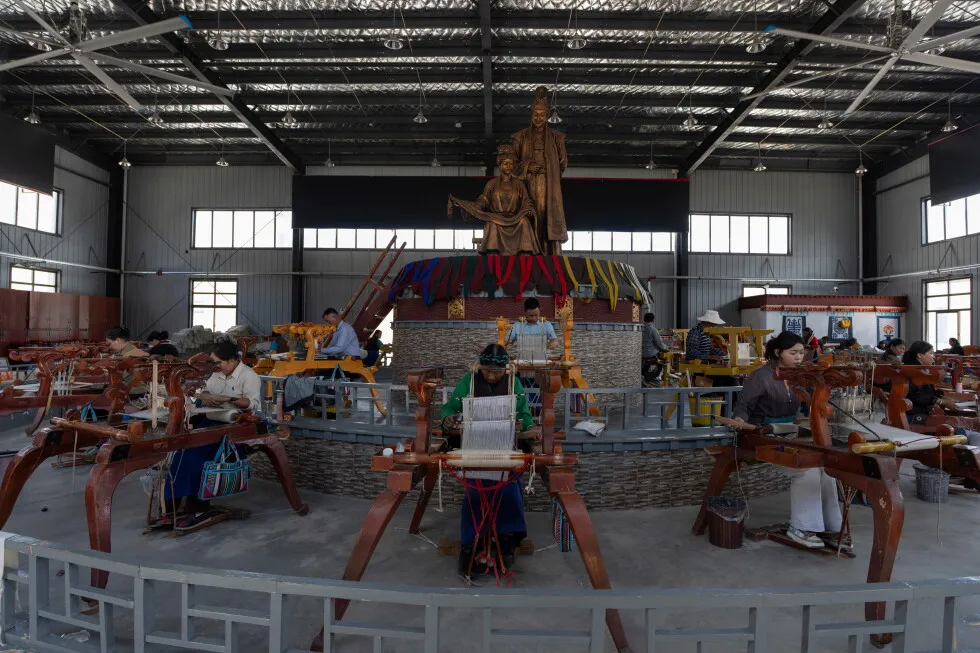
A Tibetan cooperative keeps a centuries-old weaving tradition alive 0 seconds of 1 minute, 23 secondsVolume 0% Press shift question mark to access a list of keyboard shortcuts Keyboard ShortcutsEnabledDisabled Shortcuts Open/Close/ or ? Play/PauseSPACE Increase Volume↑ Decrease Volume↓ Seek Forward→ Seek Backward← Captions On/Offc Fullscreen/Exit Fullscreenf Mute/Unmutem Decrease Caption Size- Increase Caption Size+ or = Seek %0-9 00:00 01:23 01:23 More Videos 00:42 Tibetans protest in Mumbai against China's new 'ethnic unity' law 01:12 Mustard makers preserve Dijon tradition in global market 02:44 As British Columbia logs its remaining old growth, activists try to stop it 02:13 Conservatives and Trump admin target decades-old pillar of environmental enforcement 01:50 Last Jews in Indian city of Kochi seek to preserve community's history 01:07 What will happen during this month's solar eclipse? 00:50 Hannah Einbinder: ''Hacks' is forever' 00:59 Colombia’s new president takes office in ceremony in Cali highlighting hard line on armed groups Close 1 of 6 | Artisans at a weaving cooperative in Tibet are working to preserve Pulu, a traditional wool fabric that has been used on the Tibetan plateau for centuries. At the Ethnic Huaji Handwoven Cooperative in Shannan, more than 100 local residents weave Pulu and its finer variety, Zeter, while passing the centuries-old craft to younger generations. (AP video shot by Olivia Zhang) 2 of 6 | Workers weave Pulu, a traditional wooden fabric into clothing, at wooden looms near statues of Princess Wencheng and Tibetan King Songtsen Gampo at the Ethnic Huaji Handwoven Cooperative in Shannan in western China’s Tibet-autonomous-region" class="entity-link entity-location" data-entity-id="90357" data-entity-type="location">Tibet Autonomous Region on July 23, 2026, as seen during a government organized visit for foreign journalists. (AP Photo/Ng Han Guan) 3 of 6 | A worker pulls wool into a yarn at the Ethnic Huaji Handwoven Cooperative in Shannan in western China’s Tibet-autonomous-region" class="entity-link entity-location" data-entity-id="90357" data-entity-type="location">Tibet Autonomous Region on July 23, 2026, as seen during a government organized visit for foreign journalists. (AP Photo/Ng Han Guan) 4 of 6 | A worker pulls wool into a yarn at the Ethnic Huaji Handwoven Cooperative in Shannan in western China’s Tibet-autonomous-region" class="entity-link entity-location" data-entity-id="90357" data-entity-type="location">Tibet Autonomous Region on July 23, 2026, as seen during a government organized visit for foreign journalists. (AP Photo/Ng Han Guan) 5 of 6 | Pasang, founder of the Ethnic Huaji Handwoven Cooperative, is interviewed in a showroom of the products in Shannan in western China’s Tibet-autonomous-region" class="entity-link entity-location" data-entity-id="90357" data-entity-type="location">Tibet Autonomous Region on July 23, 2026, as seen during a government organized visit for foreign journalists. (AP Photo/Ng Han Guan) 6 of 6 | A worker stands near products of the Ethnic Huaji Handwoven Cooperative displayed in a showroom in Shannan in western China’s Tibet-autonomous-region" class="entity-link entity-location" data-entity-id="90357" data-entity-type="location">Tibet Autonomous Region on July 23, 2026, as seen during a government organized visit for foreign journalists. (AP Photo/Ng Han Guan) Updated 4:23 AM MESZ, August 9, 2026 Add AP News on Google Add AP News as your preferred source to see more of our stories on Google. Share Share Facebook Copy Link copied Print Email X LinkedIn Bluesky Flipboard Pinterest Reddit Shannan, Tibet (AP) — More than a dozen men and women sit at wooden looms, sliding shuttles through rows of wool yarn before pulling each thread tight. They repeat it again and again as they weave Pulu, the traditional woolen fabric that has clothed people on the Tibetan plateau for centuries. They work at the Ethnic Huaji Handwoven Cooperative in Shannan, where artisans are trying to preserve one of Tibet’s oldest weaving traditions while creating jobs for local residents. Founded in 2008 by Tibetan artisan Pasang, the cooperative employs more than 100 local residents, including some people with disabilities, while teaching younger Tibetans a craft that he feared was disappearing. The cooperative specializes in Zeter, a finer variety of Pulu made from especially soft wool from the necks and backs of sheep. He said the finer wool makes the yarn more difficult to spin than that used for ordinary Pulu. Pasang said that because Zeter is lighter, softer and more delicate than ordinary Pulu, it was presented as a tribute from Tibet to the Chinese imperial court during the Ming dynasty. Pasang said he learned the craft from his parents at a time when fewer than 10 people still knew how to weave Zeter. He added that the craft has been recognized as part of China’s national intangible cultural heritage, and that he hopes younger generations will continue practicing it. A rare glimpse into Tibet, where some hope to preserve language and customs despite China’s new law 6 MIN READ 19 A Tibetan studies conference is canceled in Nepal at the request of officials 1 MIN READ 25 China rebukes US over Huawei dispute as Argentina’s Milei balances ties with Washington and Beijing 1 MIN READ 25 The wool comes from sheep raised around Shannan, about 3,700 meters (12,100 feet) above sea level. Statues of Tibet’s 7th century King Songtsen Gampo and his Chinese bride, Princess Wencheng, stand at the center of the workshop, surrounded by wooden looms. According to local tradition, the weaving craft dates to when Princess Wencheng introduced weaving techniques to Tibet after marrying the king. In Chinese official history, their marriage symbolizes the historical ties between Tibet and China. “It integrated Tibetan and Chinese cultures,” Pasang said about the fabric’s history. The Associated Press joined a government-organized trip to Lhasa and Shannan last month, which included visits to the cooperative, palaces, Buddhist temples, tourist sites, an eldercare center and local businesses. Next to the workshop, a small showroom displays scarves, shawls, jackets, bags and other products made from Pulu and Zeter. Pasang said most sales are in Tibet, although customers also come from elsewhere in China. Tsering Yangchen has been working for seven years in the cooperative. The 80-year-old woman moved from another county and said she struggled to find work before joining the workshop, where instructors taught her and others how to weave. She said Pulu is more than just a product she weaves. “We usually wear them,” she added. “They are made from pure wool.” Associated Press video producer Olivia Zhang contributed.
SRCAssociated Press (AP)
LANGEN
LEANCenter
WORDS1 001
ENT12
SUN · 2026-08-09 · 02:53 GMTBRIEF NSR-2026-0809-100500
NSR-2026-0809-100500News Report·EN·Human Interest
A Tibetan cooperative keeps a centuries-old weaving tradition alive
The Ethnic Huaji Handwoven Cooperative in Shannan, Tibet, is preserving the centuries-old tradition of weaving Pulu, a traditional woolen fabric. Founded in 2008 by artisan Pasang, the cooperative employs over 100 local residents, including those with disabilities, and teaches younger Tibetans this craft.
Associated Press (AP)Filed 2026-08-09 · 02:53 GMTLean · CenterRead · 5 min
Associated Press (AP)FIG 01
Reading time
5min
Word count
1 001words
Sources cited
1cited
Entities identified
12entities
Quality score
100%
§ 01
Briefing Summary
AI-generatedNEWSAR · AI
The Ethnic Huaji Handwoven Cooperative in Shannan, Tibet, is preserving the centuries-old tradition of weaving Pulu, a traditional woolen fabric. Founded in 2008 by artisan Pasang, the cooperative employs over 100 local residents, including those with disabilities, and teaches younger Tibetans this craft. They specialize in Zeter, a finer Pulu made from soft sheep wool, historically presented to the Chinese imperial court. Pasang learned the craft from his parents when few knew it, and it is now recognized as China's national intangible cultural heritage. The cooperative aims to keep this tradition alive and provide employment opportunities.
Confidence 0.90Sources 1Claims 4Entities 12
§ 02
Article analysis
Model · rule-basedFraming
Human Interest
Social Justice
Tone
Measured
AI-assessed
CalmNeutralAlarmist
Factuality
0.80 / 1.00
Factual
LowHigh
Sources cited
1
Limited
FewMany
§ 03
Key claims
4 extracted01
The article was produced during a government-organized visit for foreign journalists.
factual
Confidence
1.00
02
The cooperative is passing the centuries-old craft to younger generations.
factual
Confidence
1.00
03
The Ethnic Huaji Handwoven Cooperative in Shannan has over 100 local residents weaving Pulu and Zeter.
factual
Confidence
1.00
04
A Tibetan cooperative is preserving Pulu, a traditional wool fabric used for centuries on the Tibetan plateau.
factual
Confidence
1.00
§ 04
Full report
5 min read · 1 001 words§ 05
Entities
12 identifiedKey playerOppositionContextPositiveNeutralNegative
People4
Organizations2
Locations4
§ 06
Keywords & salience
8 termstibetan weaving tradition
1.00
pulu fabric
0.90
cultural preservation
0.80
artisanal craft
0.70
cooperative
0.60
traditional textiles
0.50
tibet autonomous region
0.50
intergenerational transfer
0.40
§ 07
Topic connections
Interactive graph Network visualization showing 20 related topics
View Full Graph Person Organization Location Event|Click node to navigate|Edge numbers = shared articles