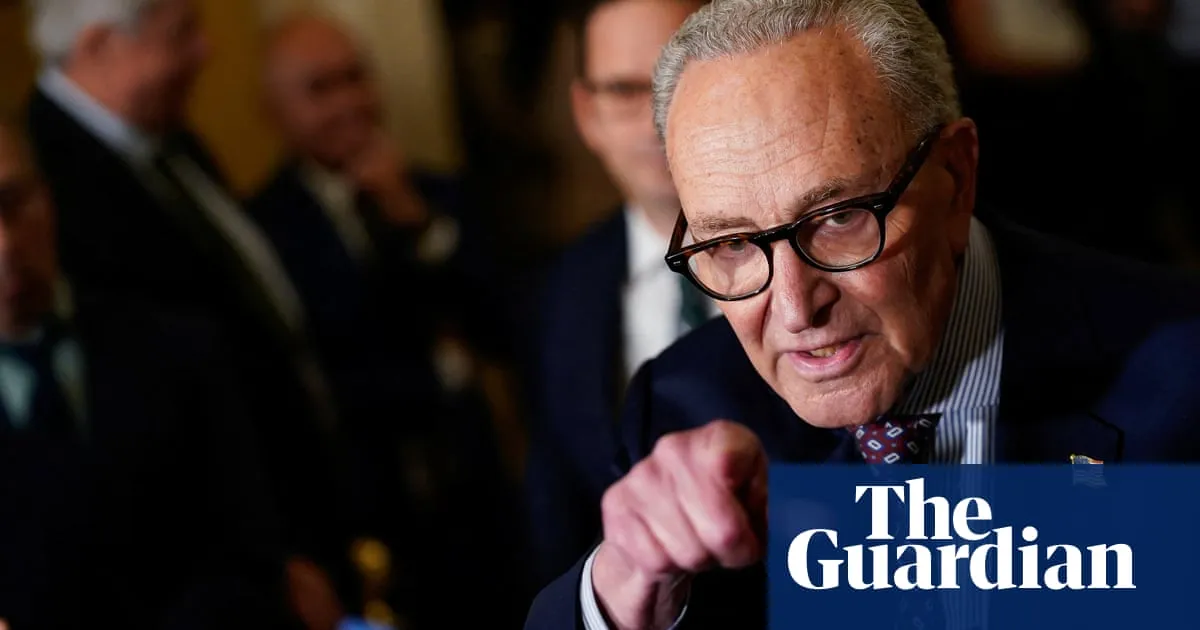
In a Washington DC conference room last month, some of the most senior Democrats in the US Senate gathered to plan for a prospect that only recently would have felt more attune to science fiction: they started to wargame democracy.Chuck Schumer, the US Senate minority leader, and senators including Alex Padilla, Adam Schiff, Mark Warner, Elissa Slotkin and Raphael Warnock were among those in the room as a team of legal experts offered scenarios.The first: realistic deepfake videos, created with artificial intelligence, showing “evidence” of widespread election fraud, spreading through social media a few weeks before voting begins.Forensic experts discredit the videos quickly as synthetic in the given scenario, but rightwing media – and the US president – amplify the claims, nonetheless. Election workers begin receiving death threats. Armed men start appearing at polls.If you’re a Democratic senator, what would you do?“These tabletop exercises are a standard planning tool for experts and stakeholders to prepare for potential scenarios. We’re not predicting exactly what would happen,” said Justin Vail, who leads the DC office of the non-partisan advocacy group Protect Democracy. “But we do want to create a realistic context that can help us identify gaps, test our assumptions, and strengthen coordination, and then ultimately develop some recommendations to increase our preparedness.”Senate Democrats have held two election disruption exercises this year. Voting rights and legal groups like Protect Democracy have also participated, along with election attorney Marc Elias, former attorney general Eric Holder, election law expert Norman Eisen and members of the left-leaning non-profit Democracy Forward.Skye Perryman, CEO of Democracy Forward, expressed confidence in the resilience of the foundations of US democracy, pointing to the legal system and the distributed nature of American elections, which she said builds a defense against crass political interference, even from the US president.“The president can try to imagine whatever he may wish to imagine,” Perryman said. “He can’t imagine a new constitution, and the constitution, frankly, is quite clear in no uncertain terms; there’s not a role for the president in election administration in this country.”Nonetheless, Donald Trump’s continuous false claims about a stolen election in 2020, and his increasingly strident demand for the US Congress to pass a package of federalized oversights of elections, have raised concerns among progressive voters that the administration may mar November’s midterms with misinformation, or worse.The administration billed Trump’s primetime TV address last month as a presentation of new evidence that the 2020 election was illegitimate, and that his administration had uncovered new findings about vulnerabilities in the US election system. Instead, Trump claimed China had illicitly acquired voter information on 220 million Americans, and that China had undermined his 2020 campaign in other unspecified ways, arguing that intelligence officials had suppressed this information.Trump’s claims fell apart under scrutiny. His own intelligence officials had already concluded that China refrained from interfering in the US election out of concern for potential political blowback if caught.Trump threatened the broadcast licenses of networks that refused to carry the address live. In his speech, he again implored Congress to pass the Save America Act, which would ban mail-in ballots nationwide and impose new identification requirements on voters when they register and report to polls. Republican senators refuse to dispense with the 60-vote filibuster threshold to pass the law.Senator Jon Ossoff of Georgia, representing a swing state that is a favored rhetorical target of the president, described Trump’s address as “signaling his unmistakable intent to attack these elections and our voting rights, just as he tried to throw out our votes and seize the presidency in 2020”.Voting rights advocates pointed toward Trump’s July primetime address as indicative of the president’s intentions – rhetorical attacks on the integrity of voting machines and elections offices, potentially escalating into more direct interference.Trump’s public commentary, and the actions of agencies under his supervision, shaped the scenario building as Democratic leaders plan their possible responses.Senators were asked at their recent session to contemplate how to react to a threat to withhold Office of Management and Budget (OMB) funding for states that don’t submit their voter rolls for federal oversight. They also considered a threat of Federal Communications Commission (FCC) action against news outlets covering deepfakes.“The development of AI will only add to the complexity and could create confusion among voters in our fragmented media landscape,” said Vail. “Unfortunately, that confusion can be to the benefit of the administration’s strategy.”FCC enforcement actions seem relatively mild compared to more extreme scenarios, like planning a response to armed vigilantes in tactical gear at ballot drop boxes – which was not a hypothetical problem in Arizona during the 2022 midterms. Senators were asked to plan responses for online license-plate doxxing, a midnight firebombing of an early voting site and a last-minute unilateral deployment of Department of Homeland Security (DHS) agents and the national guard to polling stations.The main lesson of the exercise “is that this is an all-hands-on-deck moment, and it is an all-hands-on-deck response”, said Perryman. “And so what that means is that, we’re not looking at any one silver bullet to be able to fully protect elections. It’s going to take all of us.”
SRCThe Guardian - World News
LANGEN
LEANCenter-Left
WORDS853
ENT12
SUN · 2026-08-09 · 12:00 GMTBRIEF NSR-2026-0809-100592
NSR-2026-0809-100592News Report·EN·Political Strategy
Top Democrats simulate election threats as Trump continues assault on voting
Senior Senate Democrats, including Chuck Schumer, Alex Padilla, and Adam Schiff, participated in election disruption "wargaming" exercises in Washington D.C. last month.
George ChidiThe Guardian - World NewsFiled 2026-08-09 · 12:00 GMTLean · Center-LeftRead · 4 min
The Guardian - World NewsFIG 01
Reading time
4min
Word count
853words
Sources cited
7cited
Entities identified
12entities
Quality score
100%
§ 01
Briefing Summary
AI-generatedNEWSAR · AI
Senior Senate Democrats, including Chuck Schumer, Alex Padilla, and Adam Schiff, participated in election disruption "wargaming" exercises in Washington D.C. last month. These simulations, led by legal experts, explored scenarios such as AI-generated deepfakes spreading misinformation about election fraud, leading to threats against election workers and armed individuals appearing at polls. The exercises, organized by groups like Protect Democracy and Democracy Forward, aimed to identify preparedness gaps and strengthen coordination in response to potential interference. These efforts are occurring amidst ongoing false claims by former President Donald Trump about the 2020 election and his calls for federalized election oversight, raising concerns about potential disruption of upcoming midterms.
Confidence 0.90Sources 7Claims 5Entities 12
§ 02
Article analysis
Model · rule-basedFraming
Political Strategy
Technology
Tone
Sensational
AI-assessed
CalmNeutralAlarmist
Factuality
0.60 / 1.00
Mixed
LowHigh
Sources cited
7
Well sourced
FewMany
§ 03
Key claims
5 extracted01
US democracy's foundations, including the legal system and distributed election nature, build defense against political interference.
quoteSkye Perryman (Democracy Forward)
Confidence
1.00
02
The exercises aimed to identify gaps, test assumptions, and strengthen coordination to increase preparedness for election disruption.
quoteJustin Vail (Protect Democracy)
Confidence
1.00
03
Donald Trump has made continuous false claims about the 2020 election being stolen.
factualarticle
Confidence
0.90
04
Senior Democrats participated in wargaming exercises to prepare for potential election threats, including AI-generated deepfakes.
factualarticle
Confidence
0.90
05
Trump claimed China had illicitly acquired voter information on 220 million Americans and undermined his 2020 campaign.
quoteDonald Trump
Confidence
0.80
§ 04
Full report
4 min read · 853 words§ 05
Entities
12 identifiedKey playerOppositionContextPositiveNeutralNegative
People10
DT
Donald Trump
PoliticianOpposition
3x
90
CS
Chuck Schumer
PoliticianKey Player
80
ES
Elissa Slotkin
PoliticianKey Player
60
MW
Mark Warner
PoliticianKey Player
60
RW
Raphael Warnock
PoliticianKey Player
60
AS
Adam Schiff
PoliticianKey Player
60
AP
Alex Padilla
PoliticianKey Player
60
ME
Marc Elias
ActivistContext
50
NE
Norman Eisen
AcademicContext
50
EH
Eric Holder
PoliticianContext
50
§ 06
Keywords & salience
10 termselection threats
1.00
democracy
0.90
artificial intelligence
0.80
deepfake videos
0.80
election fraud
0.70
voting rights
0.60
election disruption
0.50
donald trump
0.50
us senate democrats
0.40
preparedness
0.40
§ 07
Topic connections
Interactive graph Network visualization showing 51 related topics
View Full Graph Person Organization Location Event|Click node to navigate|Edge numbers = shared articles