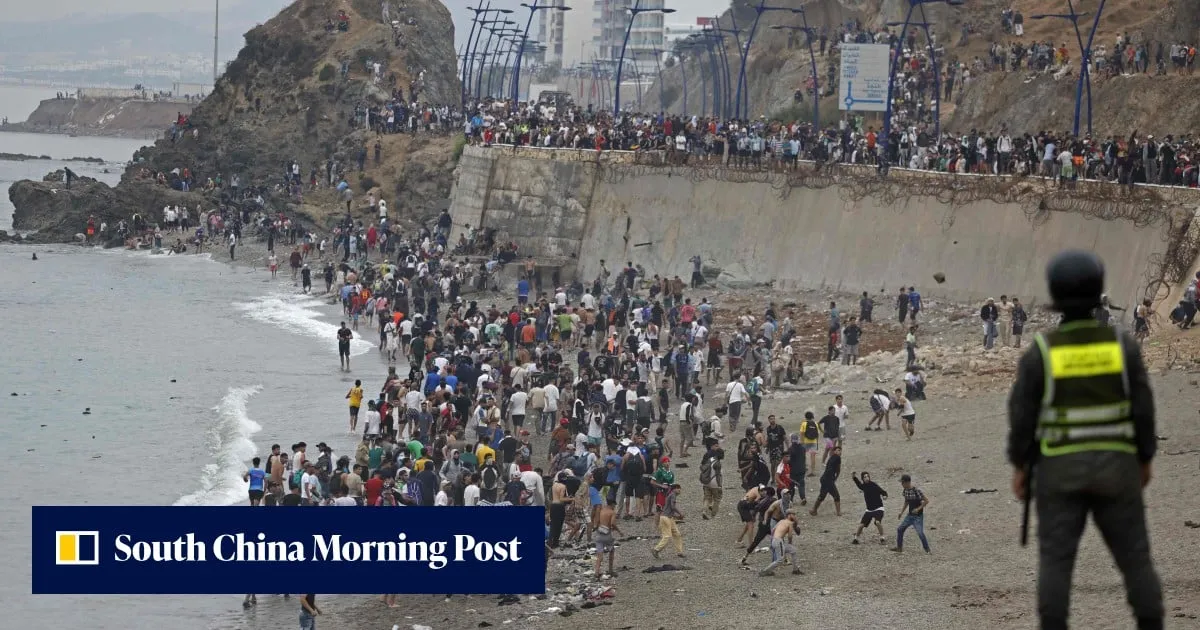
The European Union’s traditional August break was supposed to provide officials with some respite ahead of a potentially bruising autumn when it will try to set its fiery trade relationship with China on a new course.Instead, a border crisis on its southern flank has created turmoil and division among its 27 members, raising questions over how prepared the bloc is for a dust-up with one of the world’s economic superpowers.“We had a real-time test of what happens when one member state was under coercion,” said Alberto Rizzi, a Rome-based policy fellow at the European Council on Foreign Relations, specialising in geoeconomics. “Everybody was very quick to jump on that.”The crisis was sparked on July 30, when an estimated 72,000 mainly Moroccan migrants surged into Ceuta, a Spanish enclave in North Africa, after Moroccan border controls appeared to collapse. At least 75 people died, mostly at sea, with the Spanish authorities estimating more than 100 died.The surge raised suspicions that the Moroccan authorities had weaponised migrant flows in response to Spanish efforts to improve ties with its neighbour and rival Algeria.Italian Prime Minister Giorgia Meloni said Spain’s “uncontrolled immigration” policy was a security threat and suspended the Schengen freedom of movement agreement with Madrid, even though Ceuta is not part of the Schengen area.
SRCSouth China Morning Post
LANGEN
LEANCenter-Right
WORDS213
ENT12
SUN · 2026-08-09 · 14:00 GMTBRIEF NSR-2026-0809-100641
NSR-2026-0809-100641Analysis·EN·Diplomatic
Can Europe stay united in China trade battle? Ceuta migrant crisis offers a warning
A recent border crisis involving a surge of migrants into the Spanish enclave of Ceuta has exposed divisions within the European Union, raising concerns about its unity ahead of crucial trade negotiations with China. On July 30, an estimated 72,000 migrants, primarily from Morocco, entered Ceuta after Moroccan border controls reportedly faltered.
Finbarr BerminghamSouth China Morning PostFiled 2026-08-09 · 14:00 GMTLean · Center-RightRead · 1 min
South China Morning PostFIG 01
Reading time
1min
Word count
213words
Sources cited
1cited
Entities identified
12entities
Quality score
100%
§ 01
Briefing Summary
AI-generatedNEWSAR · AI
A recent border crisis involving a surge of migrants into the Spanish enclave of Ceuta has exposed divisions within the European Union, raising concerns about its unity ahead of crucial trade negotiations with China. On July 30, an estimated 72,000 migrants, primarily from Morocco, entered Ceuta after Moroccan border controls reportedly faltered. This event led to suspicions that Morocco may have used migrant flows as leverage in response to Spain's improved relations with Algeria. The crisis prompted Italian Prime Minister Giorgia Meloni to label Spain's immigration policy a security threat and suspend the Schengen agreement with Madrid, despite Ceuta not being part of the Schengen area. This incident serves as a "real-time test" of how the EU responds to coercion against a member state, highlighting potential challenges for bloc unity in future geopolitical and economic disputes.
Confidence 0.90Sources 1Claims 5Entities 12
§ 02
Article analysis
Model · rule-basedFraming
Diplomatic
Political Strategy
Tone
Mixed Tone
AI-assessed
CalmNeutralAlarmist
Factuality
0.70 / 1.00
Factual
LowHigh
Sources cited
1
Limited
FewMany
§ 03
Key claims
5 extracted01
Italian PM Giorgia Meloni called Spain's immigration policy a security threat and suspended Schengen with Madrid.
quoteGiorgia Meloni
Confidence
1.00
02
A border crisis in Ceuta created turmoil and division among EU members, questioning the bloc's preparedness for a dust-up with China.
factual
Confidence
0.90
03
An estimated 72,000 migrants surged into Ceuta after Moroccan border controls appeared to collapse.
statistic
Confidence
0.80
04
The EU faces a potentially bruising autumn in setting its trade relationship with China on a new course.
prediction
Confidence
0.80
05
Moroccan authorities may have weaponized migrant flows in response to Spanish efforts to improve ties with Algeria.
factual
Confidence
0.70
§ 04
Full report
1 min read · 213 words§ 05
Entities
12 identifiedKey playerOppositionContextPositiveNeutralNegative
Organizations2
Locations5
§ 06
Keywords & salience
9 termsceuta migrant crisis
1.00
eu china trade
1.00
european union
0.90
migrant flows
0.80
member state coercion
0.70
geoeconomics
0.60
schengen agreement
0.50
moroccan authorities
0.40
security threat
0.40
§ 07
Topic connections
Interactive graph Network visualization showing 51 related topics
View Full Graph Person Organization Location Event|Click node to navigate|Edge numbers = shared articles