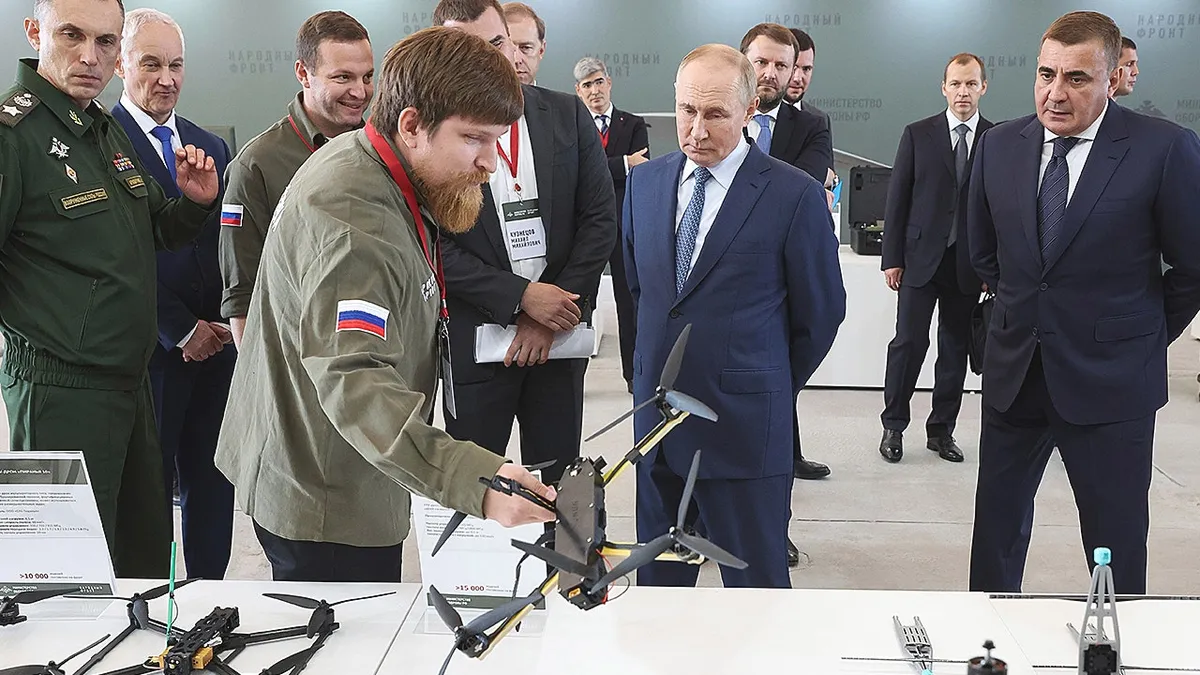
close Video Drone expert says Ukraine war takes new turn as engineers, founders become targets Assassination Attempts, car bombings and alleged spy plots put drone bosses in the crosshairs in Ukraine war, expert says. NEWYou can now listen to Fox News articles! Hören Sie sich diesen Artikel an 5 Min A dangerous new front is emerging in the Russia-Ukraine war as attackers and alleged intelligence operatives increasingly target executives and engineers developing the cutting-edge drone technology that is reshaping the battlefield, industry experts warned Sunday. The attacks include an Aug. 4 car bombing near Yekaterinburg that critically injured Vladimir Tkachuk, head of Russian drone manufacturer Uraldronzavod, and killed his driver, according to Russian state news agency TASS, The Associated Press reported. His company produces the "Upyr," or "Ghoul," a first-person-view attack drone used by Russian forces in Ukraine. 'A NEW KIND OF WAR': INSIDE Ukraine'S HIDDEN FACTORIES MASS-PRODUCING COMBAT DRONES A car bombing near Yekaterinburg that critically injured Vladimir Tkachuk, head of Russian drone manufacturer Uraldronzavod, and killed his driver. (Valeriy Sharifulin, Sputnik, Kremlin Pool Photo via AP) Days earlier, Andrei Cherezov, head of another Russian drone company, was shot three times in Tula overnight July 28-29 in an apparent assassination attempt, according to Ukrainian outlet Pravda. Authorities have not publicly attributed either attack to Ukraine. Draganfly CEO Cameron Chell told Fox News Digital that the rise in attacks comes as Russia and Ukraine race for an edge in Drone Warfare, making the relatively small number of people responsible for developing new technology increasingly important targets. "When you can't take out all the distributed infrastructure, drone manufacturing leadership becomes the primary target," Chell said. "These strikes in Russia and Ukraine and Germany on founders, leaders, engineers of defense and, in particular, drone-type companies are down to drones and these companies having such an impact themselves." Ukraine’S BATTLEFIELD IS TRANSFORMING THE FUTURE OF NATO Anti-drone laser system trialed on a Stryker combat military vehicle with a machine gun aimed at the sky in Ukraine during a counteroffensive. (Michelle Ursi/Getty Images) "Because drone technology evolves rapidly — often with significant iterations occurring every 10 to 30 days — targeting a key engineer, founder, or product lead creates immediate operational disruptions on the battlefield." "Taking out a particular engineer or taking out a particular leader can set a very important weapons program back quite some time and disrupt shipments to the front line," Chell added. German authorities have also arrested two suspected operatives accused of spying on a Bavarian drone manufacturer for Russian intelligence, while reports this month said the alleged operation included preparations to target company executive Stefan Thumann, according to Germany’s Die Zeit. The case follows a reported 2024 plot disrupted by U.S. and German intelligence to target Rheinmetall CEO Armin Papperger. ZELENSKYY ANNOUNCES 'THE FUTURE IS HERE' AFTER WAR'S FIRST ALL-ROBOT CAPTURE Drone components and battlefield systems assembled at a Ukrainian manufacturing facility in an undisclosed location in western Ukraine. (Efrat Lachter/Fox News Digital) Chell said as Ukraine and Russia push toward artificial intelligence and autonomous weapons systems, engineers developing those technologies are more strategically important. "What we see in the Ukraine-Russia conflict is nobody in the loop — total autonomy is the direction things are going because it moves with more speed and precision," Chell said. "AI and total autonomy are the big innovations for the next 18 months, so a potential reason we could see more targeted activity against leaders is because Ukrainians have that technology advantage." "Targeting small drone companies is a relatively easy operation compared to targeting individuals in state-run weapons programs," he said. "It is a fairly inexpensive, low-risk tactic for intelligence agencies that yields an immediate impact on the battlefield, and that's why we've seen this tactic." "It is a very interesting turn or tactic that's being played by both sides here." Chell highlighted how Russia and Ukraine approach such plots differently. "I wouldn't suggest one side has an advantage over the other in terms of tactics, but psychologically, it has a deeper effect on the Russian side," Chell said. Ukraine UNLEASHES MORE THAN 400 DRONES NEAR MOSCOW IN ONE OF WAR'S BIGGEST ATTACKS ( ) "The volume of drone advantage will remain with the Russians for the foreseeable future, but the innovation of drones, tactics, and technology lies with the Ukrainians right now." "Ukraine faces an existential threat, so they are ready for anything. Their tactics tend to be much more blunt — a direct shooter in a hallway or a car bomb," he added. "The Russian tactics tend to be much more state-organized, using old Cold War tactics: low-level contacts, extensive intelligence and surveillance ahead of time, and inserting into other countries like Germany," he said. "The Russians have a long-standing, well-established intelligence infrastructure dating back to World War II and the Cold War." TRUMP IS PROVING THAT THE WAY TO BETTER OUR MILITARY IS TO SECURE OUR SUPPLY CHAINS A soldier launches an RQ-35 Heidrun drone used for reconnaissance and artillery fire correction in the Zaporizhzhia, Ukraine on Feb. 22, 2026. (Dmytro Smolienko/Ukrinform/NurPhoto via Getty Images) As the drone manufacturing industry takes greater precautions, Chell maintained that threats against companies and individuals in the defense supply chain are receiving increased scrutiny. "We are very cognizant of it, and we're in contact with the proper authorities to make sure we're taking precautions on both a cyber and physical level to ensure we're at less risk," he said. "There are training and programs in place to ensure executives have a level of safety, primarily around awareness, cybersecurity, and physical location protection," Chell added before stating that the attacks and attempted assassinations have "heightened the conversation around it." "We as an industry are taking it with a measured amount more seriously," he said. Emma Bussey is a breaking news writer for Fox News Digital. Before joining Fox, she worked at The Telegraph with the U.S. overnight team, across desks including foreign, politics, news, sport and culture.
SRCFox News - World
LANGEN
LEANCenter-Right
WORDS992
ENT12
SUN · 2026-08-09 · 21:29 GMTBRIEF NSR-2026-0809-100684
NSR-2026-0809-100684News Report·EN·Conflict
Moscow, Kyiv assassins hunt weapons bosses as Ukraine war spills beyond the battlefield
A new front in the Russia-Ukraine war involves targeted attacks on executives and engineers developing drone technology. Recent incidents include a car bombing that injured the head of Russian drone manufacturer Uraldronzavod and an assassination attempt on another Russian drone company leader.
Fox News - WorldFiled 2026-08-09 · 21:29 GMTLean · Center-RightRead · 4 min
Fox News - WorldFIG 01
Reading time
4min
Word count
992words
Sources cited
4cited
Entities identified
12entities
Quality score
100%
§ 01
Briefing Summary
AI-generatedNEWSAR · AI
A new front in the Russia-Ukraine war involves targeted attacks on executives and engineers developing drone technology. Recent incidents include a car bombing that injured the head of Russian drone manufacturer Uraldronzavod and an assassination attempt on another Russian drone company leader. Experts suggest these attacks aim to disrupt drone warfare advancements, as rapid technological evolution makes key personnel critical targets. Germany has also arrested individuals accused of spying on a drone manufacturer for Russia, with alleged plans to target an executive. These actions are seen as a low-risk, high-impact tactic for intelligence agencies, with Ukraine reportedly employing more direct methods and Russia utilizing more organized, state-sponsored approaches.
Confidence 0.90Sources 4Claims 5Entities 12
§ 02
Article analysis
Model · rule-basedFraming
Conflict
Technology
Tone
Mixed Tone
AI-assessed
CalmNeutralAlarmist
Factuality
0.70 / 1.00
Factual
LowHigh
Sources cited
4
Well sourced
FewMany
§ 03
Key claims
5 extracted01
Targeting key engineers or leaders in drone development can set important weapons programs back and disrupt shipments to the front line.
quoteCameron Chell
Confidence
1.00
02
An Aug. 4 car bombing near Yekaterinburg critically injured Vladimir Tkachuk, head of Russian drone manufacturer Uraldronzavod, and killed his driver.
factualTASS, The Associated Press
Confidence
0.95
03
German authorities arrested two suspected operatives accused of spying on a Bavarian drone manufacturer for Russian intelligence.
factualGermany’s
Confidence
0.90
04
Andrei Cherezov, head of another Russian drone company, was shot three times in Tula overnight July 28-29 in an apparent assassination attempt.
factualPravda
Confidence
0.90
05
Attackers and alleged intelligence operatives are increasingly targeting executives and engineers developing drone technology in the Russia-Ukraine war.
factualindustry experts
Confidence
0.90
§ 04
Full report
4 min read · 992 words§ 05
Entities
12 identifiedKey playerOppositionContextPositiveNeutralNegative
People3
Locations5
§ 06
Keywords & salience
10 termsdrone technology
1.00
ukraine war
1.00
assassination attempts
0.90
drone warfare
0.80
intelligence operatives
0.70
defense industry
0.60
ukraine
0.50
russia
0.50
executives
0.40
engineers
0.40
§ 07
Topic connections
Interactive graph Network visualization showing 51 related topics
View Full Graph Person Organization Location Event|Click node to navigate|Edge numbers = shared articles