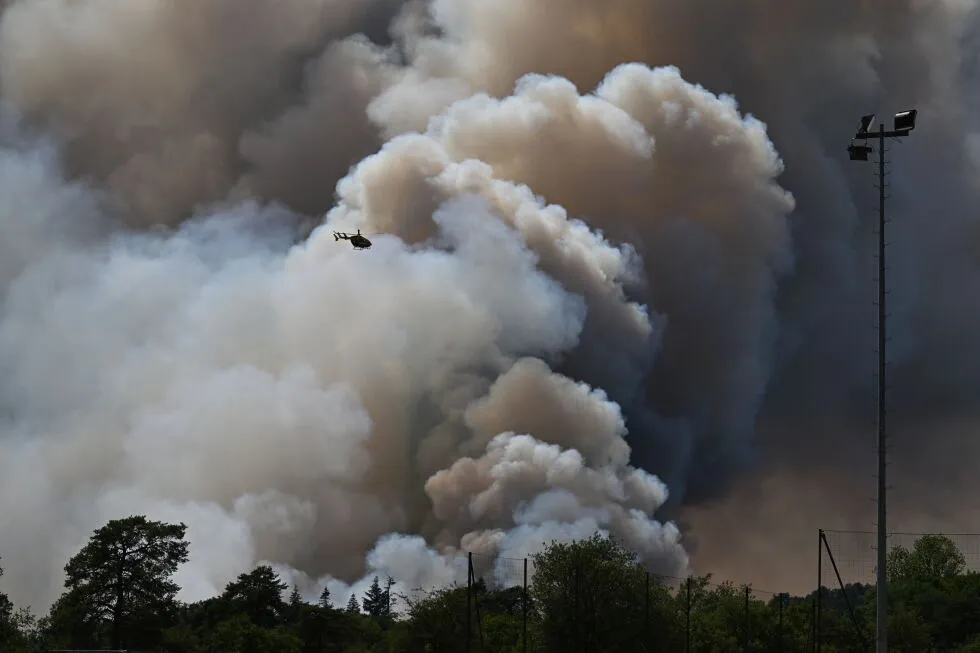
French wildfire created a monster cloud, unleashing lightning that ignited more fires 1 of 4 | A pyrocumulonimbus, a giant cloud created by a large wildfire is seen in the Fontainebleau forest region, about 60 kilometers (37 miles) south of Paris, France, Monday, July 13, 2026. (AP Photo/Emma Da Silva, File) 2 of 4 | FiILE - A pyrocumulonimbus, a giant cloud created by a large wildfires in the Lège-Cap-Ferret region, western France, Thursday, July 23, 2026. (AP Photo/Caroline Blumber, File) 3 of 4 | People watch a pyrocumulonimbus, a giant cloud created by a large wildfires in Le Porge, western France, Thursday, July 23, 2026. (AP Photo/Caroline Blumberg, File) 4 of 4 | A pyrocumulonimbus, a giant cloud created by a large wildfire is seen near Lacanau, southwestern France, Saturday, July 25, 2026. (AP Photo/Emma Da Silva, File) By Thomas Adamson Updated 4:05 PM MESZ, July 27, 2026 Leer en español Add AP News on Google Add AP News as your preferred source to see more of our stories on Google. Share Share Facebook Copy Link copied Print Email X LinkedIn Bluesky Flipboard Pinterest Reddit Paris (AP) — A wildfire in southwest France grew so powerful that its smoke column became a thunderstorm, generating lightning that struck the ground and ignited new fires beyond the original blaze, French officials said. Put another way, that means the inferno was no longer simply being propelled by the weather. It was making its own. The thundercloud also produced violent, erratic winds capable of driving the flames in new directions. The phenomenon, called a pyrocumulonimbus, or pyroCb, is rare in Europe and more commonly documented in North America and Australia, where it occurs only over some of the most extreme fires. France’s national firefighters federation said it had never before recorded one in the country. The blaze erupted near Saumos on July 22 and has since burned more than 420 square kilometers (162 square miles) of forests and scrubland, damaged or destroyed more than 240 homes and forced 220,000 people to evacuate in Gironde. At about 6:20 p.m. Friday, two days after the fire began, the departmental fire and rescue service said it had generated a pyrocumulonimbus. The cloud weakened overnight as humidity rose, then formed again several times. Repeatedly, heat and smoke have surged upward into a vast black thundercloud, electrified and lit from within. “Imagine a campfire so large and hot that the smoke rising off it turns into a storm-like cloud,” said Theodore M. Giannaros, a fire meteorologist at the National Observatory of Athens. “That is a pyroCb — a storm cloud born from the intense heat that a wildfire produces.” 2 killed when firefighting helicopters collide near Athens as Europe’s wildfire emergency rages 3 MIN READ Europe’s wildfire crisis eases in west as danger shifts east to Greece 3 MIN READ 31 Europe’s hot, dry summer takes its toll with fires in France and Greece, and drought in the UK 3 MIN READ 31 There is no set temperature at which one forms, Giannaros said; what is needed is the kind of atmosphere that breeds dry thunderstorms — very hot, very dry air near the ground, with cooler and moister air above it. Hot air loaded with smoke and moisture then rises rapidly from the flames. As it climbs and cools, water vapor condenses around particles of ash. Above the freezing level, droplets become ice crystals whose collisions separate electrical charges, as in an ordinary thunderstorm. Beneath this storm lies a landscape already primed to burn. The cloud then amplifies the disaster that created it. Rising air pulls powerful winds toward the fire, while downdrafts punch gusts back to the surface. Those shifts can turn the flames, divide them into several fronts or send them racing in a new direction. “It’s a feedback loop, not a one-way effect,” Giannaros said. “Once it forms, the cloud becomes its own weather system, sitting on top of the fire and making it harder to predict.” The systems can also spin up whirling columns of flame — usually a fire whirl, which Giannaros describes as a dust devil made of fire and heat instead of dust. True tornadoes are rarer, though one struck Redding, California, during the 2018 Carr Fire with winds equivalent to an EF-3, killing a fire inspector. For firefighters, escape routes can close without warning as fresh outbreaks appear beyond their crews and equipment. Direct attack may become impossible, forcing crews to retreat and defend communities. The danger, Giannaros said, is fire moving faster than evacuations can be organized. Until now, pyroCbs have been essentially an Australian and North American phenomenon. Canada alone produced a record 142 of them in 2023. Portugal recorded one during its deadly 2017 fire season. France has now joined the list. The continent is heating faster than any other on Earth — at roughly twice the global average since the 1980s, according to the EU’s Copernicus Climate Change Service and the World Meteorological Organization — with heat waves growing more frequent and severe and drought spreading across the south, curing forests into fuel. Hotter and drier conditions give extreme fires more opportunity to form them, Giannaros said, but scientists still lack enough long-term data to establish a trend. The European research project ROSETTA aims to close that gap. The most common misunderstanding, he said, is that the cloud is merely a side effect. As long as it hangs above the flames, it is helping decide where the fire goes next. The Associated Press’ climate and environmental coverage receives financial support from multiple private foundations. AP is solely responsible for all content. Find AP’s standards for working with philanthropies, a list of supporters and funded coverage areas at AP.org. Thomas Adamson Adamson is a foreign reporter based in Paris for The Associated Press. He covers European politics, culture and style. He has reported across the continent in an over two-decade career. twitter mailto
SRCAssociated Press (AP)
LANGEN
LEANCenter
WORDS987
ENT12
MON · 2026-08-10 · 16:23 GMTBRIEF NSR-2026-0810-100963
NSR-2026-0810-100963News Report·EN·Environmental
French wildfire created a monster cloud, unleashing lightning that ignited more fires
A massive wildfire in southwest France generated a pyrocumulonimbus cloud, a rare phenomenon that produced lightning and ignited new fires. This "monster cloud" also created violent, erratic winds, essentially allowing the inferno to generate its own weather system.
Associated Press (AP)Filed 2026-08-10 · 16:23 GMTLean · CenterRead · 4 min
Associated Press (AP)FIG 01
Reading time
4min
Word count
987words
Sources cited
2cited
Entities identified
12entities
Quality score
100%
§ 01
Briefing Summary
AI-generatedNEWSAR · AI
A massive wildfire in southwest France generated a pyrocumulonimbus cloud, a rare phenomenon that produced lightning and ignited new fires. This "monster cloud" also created violent, erratic winds, essentially allowing the inferno to generate its own weather system. The blaze, which erupted near Saumos on July 22, has burned over 420 square kilometers, destroyed homes, and forced mass evacuations in Gironde. French officials stated this is the first recorded instance of a pyrocumulonimbus in the country, a phenomenon more commonly seen in North America and Australia. The formation requires intense heat and specific atmospheric conditions, creating a dangerous feedback loop that amplifies the fire's intensity and unpredictability.
Confidence 0.90Sources 2Claims 5Entities 12
§ 02
Article analysis
Model · rule-basedFraming
Environmental
Human Interest
Tone
Mixed Tone
AI-assessed
CalmNeutralAlarmist
Factuality
0.80 / 1.00
Factual
LowHigh
Sources cited
2
Limited
FewMany
§ 03
Key claims
5 extracted01
A pyroCb is a storm cloud born from the intense heat that a wildfire produces.
quoteTheodore M. Giannaros
Confidence
1.00
02
The blaze in Gironde has burned over 420 square kilometers, damaged/destroyed over 240 homes, and forced 220,000 evacuations.
statistic
Confidence
1.00
03
Pyrocumulonimbus clouds are rare in Europe and more commonly documented in North America and Australia.
factual
Confidence
1.00
04
A wildfire in southwest France generated a pyrocumulonimbus cloud, which produced lightning that ignited new fires.
factualFrench officials
Confidence
1.00
05
The inferno was making its own weather, not simply being propelled by it, due to the pyrocumulonimbus.
factual
Confidence
0.90
§ 04
Full report
4 min read · 987 words§ 05
Entities
12 identifiedKey playerOppositionContextPositiveNeutralNegative
Locations8
§ 06
Keywords & salience
10 termswildfire
1.00
pyrocumulonimbus
1.00
lightning
0.90
thundercloud
0.80
france
0.70
fontainebleau forest
0.60
evacuation
0.50
gironde
0.50
extreme fires
0.40
firefighters
0.40
§ 07
Topic connections
Interactive graph Network visualization showing 51 related topics
View Full Graph Person Organization Location Event|Click node to navigate|Edge numbers = shared articles