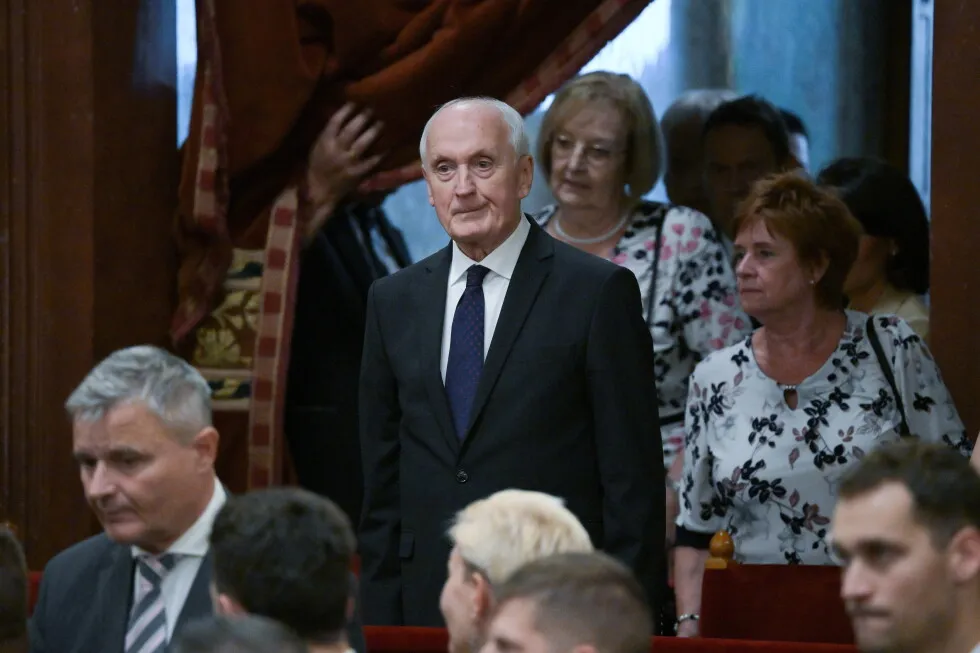
Hungary’s Parliament taps András Baka as president as part of Orbán-era purge 1 of 3 | Andras Baka, sole candidate of the Tisza Party for President of the Republic of Hungary and former President of the Supreme Court, center, arrives for the presidential election during the extraordinary plenary session of the Parliament in Budapest, Hungary, Tuesday, Aug.11, 2026. (Zoltan Balogh/MTI via AP) 2 of 3 | Andras Baka, sole candidate of the Tisza Party for President of the Republic of Hungary and former President of the Supreme Court attends the presidential election during the extraordinary plenary session of the Parliament in Budapest, Hungary, Tuesday, Aug.11, 2026. (Zoltan Balogh/MTI via AP) 3 of 3 | Andras Baka, sole candidate of the Tisza Party for President of the Republic of Hungary and former President of the Supreme Court, centre, attends the presidential election during the extraordinary plenary session of the Parliament in Budapest, Hungary, Tuesday, Aug.11, 2026. (Zoltan Balogh/MTI via AP) By JUSTIN SPIKE Updated 4:19 PM MESZ, August 11, 2026 Leer en español Add AP News on Google Add AP News as your preferred source to see more of our stories on Google. Share Share Facebook Copy Link copied Print Email X LinkedIn Bluesky Flipboard Pinterest Reddit Budapest, Hungary (AP) — Hungary’s Parliament elected former Supreme Court chief justice András Baka as president on Tuesday as the country’s new government dismantles power structures left behind by former Prime Minister Viktor Orbán. Lawmakers with the governing Tisza Party elected Baka in a secret ballot with 140 votes for and six votes against with no abstentions, while Orbán’s far-right Fidesz party boycotted the vote. Baka is expected to be sworn in on Aug. 19. The role of president in Hungary is largely ceremonial, though the president does have the power to send bills back to lawmakers or to the Constitutional Court for review. Incoming president says change should not include revenge Prime Minister Peter Magyar’s government has argued that the purge of officials appointed during Orbán’s time in office is necessary to restore democratic norms and institutional integrity that were eroded during his tenure. Orbán and Fidesz have accused the new government of “tyrannical” policies, which Magyar and Tisza deny. In comments in Parliament following his election, Baka criticized the performance of Orbán’s four successive governments and said one of the biggest challenges facing Hungary was the deep social and political polarization during the former leader’s 16 years in power. Baka added that while past legal and financial abuses must be investigated and prosecuted and democratic institutions restored, political change in Hungary should not come through “revenge.” “This country cannot build a common future while its citizens see each other as enemies,” he said. “Political change should not mean that from now on people will have to be afraid, be silent, or feel like outsiders in their own country.” Hungary passes constitutional amendment to remove Orbán-era president 4 MIN READ Hungary’s Orbán declares resistance movement against Magyar government’s ‘tyranny’ 3 MIN READ 15 Hungarian prosecutors raid Orbán party’s data center in embezzlement probe 3 MIN READ 15 First, the ruling party had to unseat the previous president Since taking office in May, Magyar’s administration has gone to work dismantling what he calls Orbán’s “mafia” by removing numerous political appointees and heads of institutions viewed as having facilitated Orbán’s autocratic government. The new government has suspended the news service of Hungary’s public television and radio — which Magyar has argued served as a “propaganda factory” for Orbán’s party — and closed Hungary’s Sovereignty Protection Office, an authority seen by Orbán’s opponents as a tool for intimidating critics and silencing independent media. It has also made judicial reforms, set up an office aimed at investigating financial abuses under the Orbán government and imposed a 12-year term limit on lawmakers and an 8-year limit for prime ministers. Baka’s election came after weeks of wrangling by Tisza to oust Orbán-era president Tamás Sulyok, who was nominated and confirmed by Orbán’s party in 2024. Magyar, who has referred to Sulyok as “Orbán’s puppet,” had called on the former president to resign after he and Tisza won a landslide election in April. After Sulyok refused, Tisza passed a constitutional amendment ending his term, which Sulyok reluctantly signed in July. Baka had been removed as chief justice under Orbán Baka, 74, served from 1991 to 2008 on the European Court of Human Rights. He was Supreme Court chief justice from 2009 to 2011 but was removed by Orbán’s government three years before the end of his term. Baka brought his removal before the European Court of Human Rights, which found in 2014 that Orbán’s government had violated his rights and that his dismissal was linked to his criticism of the government’s judicial reforms. He has been a visiting professor or lecturer at numerous U.S. universities including the University of Virginia, the University of California at Berkeley and Columbia University. JUSTIN SPIKE Spike is an Associated Press reporter based in Budapest, Hungary. twitter mailto
SRCAssociated Press (AP)
LANGEN
LEANCenter
WORDS833
ENT10
TUE · 2026-08-11 · 14:23 GMTBRIEF NSR-2026-0811-101274
NSR-2026-0811-101274News Report·EN·Political Strategy
Hungary’s Parliament taps András Baka as president as part of Orbán-era purge
Hungary's Parliament has elected András Baka, former chief justice of the Supreme Court, as the country's new president. This appointment is part of the governing Tisza party's effort to dismantle power structures established during former Prime Minister Viktor Orbán's tenure.
Associated Press (AP)Filed 2026-08-11 · 14:23 GMTLean · CenterRead · 4 min
Associated Press (AP)FIG 01
Reading time
4min
Word count
833words
Sources cited
2cited
Entities identified
10entities
Quality score
100%
§ 01
Briefing Summary
AI-generatedNEWSAR · AI
Hungary's Parliament has elected András Baka, former chief justice of the Supreme Court, as the country's new president. This appointment is part of the governing Tisza party's effort to dismantle power structures established during former Prime Minister Viktor Orbán's tenure. Baka was elected in a secret ballot with 140 votes in favor, while Orbán's Fidesz party boycotted the vote. The new government aims to restore democratic norms, which they argue were eroded under Orbán. Baka, who was previously removed as chief justice under Orbán's government, stated that while past abuses must be investigated, political change should not involve "revenge." The election follows the removal of the previous president, Tamás Sulyok, through a constitutional amendment.
Confidence 0.90Sources 2Claims 5Entities 10
§ 02
Article analysis
Model · rule-basedFraming
Political Strategy
Legal & Judicial
Tone
Measured
AI-assessed
CalmNeutralAlarmist
Factuality
0.80 / 1.00
Factual
LowHigh
Sources cited
2
Limited
FewMany
§ 03
Key claims
5 extracted01
Baka stated that political change should not come through “revenge” and that citizens should not see each other as enemies.
quoteAndrás Baka
Confidence
1.00
02
Prime Minister Peter Magyar’s government argues the purge is necessary to restore democratic norms and institutional integrity eroded during Orbán’s tenure.
factualPrime Minister Peter Magyar’s government
Confidence
1.00
03
Orbán’s far-right Fidesz party boycotted the vote.
factual
Confidence
1.00
04
Lawmakers with the governing Tisza party elected Baka in a secret ballot with 140 votes for and six votes against.
factual
Confidence
1.00
05
Hungary’s Parliament elected former Supreme Court chief justice András Baka as president.
factual
Confidence
1.00
§ 04
Full report
4 min read · 833 words§ 05
Entities
10 identifiedKey playerOppositionContextPositiveNeutralNegative
People3
Organizations4
§ 06
Keywords & salience
9 termsorbán-era purge
1.00
andrás baka
0.90
tisza party
0.80
president of hungary
0.70
hungarian parliament
0.60
democratic norms
0.50
viktor orbán
0.50
institutional integrity
0.40
peter magyar
0.40
§ 07
Topic connections
Interactive graph Network visualization showing 47 related topics
View Full Graph Person Organization Location Event|Click node to navigate|Edge numbers = shared articles