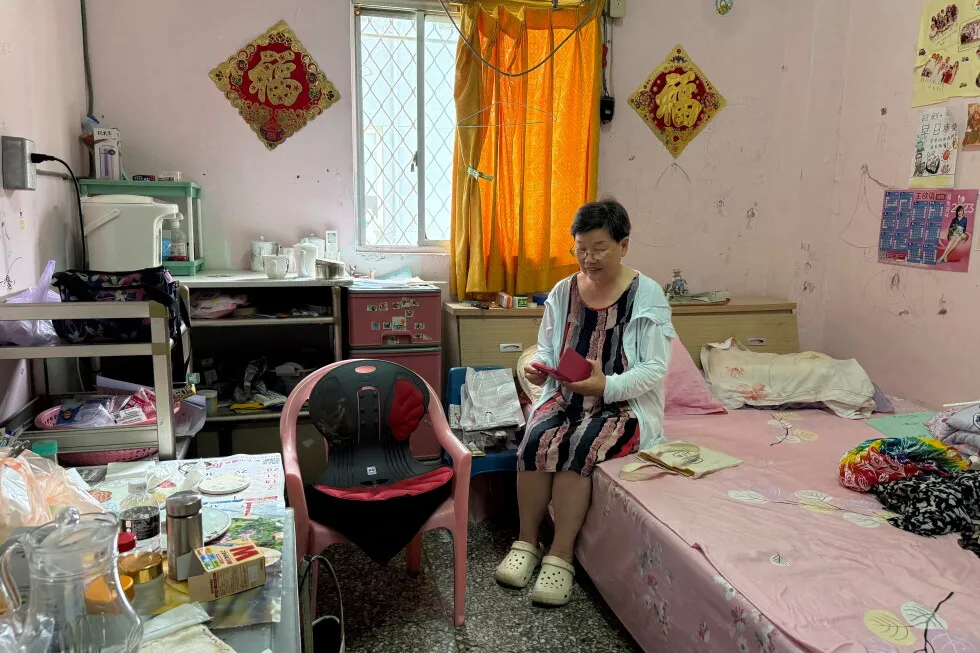
In Taiwan, Chinese-born spouses face questions of loyalty and, some say, discrimination 1 of 5 | Li Chen-hsiu speaks during an interview in Taoyuan, northern Taiwan, on July 21, 2026. (AP Photo/Johnson Lai) 2 of 5 | Mi Zhengrong speaks during an interview in Taipei, Taiwan, on July 20, 2026. (AP Photo/Johnson Lai) 3 of 5 | Mi Zhengrong sits in her room in Taipei, Taiwan, on July 20, 2026. (AP Photo/Johnson Lai) 4 of 5 | Shang Guan, a writer and activist from China who moved to Taiwan in 2021, speaks during an interview in Taipei, Taiwan, on July 20, 2026. (AP Photo/Johnson Lai) 5 of 5 | Shang Guan, a writer and activist from China who moved to Taiwan in 2021, visits 97 years old military veteran Li Guo-dong, right, in Taipei, Taiwan, on July 20, 2026. (AP Photo/Johnson Lai) By HUIZHONG WU Updated 5:21 AM MESZ, August 12, 2026 Add AP News on Google Add AP News as your preferred source to see more of our stories on Google. Share Share Facebook Copy Link copied Print Email X LinkedIn Bluesky Flipboard Pinterest Reddit Taipei, Taiwan (AP) — The day after Li Chen-hsiu was sworn in as a member of Taiwan’s Legislature, she was questioned about whether she belonged — about her nationality, about her identity and ultimately about her loyalty to Taiwan. That’s because Li is a “mainland spouse” — born in China and a citizen of Taiwan through marriage. She’s part of a community of some 369,000 people in the island nation who are subject to rapidly changing policies — and some say discrimination — as tensions rise with China and Taiwan’s government questions the spouses’ allegiances. For the two months she served before being forced out of the legislature, Li was the country’s only China-born lawmaker who had immigrated to Taiwan by marriage. “It’s only because of Taiwan which has this free and democratic system, and the Taiwan People’s Party which was willing to give a political newcomer a chance, that I could have this opportunity,” she told The Associated Press in July. But now, fears of a China" class="entity-link entity-event" data-entity-id="183411" data-entity-type="event">military invasion by China have complicated Taiwan’s policy toward spouses like Li. She is part of a diverse group that includes multiple generations, from those who married retired Chinese soldiers and came to Taiwan in search of better economic opportunity to a younger, more educated and wealthier group that met after both sides relaxed their borders. Taiwan court sentences a woman to 7 years in prison for conspiring with Chinese officials 3 MIN READ 27 Taiwan’s military drills suggest deeper alignment with the US 3 MIN READ Taiwan representative in Japan boycotts Nagasaki bombing anniversary ceremony over seating 3 MIN READ 70 years of silence and tension drive the issue China and Taiwan split during a civil war in 1949, with the Nationalist Party fleeing to the island. For decades, the two sides banned all contact, until 1987 when Taiwan’s residents were allowed to visit their family members in China for the first time. Tensions have fluctuated, but have been high since independence-leaning Tsai Ing-wen was elected Taiwan’s president in 2016, and China cut off official contact. Today, China sends military planes and navy ships toward Taiwan daily as part of military exercises. It has also stepped up its diplomatic campaign to isolate the island on the international stage, poaching allies, keeping Taiwan out of international organizations and targeting the island with misinformation. That threat is raising fears on the island about who’s loyal to Taiwan. A New Taipei court sentenced Hsu Chun-ying, head of an organization dedicated to helping spouses, to seven years in prison Tuesday for acting on Beijing’s behalf to spy on Taiwan and interfere with its politics. Historically, ‘mainland spouses’ were brides of soldiers Mi Zhengrong, 72, met her husband through relatives in China’s Hubei province. Her husband was one of the veterans of the civil war who had fled to Taiwan and later were allowed back into China to visit their hometowns for the first time. Many of them had been unable to marry in Taiwan and brought back women from China. Mi and her husband got married and lived in China, but her husband missed Taiwan — so they moved to the island in 2002. Her husband passed away after 12 years together. She then married a neighbor in Taiwan, and they were together for nearly a decade. For the last two years, she said, he was paralyzed, and she had to take care of him round-the-clock. Mi is now fighting to get her second husband’s pension, for which she is eligible if they’ve been married for 10 years. But her late husband passed away 13 days before they met that threshold. The military initially gave her the pension, but took it away after they realized the marriage fell short. Mi lives on about 10,000 New Taiwan Dollar a month ($330), of which about a third goes to rent. Still, she said, she prefers Taiwan. “How many of us want to go back?” she said. “No one wants to go back.” Taiwan’s government had been changing laws to integrate the community into society by shortening the time it takes for them to get Taiwanese citizenship and allowing them to work. Now, the island is scaling back the integration of “mainland spouses.” Last spring, Taiwan’s government deported three women who had advocated on social media for reunification with China by force. Taiwan’s Mainland Affairs Council, which governs the island’s relationship with China, said the women represented “repeated threats to Taiwan’s national security and social stability.” Taiwanese immigration authorities also issued a notice to some 12,000 spouses who already held Taiwanese citizenship to provide proof they canceled their household registrations in China or have their citizenship revoked. A nationally watched fight over whether a ‘mainland spouse’ can stay — and serve Li, the former legislator, came into office in February with the Taiwan People’s Party to intense opposition. Taiwan’s interior minister said Li could not serve as a legislator because she did not submit paperwork showing she renounced her Chinese citizenship. The Mainland Affairs Council said she did not submit documentation in time to show she had only a single nationality for the previous 10 years. Li argues she has held Taiwanese citizenship since 1999 and canceled her Chinese household registration then, thereby meeting the requirements. With the sides still at an impasse in April, Li’s party expelled her. The government then toughened standards Chinese-born legislators must meet. “There’s no political consideration here,” a spokesperson for the Mainland Affairs council said in defending the decision. Some scholars, though, say that Taiwan’s government is enforcing the law selectively. “The government these few years, they are interpreting many of the laws wrongly, or in a distorted way,” said Bruce Liao, a law professor and expert in immigration law at National Chengchi University. “You can’t move against the Mainland,” he added. “But you can bully the ‘mainland spouses’ here, and use them to create hostility.” Others defend the approach as a national security matter. “The government has a compelling interest in protecting the safety of the country,” said Yen-Tu Su, a researcher at Academia Sinica in Taiwan. “And so usually the government would have some leeway in determining whether a foreign resident is a threat to the social order or safety of the society.” ‘Mainland spouses’ are treated differently from other immigrants by law Even before recent controversies, spouses born in China were treated differently from spouses born anywhere else. For example, “mainland spouses” can apply for Taiwanese citizenship after six years, while foreign spouses can apply in four years. They also must be Taiwanese citizens for 10 years before they can apply for government jobs, while foreign spouses can apply for most lower-level government jobs right after becoming citizens. Behind the difference in law is a question of loyalty. Shangguanluan, a Chinese writer and activist who is known professionally by her pen name, moved to Taiwan in 2021 with her Taiwanese husband, says she’s constantly plagued by such questions — whether she is acting on orders from the Chinese Communist Party, for example, or whether she’s a spy. She acknowledges that China is actively looking for targets, but said spouses were hardly ideal. “If they want some core secrets, the people who are most convenient targets for them, are people who are closest to the secrets, in Taiwan’s defense, or in tech,” she said, such as “Taiwanese businessmen, or academics, or some institutional head.” But on the list of valuable targets for information, “there’s no room for ‘mainland spouses.’” HUIZHONG WU Wu covers Chinese culture, society, and politics for The Associated Press, as well as the country’s growing overseas influence from Bangkok. She was previously based in Taiwan and China. twitter
SRCAssociated Press (AP)
LANGEN
LEANCenter
WORDS1 466
ENT12
WED · 2026-08-12 · 03:53 GMTBRIEF NSR-2026-0812-101423
NSR-2026-0812-101423News Report·EN·Human Interest
In Taiwan, Chinese-born spouses face questions of loyalty and, some say, discrimination
In Taiwan, individuals born in mainland China who are married to Taiwanese citizens, known as "mainland spouses," are facing increased scrutiny and, according to some, discrimination. This situation arises as cross-strait tensions escalate and Taiwan's government questions the allegiances of this community of approximately 369,000 people.
Associated Press (AP)Filed 2026-08-12 · 03:53 GMTLean · CenterRead · 6 min
Associated Press (AP)FIG 01
Reading time
6min
Word count
1 466words
Sources cited
3cited
Entities identified
12entities
Quality score
100%
§ 01
Briefing Summary
AI-generatedNEWSAR · AI
In Taiwan, individuals born in mainland China who are married to Taiwanese citizens, known as "mainland spouses," are facing increased scrutiny and, according to some, discrimination. This situation arises as cross-strait tensions escalate and Taiwan's government questions the allegiances of this community of approximately 369,000 people. Recent policy changes include deporting women who advocated for forceful reunification with China and requiring some citizens to prove they have renounced their Chinese household registration. The article highlights the case of Li Chen-hsiu, a former legislator who was questioned about her loyalty and removed from office due to citizenship documentation issues. Historically, many "mainland spouses" were women who married retired soldiers, but the community now includes younger, more educated individuals. These spouses face legal differences compared to other immigrants, such as longer waiting periods for citizenship and restrictions on government employment, stemming from concerns about loyalty.
Confidence 0.90Sources 3Claims 5Entities 12
§ 02
Article analysis
Model · rule-basedFraming
Human Interest
National Security
Tone
Measured
AI-assessed
CalmNeutralAlarmist
Factuality
0.70 / 1.00
Factual
LowHigh
Sources cited
3
Well sourced
FewMany
§ 03
Key claims
5 extracted01
Li Chen-hsiu stated that Taiwan's free and democratic system and the Taiwan People's Party gave her an opportunity.
quoteLi Chen-hsiu
Confidence
1.00
02
Li Chen-hsiu, a China-born lawmaker in Taiwan's Legislature, was questioned about her loyalty after being sworn in.
factual
Confidence
0.95
03
Chinese-born spouses in Taiwan face questions of loyalty and, some say, discrimination.
factual
Confidence
0.90
04
Fears of a military invasion by China have complicated Taiwan's policy toward spouses like Li.
factual
Confidence
0.85
05
There are approximately 369,000 Chinese-born spouses in Taiwan.
statistic
Confidence
0.80
§ 04
Full report
6 min read · 1 466 words§ 05
Entities
12 identifiedKey playerOppositionContextPositiveNeutralNegative
People4
Organizations2
Locations4
§ 06
Keywords & salience
8 termsmainland spouses
1.00
loyalty questions
0.90
discrimination
0.80
taiwanese policy
0.70
china tensions
0.60
allegiances
0.50
national identity
0.50
immigration
0.40
§ 07
Topic connections
Interactive graph Network visualization showing 51 related topics
View Full Graph Person Organization Location Event|Click node to navigate|Edge numbers = shared articles