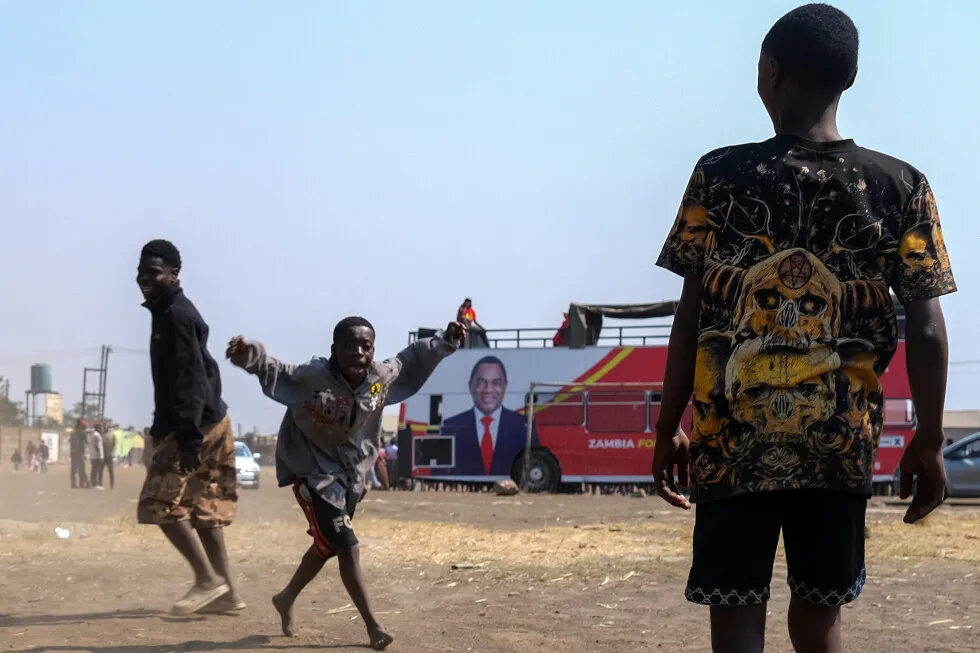
A guide to this week’s election in Zambia, a southern African country rich in critical minerals 1 of 5 | Supporters of Zambian incumbent President and United Party for National Development (UPND) presidential candidate Hakainde Hichilema attend a campaign rally on the outskirts of Lusaka, Zambia, Saturday, Aug. 8, 2026. (AP Photo/Anita Reed) 2 of 5 | Supporters of Zambian incumbent President and United Party for National Development (UPND) presidential candidate Hakainde Hichilema campaign on the street in Lusaka, Zambia, Monday, Aug. 10, 2026. (AP Photo/Anita Reed) 3 of 5 | Supporters of Zambian incumbent President and United Party for National Development (UPND) presidential candidate Hakainde Hichilema attend a campaign rally on the outskirts of Lusaka, Zambia, Saturday, Aug. 8, 2026. (AP Photo/Anita Reed) 4 of 5 | Street vendors selling vegetables on the outskirts of Lusaka, Zambia, Monday, Aug. 10, 2026. (AP Photo/Anita Reed) 5 of 5 | A motor bike delivery rider waits next a wall covered with electoral campaign posters in Lusaka, Zambia, Saturday, Aug. 8, 2026. (AP Photo/Anita Reed) By JACOB ZIMBA Updated 4:42 AM MESZ, August 12, 2026 Add AP News on Google Add AP News as your preferred source to see more of our stories on Google. Share Share Facebook Copy Link copied Print Email X LinkedIn Bluesky Flipboard Pinterest Reddit Lusaka, Zambia (AP) — Zambia holds an election Thursday to decide if President Hakainde Hichilema will get a second five-year term as reward for his economic recovery plan in the southern African nation that’s one of the world’s top copper producers but was recently mired in a debt crisis. Zambia defaulted on sovereign debt repayments to China and other nations in 2020 in the midst of the COVID-19 pandemic, drawing attention to the unsustainable burdens faced by some developing countries. Hichilema was elected a year later, and Zambia has restructured more than $12 billion in debts to other countries and private creditors under his leadership while reigning in inflation and stabilizing the currency. His long-term economic plan involves a pledge to more than triple Zambia’s copper output to 3 million metric tons a year by 2031 — which would be a staggering rise that could put Zambia ahead of the United States and China in terms of global producers of the in-demand critical mineral. Opposition leader likely Hichilema’s strongest challenger Hichilema won a presidential election in 2021 having lost in five votes before that stretching back to 2006. The 64-year-old is a former financial services executive but also has a background in farming and is one of the nation’s biggest cattle ranchers. He is a member of the Seventh-day Adventist Church and has led the United Party for National Development since 2006. Zambia’s Guy Scott, who was Africa’s first white head of state in decades, has died at 82 1 MIN READ Trump administration revokes visa of Brazil’s ambassador to US in spat with Lula 3 MIN READ Flávio Bolsonaro announces his running mate for Brazil’s October election in a bid against Lula 3 MIN READ In a field that includes 13 other presidential candidates, analysts say Hichilema’s strongest challenger will likely be Brian Mundubile, the leader of an opposition alliance called the Tonse Alliance. The 55-year-old Mundubile, who is a law graduate, was not considered a major political figure in Zambia but emerged in January as the leader of Tonse after it was embroiled in internal wrangles. While inflation has dropped and the value of Zambia’s currency, the Kwacha, has improved under Hichilema, ordinary Zambians bemoan high food and energy costs. Some critics say the macroeconomic stability hasn’t benefited most people in the landlocked country of some 22 million. “You expect a minimum of three years to be able to drive an economic agenda and turn around a country,” Zambian economist Trevor Hambayi said. “That has passed and they’ve had five years. But these effects have not yet trickled down to the Zambian people.” Hichilema promised this week while campaigning to build more schools, health facilities and roads, and to create more jobs. “We love you so much and this is why we are working round the clock to lower the cost of living,” he said. Another criticism of Hichilema is that he has squeezed dissent in a country where elections have been largely peaceful. On Tuesday, the Tonse Alliance accused Hichilema’s government of being behind a law enforcement agency raid on its offices that saw vehicles, communication equipment and other items seized. The alliance alleged it was politically motivated to disrupt its campaigning. Zambia gained independence from Britain in 1960 and was a one-party state from 1973 to 1991. Since then, several parties and political alliances have won and lost power. Hichilema’s rivalry with his predecessor, the late former President Edgar Lungu, was especially bitter and continued even after Lungu’s death last year. When Lungu was president, then-opposition leader Hichilema was imprisoned for four months in 2017 on charges of treason after Lungu alleged Hichilema’s motorcade didn’t gave way to his on a road. Lungu claimed he was effectively put under house arrest during Hichilema’s first term and had to sneak out of the country to seek medical care in South Africa. Lungu died in South Africa in June 2025, prompting a macabre yearlong battle between Hichilema’s government and Lungu’s family over where the body should be buried. The government insisted it be repatriated for a state funeral, while the family said one of Lungu’s last wishes was that he not have a state funeral presided over by Hichilema. The dispute, which fascinated Zambians, went to South Africa’s Supreme Court of Appeal. It ruled in favor of the family, though burial plans have still not been announced. China is the top foreign investor in Zambia, especially for its copper and cobalt — critical minerals that are used in electronics, electric vehicles and other new technologies. Those minerals have also drawn interest from U.S. President Donald Trump’s administration, though Zambia has accused the U.S. of tying critical minerals access to a proposed $2 billion health deal between the countries — allegations the U.S. rejected. Voters in the one-day election on Thursday will also choose lawmakers in Parliament and local government councilors. Around 8 million people are registered to vote. Zambia’s presidential election works on the 50% plus one system where a candidate has to get an outright majority to win. That raises the possibility of a second round of voting if no candidate gets more than 50% of the vote first time around.
SRCAssociated Press (AP)
LANGEN
LEANCenter
WORDS1 081
ENT11
WED · 2026-08-12 · 02:53 GMTBRIEF NSR-2026-0812-101425
NSR-2026-0812-101425News Report·EN·Economic Impact
A guide to this week’s election in Zambia, a southern African country rich in critical minerals
Zambia is holding an election on Thursday to determine if President Hakainde Hichilema will secure a second term. Hichilema, who was elected in 2021, is campaigning on his economic recovery plan, which has involved restructuring over $12 billion in debt and stabilizing the currency.
Associated Press (AP)Filed 2026-08-12 · 02:53 GMTLean · CenterRead · 5 min
Associated Press (AP)FIG 01
Reading time
5min
Word count
1 081words
Sources cited
0cited
Entities identified
11entities
Quality score
100%
§ 01
Briefing Summary
AI-generatedNEWSAR · AI
Zambia is holding an election on Thursday to determine if President Hakainde Hichilema will secure a second term. Hichilema, who was elected in 2021, is campaigning on his economic recovery plan, which has involved restructuring over $12 billion in debt and stabilizing the currency. His administration aims to significantly increase copper output, a key mineral for Zambia. Hichilema's main challenger is Brian Mundubile of the Tonse Alliance. While economic indicators have improved, some critics argue that the benefits have not reached ordinary Zambians, who still face high living costs. The election also includes parliamentary and local council races, with approximately 8 million registered voters.
Confidence 0.90Claims 5Entities 11
§ 02
Article analysis
Model · rule-basedFraming
Economic Impact
Political Strategy
Tone
Measured
AI-assessed
CalmNeutralAlarmist
Factuality
0.80 / 1.00
Factual
LowHigh
Sources cited
0
No named sources
FewMany
§ 03
Key claims
5 extracted01
Hichilema won a presidential election in 2021 having lost in five votes before that stretching back to 2006.
factual
Confidence
1.00
02
Zambia has restructured more than $12 billion in debts to other countries and private creditors under Hichilema's leadership.
factual
Confidence
1.00
03
Zambia defaulted on sovereign debt repayments to China and other nations in 2020.
factual
Confidence
1.00
04
Zambia holds an election Thursday to decide if President Hakainde Hichilema will get a second five-year term.
factual
Confidence
1.00
05
Hichilema's long-term economic plan involves a pledge to more than triple Zambia’s copper output to 3 million metric tons a year by 2031.
prediction
Confidence
0.90
§ 04
Full report
5 min read · 1 081 words§ 05
Entities
11 identifiedKey playerOppositionContextPositiveNeutralNegative
Organizations2
Locations4
§ 06
Keywords & salience
8 termscritical minerals
1.00
zambian election
1.00
economic recovery
0.90
debt crisis
0.80
copper production
0.70
hakainde hichilema
0.60
sovereign debt
0.50
southern africa
0.40
§ 07
Topic connections
Interactive graph Network visualization showing 18 related topics
View Full Graph Person Organization Location Event|Click node to navigate|Edge numbers = shared articles