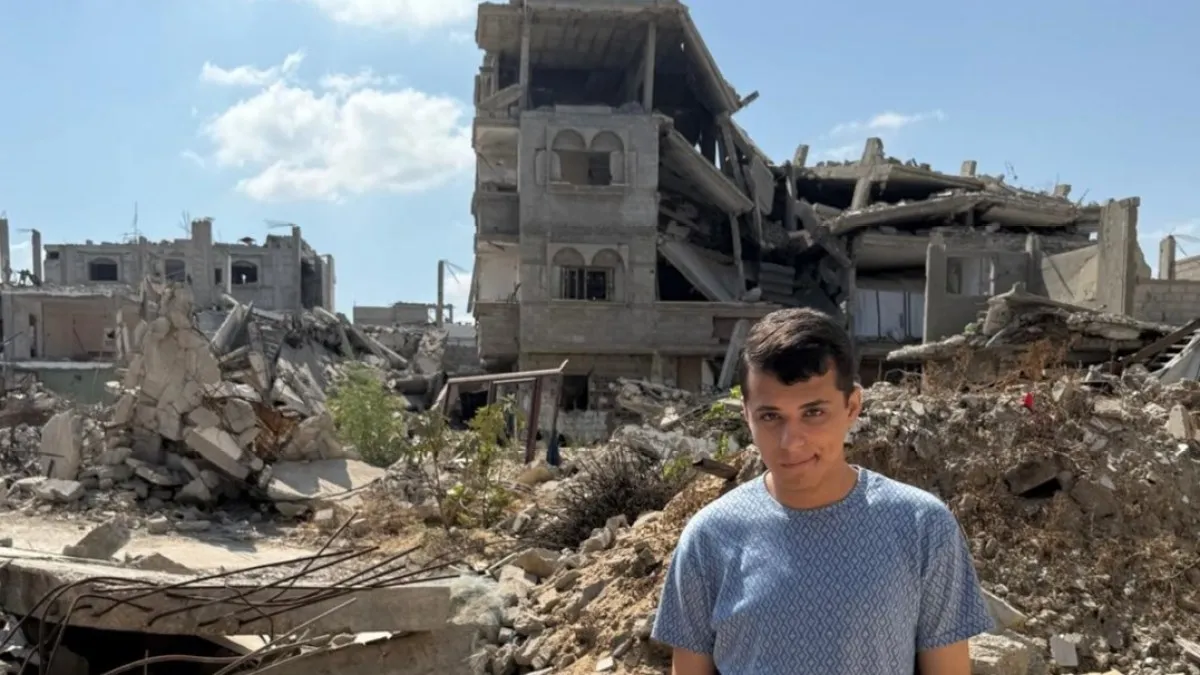
Continuous bombing disrupts routines, causing sensory shocks and behavioural relapses in Gaza’s autistic children.Ahmed Hatem al-Mahabeel stands amid the rubble of his home in Khan Younis, Gaza, which was destroyed by Israel [Enas Abu Ghayad/Al Jazeera]Published On 12 Aug 2026Khan Younis, Gaza Strip – Among the rubble of Khan Younis, 16-year-old Ahmed Hatem al-Mahabeel clutches his hand tightly under his chin – a repetitive movement he uses to calm his nervous system and cope with the memory of the sound of explosions.Ahmed, who lives with autism, has had to face the loss of some of his favourite places – his bedroom, his school, the sports academy he would attend, all destroyed in Israel’s genocidal war on Gaza.Recommended Stories list of 3 itemslist 1 of 3Venezuela and Israel restore consular ties as relations warmlist 2 of 3Rights groups launch new legal challenge to Trump campaign against ICClist 3 of 3Iran, US set new conditions during Hormuz talks: What does this mean?end of listBefore the war, Ahmed was doing well. He was progressing through school under the supervision of a specialist. He was training at a football academy, as well as memorising the Quran and excelling in English.But Israel’s war, ongoing since October 2023, has killed more than 73,380 Palestinians and destroyed vast swathes of the enclave. And behind those headlines is the disruption of the services and supportive environments needed by individuals like Ahmed who have autism spectrum disorder.“Ahmed used to go to the mosque and the club on his own, making excellent progress, but the war destroyed everything we built,” said his mother, Umm Ahmed. “He suffers from extreme sensitivity to sudden noise; when explosions sound, he enters a severe panic attack, covering his ears and swaying. In cases of extreme terror, he resorts to self-harm, hitting his head against the ground to escape the sound.”Beyond psychological trauma, severe malnutrition and protein deficiency caused his appendix to rupture.“With food shortages, complications led to a wound infection, forcing doctors to perform a second surgical operation to open the abdomen and clean it until he recovered,” Umm Ahmed recalled.Today, Ahmed spends his days confined indoors due to the lack of safety in Gaza, with Israeli attacks ongoing, despite an October ceasefire.“All our hope is for Ahmed to get an opportunity to travel abroad for treatment and rehabilitation, to reclaim what the war took from him,” his mother said.Psychological specialist Diaa Abu Aoun [Enas Abu Ghayad/Al Jazeera]Shelling and sensory overloadContinuous bombardment poses a direct threat to the nervous systems of autistic children. In Gaza, constant explosions have driven severe behavioural relapses, including total sleep deprivation, wandering from tents, panic attacks, and self-harm.“A child with autism relies entirely on routine and calm to feel safe,” explained psychological specialist Diaa Abu Aoun, who has worked with Ahmed. “When forced to live in a tent amidst continuous explosions, their brain receives a sensory shock it cannot process. This fear translates into insomnia, digestive issues, and severe screaming fits where the child completely loses control.”In Nuseirat camp in central Gaza, 19-year-old Muneer al-Haj has exhibited elements of those behaviours. When he hears air strikes, he squeezes his hands tightly into fists, pacing back and forth while making sounds to block out the noise.Before the war, Muneer followed a promising rehabilitation path under specialists. He attended school, and displayed strong communication skills and a talent for drawing.With the onset of Israeli shelling during the war, and medication shortages that were caused by Israel’s blockade of Gaza, his condition regressed to screaming fits and seizure-like symptoms.Muneer’s treatment protocol was reduced to half a tablet daily of a sedative due to the shortages.His father, who did not wish to give his full name but preferred to be called Abu Muneer, described the shift.“He used to communicate and express himself clearly, but the war consumed everything… this safe space dissolved facing hardship and fear,” Abu Muneer said. “He now asks urgent questions we cannot answer, entering severe attacks if unresolved. We try to reassure him during shelling, saying ‘God will protect us’, but he realises what is happening, expressing his anguish by saying: ‘I am without shelter or a homeland.'”“The absence of a safe space and the depletion of sedatives turned our attempts to calm our children into individual efforts fraught with fear and confusion,” Abu Muneer said.Muneer al-Haj standing next to an exhibition board featuring his artwork at his school before the war [Enas Abu Ghayad/Al Jazeera]Medication shortagesThe interruption of specialised treatments directly threatens dozens of children, experts say.“The sudden interruption or forced reduction of psychiatric and anti-convulsant medication doses… creates severe disruption in brain chemistry,” Abu Aoun said. “When a child is deprived of medication or receives only half a dose, the nervous system enters a severe rebound effect. Violent fits and acute convulsions increase, driving self-harm and preventing response to behavioural training.”Medicine shortages and the collapse of specialist services have left autistic children without consistent treatment or suitable alternatives. The World Health Organization says no rehabilitation equipment entered Gaza between May 2024 and April of this year, while all facilities faced severe constraints.The Palestine Center for Special Education was also destroyed, and its former director, Arij Abu Sultan, was killed, forcing parents to increasingly assume greater therapeutic roles.Reem Jarour, the head of autism programmes at Gaza’s Dolphins Association for Education and Community Development, emphasises that individuals with autism rely on predictable environments for emotional stability.“An autistic child cannot survive without a predictable ecosystem; routine is a neurological safety valve,” Jarour said. “What we witness today in Gaza is the total destruction of the behavioural foundations built over years. Sudden displacement turns environmental triggers into acute threats, leading to massive regression in linguistic and social skills.”
SRCAl Jazeera
LANGEN
LEANCenter
WORDS947
ENT9
WED · 2026-08-12 · 07:27 GMTBRIEF NSR-2026-0812-101488
NSR-2026-0812-101488News Report·EN·Human Interest
Autism and war: Gaza families grapple with destruction and loss
Gaza's autistic children are experiencing severe behavioral relapses and sensory shocks due to continuous bombing and destruction of their routines and safe spaces. Families like Ahmed Hatem al-Mahabeel's report that the ongoing war, which began in October 2023, has led to panic attacks, self-harm, and even medical complications like appendix rupture due to malnutrition.
By Enas Abu GhayadAl JazeeraFiled 2026-08-12 · 07:27 GMTLean · CenterRead · 4 min
Al JazeeraFIG 01
Reading time
4min
Word count
947words
Sources cited
2cited
Entities identified
9entities
Quality score
100%
§ 01
Briefing Summary
AI-generatedNEWSAR · AI
Gaza's autistic children are experiencing severe behavioral relapses and sensory shocks due to continuous bombing and destruction of their routines and safe spaces. Families like Ahmed Hatem al-Mahabeel's report that the ongoing war, which began in October 2023, has led to panic attacks, self-harm, and even medical complications like appendix rupture due to malnutrition. Psychological specialists explain that the constant explosions overwhelm the nervous systems of autistic children, who rely on routine and calm. Medication shortages further exacerbate their conditions, leading to regression in progress and increased distress. Families are seeking opportunities for their children to receive treatment and rehabilitation abroad.
Confidence 0.90Sources 2Claims 5Entities 9
§ 02
Article analysis
Model · rule-basedFraming
Human Interest
Human Rights
Tone
Mixed Tone
AI-assessed
CalmNeutralAlarmist
Factuality
0.60 / 1.00
Mixed
LowHigh
Sources cited
2
Limited
FewMany
§ 03
Key claims
5 extracted01
A child with autism relies entirely on routine and calm to feel safe.
quoteDiaa Abu Aoun
Confidence
0.95
02
Ahmed Hatem al-Mahabeel, who lives with autism, has had to face the loss of his home, school, and sports academy destroyed in the war.
factual
Confidence
0.95
03
Ahmed suffers from extreme sensitivity to sudden noise; when explosions sound, he enters a severe panic attack, covering his ears and swaying.
quoteUmm Ahmed
Confidence
0.90
04
Continuous bombing disrupts routines, causing sensory shocks and behavioral relapses in Gaza’s autistic children.
factual
Confidence
0.90
05
Israel’s war, ongoing since October 2023, has killed more than 73,380 Palestinians and destroyed vast swathes of the enclave.
statistic
Confidence
0.85
§ 04
Full report
4 min read · 947 words§ 05
Entities
9 identifiedKey playerOppositionContextPositiveNeutralNegative
Organizations1
Locations4
§ 06
Keywords & salience
9 termsautism
1.00
gaza war
1.00
destruction
0.90
trauma
0.80
disruption of services
0.70
sensory overload
0.70
loss
0.60
malnutrition
0.50
rehabilitation
0.40
§ 07
Topic connections
Interactive graph Network visualization showing 51 related topics
View Full Graph Person Organization Location Event|Click node to navigate|Edge numbers = shared articles