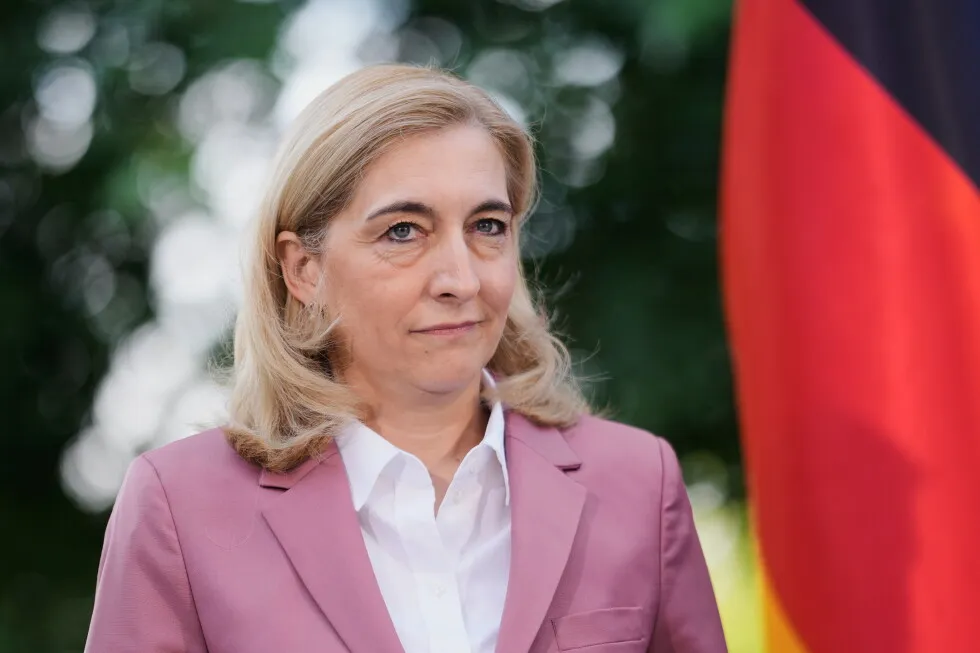
Germany beefs up its intelligence services as threat from ‘foreign powers’ rises 1 of 4 | German Health Minister and designated Chief of Staff at the Chancellery Nina Warken attends a statement about planned personnel changes in the German government at the Chancellery in Berlin, Germany, Friday, July 24, 2026. (AP Photo/Markus Schreiber) 2 of 4 | Germany’s Interior Minister Alexander Dobrindt attends the cabinet meeting at the Chancellery in Berlin, Germany, Wednesday, July 15, 2026. (AP Photo/Ebrahim Noroozi) 3 of 4 | German Finance Minister and Vice Chancellor Lars Klingbeil, left, speaks to Chief of Staff at the Chancellery Nina Warken prior to the cabinet meeting at the Chancellery in Berlin, Germany, Wednesday, Aug. 12, 2026. (AP Photo/Ebrahim Noroozi) 4 of 4 | German Finance Minister and Vice Chancellor Lars Klingbeil, right, and Interior Minister Alexander Dobrindt arrive for the cabinet meeting at the Chancellery in Berlin, Germany, Wednesday, Aug. 12, 2026. (AP Photo/Ebrahim Noroozi) 1 of 4 | German Health Minister and designated Chief of Staff at the Chancellery Nina Warken attends a statement about planned personnel changes in the German government at the Chancellery in Berlin, Germany, Friday, July 24, 2026. (AP Photo/Markus Schreiber) 1 of 4 German Health Minister and designated Chief of Staff at the Chancellery Nina Warken attends a statement about planned personnel changes in the German government at the Chancellery in Berlin, Germany, Friday, July 24, 2026. (AP Photo/Markus Schreiber) Add AP News on Google Add AP News as your preferred source to see more of our stories on Google. Share 2 of 4 | Germany’s Interior Minister Alexander Dobrindt attends the cabinet meeting at the Chancellery in Berlin, Germany, Wednesday, July 15, 2026. (AP Photo/Ebrahim Noroozi) 2 of 4 Germany’s Interior Minister Alexander Dobrindt attends the cabinet meeting at the Chancellery in Berlin, Germany, Wednesday, July 15, 2026. (AP Photo/Ebrahim Noroozi) Add AP News on Google Add AP News as your preferred source to see more of our stories on Google. Share 3 of 4 | German Finance Minister and Vice Chancellor Lars Klingbeil, left, speaks to Chief of Staff at the Chancellery Nina Warken prior to the cabinet meeting at the Chancellery in Berlin, Germany, Wednesday, Aug. 12, 2026. (AP Photo/Ebrahim Noroozi) 3 of 4 German Finance Minister and Vice Chancellor Lars Klingbeil, left, speaks to Chief of Staff at the Chancellery Nina Warken prior to the cabinet meeting at the Chancellery in Berlin, Germany, Wednesday, Aug. 12, 2026. (AP Photo/Ebrahim Noroozi) Add AP News on Google Add AP News as your preferred source to see more of our stories on Google. Share 4 of 4 | German Finance Minister and Vice Chancellor Lars Klingbeil, right, and Interior Minister Alexander Dobrindt arrive for the cabinet meeting at the Chancellery in Berlin, Germany, Wednesday, Aug. 12, 2026. (AP Photo/Ebrahim Noroozi) 4 of 4 German Finance Minister and Vice Chancellor Lars Klingbeil, right, and Interior Minister Alexander Dobrindt arrive for the cabinet meeting at the Chancellery in Berlin, Germany, Wednesday, Aug. 12, 2026. (AP Photo/Ebrahim Noroozi) Add AP News on Google Add AP News as your preferred source to see more of our stories on Google. Share Updated [hour]:[minute] [AMPM] [timezone], [monthFull] [day], [year] Berlin (AP) — Germany’s government plans to give its intelligence services broader powers for actions such as disabling sabotage and hacking attempts in response to a rising threat from powers such as Russia and extremists.The Cabinet on Wednesday approved draft legislation meant to strengthen Germany’s Federal Intelligence Service, the BND, and its domestic intelligence service, the BfV, and reduce the reliance of the European Union’s most populous nation on tips from its allies.The powers of Germany’s intelligence services have long lagged behind those of major European counterparts. Modern Germany has traditionally been sensitive to data protection concerns, not least because of memories of repression under the Nazis and later by communist East Germany’s secret police. “Nowadays, Germany is constantly a target of hybrid attacks by foreign powers and that is a real, very acute danger,” said Nina Warken, Chancellor Friedrich Merz’s chief of staff. “We are simply too dependent on the intelligence services of other countries supporting us, and at the moment this help is a one-way street in too many areas.” Interior Minister Alexander Dobrindt said “we are developing our intelligence services into real intelligence services.” The threats Germany now faces require intelligence services that are “competitive with our partner services in the European Union, but also with friendly services beyond that,” Dobrindt added. 1 MIN READ 4 MIN READ 1 MIN READ “We are a daily target of espionage, sabotage, cyberattacks and hidden actions by foreign powers with the aim of destabilizing our country, damaging our country, and bringing about political and social changes in our country,” Dobrindt said. Under the planned reform, which still requires parliamentary approval, the intelligence services will get more powers to access laptops, cellphones and other devices and store the data. Warken, whose job involves overseeing the intelligence services, said they also will be able to take “active measures.” The BND could, for example, swap out components in deliveries for faulty ones, access the IT systems of drone factories or chemical weapons laboratories to sabotage them, or disable or switch off the servers of hackers or disinformation agents linked to foreign states, Warken said.Dobrindt also pointed to the possibility of exchanging explosives for harmless substances.The reform has been planned for months. The risks Germany faces were underlined last week by the discovery of a drone carrying explosives at Leipzig/Halle airport, a major hub for international freight and for providing support to Ukraine.That incident is under investigation and authorities haven’t said who might have been responsible.While Dobrindt and Warken didn’t name the foreign powers they are worried about, Russia’s activities in particular have been a constant concern for authorities across much of Europe in recent years.
SRCAssociated Press (AP)
LANGEN
LEANCenter
WORDS973
ENT10
WED · 2026-08-12 · 12:23 GMTBRIEF NSR-2026-0812-101582
NSR-2026-0812-101582News Report·EN·National Security
Germany beefs up its intelligence services as threat from ‘foreign powers’ rises
Germany's government has approved draft legislation to significantly enhance the powers of its domestic and federal intelligence services. This move aims to counter a perceived rise in threats from foreign powers, including Russia, and extremists, who are reportedly targeting Germany with espionage, sabotage, and cyberattacks.
By
GEIR MOULSONAssociated Press (AP)Filed 2026-08-12 · 12:23 GMTLean · CenterRead · 4 min
Associated Press (AP)FIG 01
Reading time
4min
Word count
973words
Sources cited
0cited
Entities identified
10entities
Quality score
100%
§ 01
Briefing Summary
AI-generatedNEWSAR · AI
Germany's government has approved draft legislation to significantly enhance the powers of its domestic and federal intelligence services. This move aims to counter a perceived rise in threats from foreign powers, including Russia, and extremists, who are reportedly targeting Germany with espionage, sabotage, and cyberattacks. The proposed changes will grant intelligence agencies broader capabilities for actions like disabling sabotage and hacking attempts, and reduce the nation's reliance on intelligence from allies. Historically, Germany's intelligence powers have been more limited due to data protection concerns. The legislation, which requires parliamentary approval, will allow agencies to access and store data from devices and conduct "active measures" to disrupt hostile activities.
Confidence 0.90Claims 3Entities 10
§ 02
Article analysis
Model · rule-basedFraming
National Security
Political Strategy
Tone
Measured
AI-assessed
CalmNeutralAlarmist
Factuality
0.70 / 1.00
Factual
LowHigh
Sources cited
0
No named sources
FewMany
§ 03
Key claims
3 extracted01
Germany is increasing the resources and staff of its intelligence services.
factual
Confidence
0.90
02
The threat from foreign powers to Germany is rising.
factual
Confidence
0.80
03
The German government is planning personnel changes.
factual
Confidence
0.70
§ 04
Full report
4 min read · 973 words§ 05
Entities
10 identifiedKey playerOppositionContextPositiveNeutralNegative
People3
Organizations4
§ 06
Keywords & salience
8 termsintelligence services
1.00
foreign powers
0.90
national security
0.80
espionage
0.70
government
0.60
germany
0.50
cybersecurity
0.40
threat assessment
0.40
§ 07
Topic connections
Interactive graph Network visualization showing 51 related topics
View Full Graph Person Organization Location Event|Click node to navigate|Edge numbers = shared articles