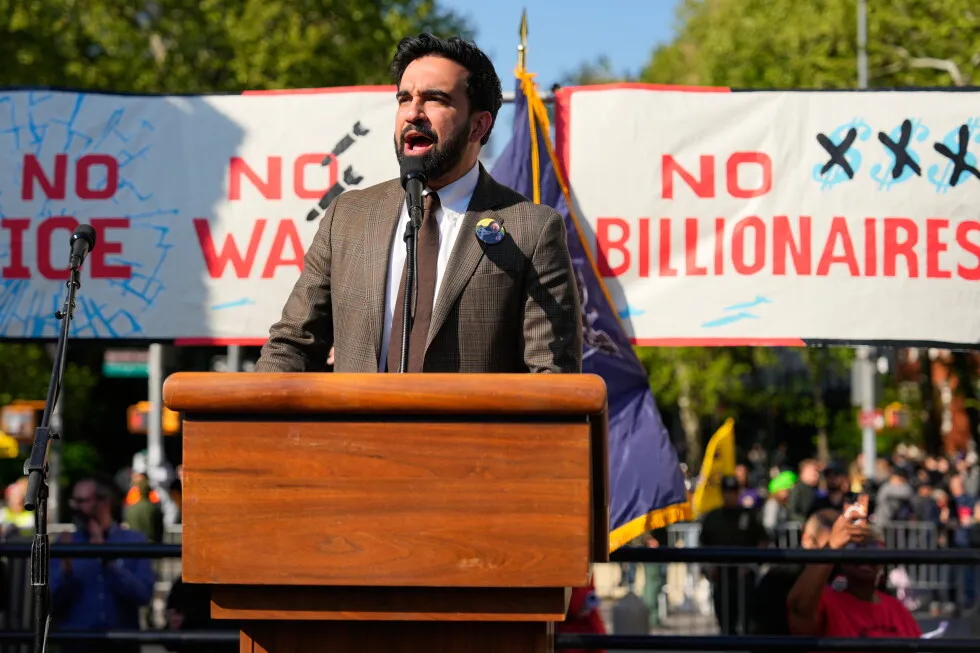
Mayor Zohran Mamdani speaks during a May Day rally at Washington Square Park in New York, May 1, 2026. (AP Photo/Yuki Iwamura, File) By ANTHONY IZAGUIRRE Updated 7:48 PM MESZ, August 12, 2026 Add AP News on Google Add AP News as your preferred source to see more of our stories on Google. Share Share Facebook Copy Link copied Print Email X LinkedIn Bluesky Flipboard Pinterest Reddit NEW YORK (AP) — Across the U.S., calls to “tax the rich” have become potent political slogans. But even in Mayor Zohran Mamdani’s New York, getting the wealthy to pay more isn’t playing out as smoothly as supporters hoped. What seemed at first like an easy idea — slapping a new tax on people who own luxury second homes in the Big Apple but live elsewhere most of the year — has instead created a lot of confusion in the city’s notoriously convoluted world of real estate arrangements. “It seems very simple but the more you dig into it, the more nuances you look at, the more complicated it gets,” said Gary Bingel, a state and local tax expert and partner at EisnerAmper, an accounting firm. It has also prompted pushback from both the city’s very wealthy and the merely moderately wealthy. President Donald Trump, whose gilded Manhattan penthouse could be subject to the tax since his primary residence is now in Florida, said he was looking into whether federal intervention could “avert this disaster, before it is too late.” A group of homeowners sued over the city’s rollout of the tax, arguing that officials had not done enough to figure out who would have to pay the tax and instead made it property owners’ responsibility. A judge temporarily paused the process this week, but the city moved to appeal, allowing the tax effort to continue until it’s sorted out in court. Securing a new tax on multimillion-dollar second homes, known as pied-à-terres, was an early win for Mamdani in his quest to raise taxes on the city’s highest earners to pay for his ambitious liberal agenda. Mamdani plans to offer 30% discount on meat and produce at city-owned grocery stores 6 MIN READ FACT FOCUS: No, you won’t need an ID to shop at city-owned grocery stores in New York City 3 MIN READ 49 NYC’s Rikers Island jail hosts World Cup watch party for inmates 3 MIN READ 49 The so-called pied-à-terre tax would levy a new surcharge on one-, two- and three-family homes valued at more than $5 million, as well as condos and co-ops valued at $1 million or more, if those dwellings are not a person’s primary residence. The idea, according to officials, would bring $500 million to the city’s coffers annually, paid primarily by bigwigs who get to enjoy city life but don’t pay city income taxes. It’s common for high rollers to place their properties in trusts, obscuring ownership while allowing the property to pass more easily to family members. Limited liability companies can similarly shield an owner’s identity, also making it hard for government officials to tell who actually lives in any given apartment. From there, there are numerous arrangements that can complicate who would be subject to the tax. For example, letting a distant family member stay at a second home without formal documentation, or if someone owns one or more properties and rents them out, but the tenants don’t have documentation that the unit is their primary residence. “Those situations make it difficult to prove people are in there,” said Mark Limardo, a partner at the law firm Herrick in Manhattan who focuses on taxes. “The concept is simple, but the ownership rules and the documentation rules have made it very complicated.” City Hall, for its part, argues that it shouldn’t be difficult to provide proof that someone actually lives in the city and says that its finance department is experienced in parsing tangled webs of paperwork. Mamdani, no stranger to razzing wealthy people, debuted the tax with a video singling out hedge fund CEO Ken Griffin by standing outside a Manhattan penthouse the billionaire purchased for around $239 million. The clip sent Mamdani’s supporters swooning, but Griffin later said it was “frightening” that a public official would call attention to one of his homes, especially after the killing of UnitedHealthcare CEO Brian Thompson in the same neighborhood. The city then published an expansive online list of property owners who it said could be subject to the tax, listing their names, addresses and property values. The list, which the city is legally required to publish, inflamed tensions between the mayor and the city’s wealthy, many of whom argued the roll amounted to doxing or public shaming. The administration has mailed notices to a much smaller group — about 17,000 properties — that it suspected would be subject to the tax, telling them they could apply for exemptions. Mamdani announced the mailers in a celebratory social media post that read: “If you have a second home in New York City worth more than $5M, check your mailbox when you’re back in the five boroughs — because you’ve got mail.” He later pushed back the deadline for exemption requests following public outcry from people who claimed to have received the letters in error or had trouble navigating the process. Stewart Sterk, a real estate law professor at Cardozo School of Law in New York, predicted last week’s lawsuit wouldn’t be the last, saying he expected many of the targets of the tax to file individual cases over denied exemptions, given the vast number of apartments at play and the various arrangements people have connecting them to their properties. “This is going to be a subject of litigation for quite a while,” he said.
SRCAssociated Press (AP)
LANGEN
LEANCenter
WORDS958
ENT11
WED · 2026-08-12 · 17:53 GMTBRIEF NSR-2026-0812-101649
NSR-2026-0812-101649News Report·EN·Economic Impact
Everyone wants to ‘tax the rich.’ In New York City, it’s getting complicated
New York City's attempt to implement a new tax on luxury second homes, known as pied-à-terres, has become unexpectedly complicated. The tax, intended to generate $500 million annually by targeting properties valued over $5 million (or $1 million for condos/co-ops) not used as primary residences, has faced significant pushback and legal challenges.
Associated Press (AP)Filed 2026-08-12 · 17:53 GMTLean · CenterRead · 4 min
Associated Press (AP)FIG 01
Reading time
4min
Word count
958words
Sources cited
3cited
Entities identified
11entities
Quality score
100%
§ 01
Briefing Summary
AI-generatedNEWSAR · AI
New York City's attempt to implement a new tax on luxury second homes, known as pied-à-terres, has become unexpectedly complicated. The tax, intended to generate $500 million annually by targeting properties valued over $5 million (or $1 million for condos/co-ops) not used as primary residences, has faced significant pushback and legal challenges. Homeowners have sued, arguing the city did not adequately determine who should pay, and a judge temporarily paused the tax, though the city is appealing. Complicating matters are complex real estate ownership structures like trusts and LLCs, which obscure who truly owns or occupies these properties. The city published a list of potential targets, sparking accusations of doxing, and later extended exemption deadlines after public outcry. This initiative, a key part of Mayor Zohran Mamdani's agenda, is expected to be a subject of litigation for some time.
Confidence 0.90Sources 3Claims 5Entities 11
§ 02
Article analysis
Model · rule-basedFraming
Economic Impact
Political Strategy
Tone
Measured
AI-assessed
CalmNeutralAlarmist
Factuality
0.70 / 1.00
Factual
LowHigh
Sources cited
3
Well sourced
FewMany
§ 03
Key claims
5 extracted01
President Donald Trump is exploring federal intervention to 'avert this disaster' related to the pied-à-terre tax.
quoteDonald Trump
Confidence
0.90
02
A new tax on luxury second homes (pied-à-terres) in New York City has created confusion due to complex real estate arrangements.
factual
Confidence
0.90
03
Calls to 'tax the rich' are potent political slogans across the U.S., but implementing them is proving complicated in New York City.
factual
Confidence
0.90
04
The proposed pied-à-terre tax on homes valued over $5 million (or $1 million for condos/co-ops) not primary residences is expected to generate $500 million annually.
statisticcity officials
Confidence
0.80
05
A group of homeowners sued over the tax rollout, arguing officials failed to determine who should pay, making it the property owners' responsibility.
factualgroup of homeowners
Confidence
0.80
§ 04
Full report
4 min read · 958 words§ 05
Entities
11 identifiedKey playerOppositionContextPositiveNeutralNegative
People3
Organizations2
Locations5
§ 06
Keywords & salience
9 termspied-à-terre tax
1.00
tax the rich
1.00
new york city
0.90
luxury real estate
0.80
tax complexity
0.70
wealthy homeowners
0.60
legal challenges
0.50
mayor zohran mamdani
0.40
donald trump
0.40
§ 07
Topic connections
Interactive graph Network visualization showing 51 related topics
View Full Graph Person Organization Location Event|Click node to navigate|Edge numbers = shared articles