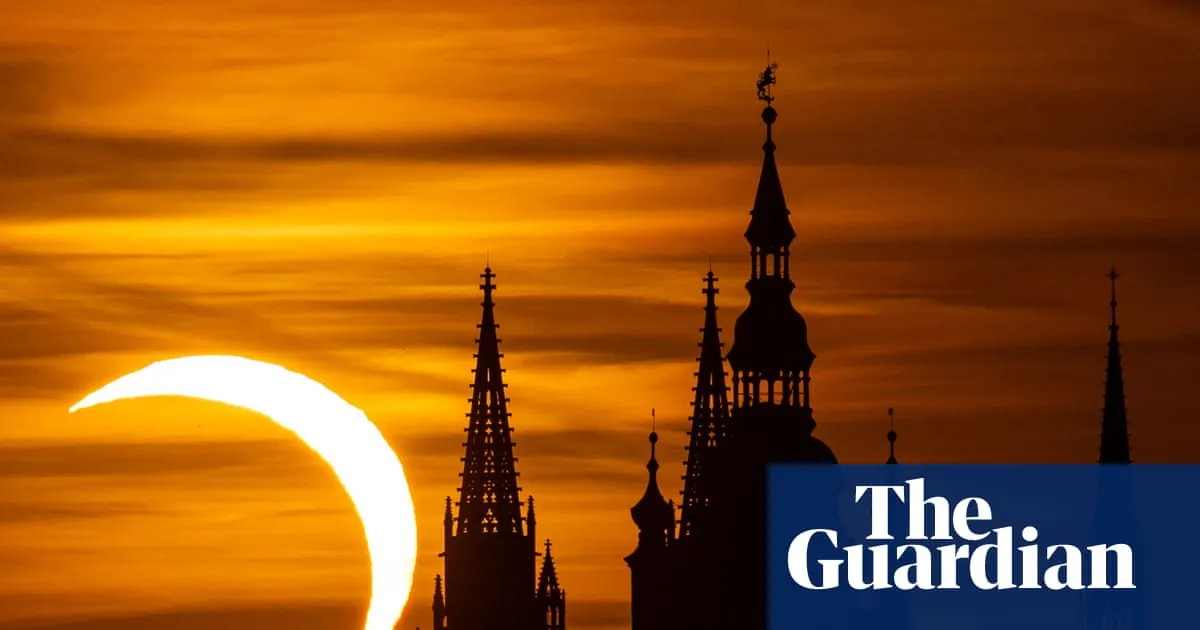
It was a moment of awe shared by millions across Europe: an eclipse that blocked out the sun, plunging parts of the continent into a daytime darkness in which temperatures dropped and birds suddenly went quiet.Wednesday’s eclipse began in Russia’s remote Arctic north, going on to trace an arc over much of western Europe. From the UK to northern Italy, tens of millions of people turned to the sky as the light of the setting sun was almost completely blocked out.The most sought-after experiences were in Greenland, Iceland and Spain along with a small strip of Portugal. It was in parts of these countries that totality – referring to when the moon completely covers the sun’s light – was on offer, drawing millions of local people and thousands of tourists from across the globe into the path of the eclipse.“It was one of the most beautiful things I’ve ever seen in my life,” Sara García Alonso, a reserve astronaut for the European Space Agency, told broadcaster RTVE. “It gave me goosebumps.”Standing next to her, the astronaut Pablo Álvarez Fernández nodded in agreement: “It had been described to me so many times, but it was much more beautiful than what I had expected.”In Iceland, people flocked by air, land and sea to take in the country’s first total solar eclipse in 72 years. Amid concerns that clouds would block the view, a record 31 cruise ships plied the waters off the western part of the country, hoping to secure a top view for about 53,000 passengers and crew.The sun during a partial solar eclipse and partially obscured by clouds, the International Space Station silhouetted as it transits at roughly five miles per second. Photograph: Nasa Handout/EPAPeople gather to observe the total solar eclipse, as clouds cover the sky, in Reykjavik Photograph: Denis Balibouse/ReutersPassengers on board the Ambassador cruise ship Ambition watching the start of the total solar eclipse off the coast of Greenland Photograph: Owen Humphreys/PA The sun during a partial solar eclipse and partially obscured by clouds, the International Space Station silhouetted as it transits at roughly five miles per second. Photograph: Nasa Handout/EPA The eclipse-themed activities included a day-long music festival hosted by the Icelandic artist Björk in Víðistaðatún park, offering a DJ-curated backdrop as people took in the eclipse. The 10-hour set list included two minutes set aside for totality, the artist said on social media, while the festival website noted that every ticket included a pair of approved solar eclipse glasses.Those watching from Iceland included the US space agency, Nasa, which followed the moon’s shadow using a high-altitude WB-57 aircraft while Nasa-funded teams launched balloons to study the atmospheric impact of the sudden darkness and cooling.A WB-57 Canberra aircraft is pictured during a media visit ahead of a Nasa-supported mission Photograph: Denis Balibouse/ReutersCary Klemm, sensor equipment operator, and pilot John Gustine of Nasa’s Johnson Space Centre pose in front of a WB-57 Canberra aircraft Photograph: Denis Balibouse/ReutersA WB-57 Canberra aircraft Photograph: Denis Balibouse/ReutersA gyroscopic sensor system aboard a WB-57 Canberra aircraft Photograph: Denis Balibouse/Reuters Cary Klemm, sensor equipment operator, and pilot John Gustine of Nasa’s Johnson Space Centre pose in front of a WB-57 Canberra aircraft Photograph: Denis Balibouse/Reuters In Spain, where some of the best views of the total eclipse were expected, the hours leading up to the celestial alignment were filled with frenzied debate about weather forecasts and where best to watch the phenomenon.More than 450,000 tourists had arrived in the country from as far as Canada and Australia, crisscrossing Spain by train, bus and caravan to stake out the perfect viewing spot.The sun’s corona glows as the moon completely blocks the sun during the totality phase of the total solar eclipse as seen from San Asensio, La Rioja region, Spain Photograph: Ander Gillenea/AFP/Getty ImagesPeople wait for a solar eclipse at the beach in A Coruña, Spain Photograph: Lavandeira/EPAA beachgoer wearing special eclipse glasses looks up during the beginning phase of a solar eclipse at Puerto de Sagunto beach near Valencia, Spain Photograph: Alberto Saiz/APThe sun’s corona glows as the moon completely blocks the sun during the totality phase of the total solar eclipse as seen from Arenal beach in Llucmajor, on the Balearic island of Mallorca Photograph: Jaime Reina/AFP/Getty Images People wait for a solar eclipse at the beach in A Coruña, Spain Photograph: Lavandeira/EPA “Our car was cancelled,” one woman, who had travelled from Brazil with her sister to take in the eclipse, said on social media. After her appeals to hitch a ride to their chosen site were met with no response, they took matters into their own hands. “So we took a three-hour bus, a 20-minute taxi and two-hour hike. Arrived at the location!”About 10,000 metres above sea level, the Spanish airline Iberia livestreamed the moment when the sun, moon and Earth aligned from a special charter flight. “Some flights take us to new destinations. Others allow us to see the world from a different perspective,” the airline said as it announced the charter flight.Spanish officials estimated that as many as 6 million people were expected to flock to the path of the eclipse, which stretched about 124 miles (200km) from A Coruña in Spain’s north-west to the Mediterranean island of Mallorca. On Wednesday, just hours before the eclipse, officials reported traffic jams on the major thoroughfares out of Madrid and Barcelona.Others took their chances in the cities. In Madrid’s Parque del Oeste, hundreds gathered in hopes of catching a good view of the eclipse, cheering as they watched the moon cover the sun – plunging the park into darkness – and gasping as the outer corona left a glowing halo around the moon. Just over a minute later, when daylight returned to the park, the crowd burst into raucous cheers.It was, in the words of César González, an astronomer and science communicator at the Madrid Planetarium, “a spectacular experience”. He had left Madrid early in the morning to set himself up in a field in northern Spain to watch the eclipse. “Until one goes and experiences it, there’s no way to explain what it is to see an eclipse.”Mario Garrido, a member of the Los Taraos amateur astrophotography group, waits to shoot a total solar eclipse in Berlanga de Duero, central Spain Photograph: Bernat Armangué/APThe moon completely covers the sun during a total solar eclipse as seen from the Javalambre Astrophysical Observatory in Arcos de las Salinas, near Teruel, Spain Photograph: Christian Hartmann/ReutersArtists use self-made artefacts to observe a solar eclipse before totality near the small village of Castell de Cabres, Spain Photograph: Eva Manez/ReutersA composite image of seven separate photographs taken with a single fixed camera shows stages of a solar eclipse before, during and after totality, as seen from Arija, Spain Photograph: Borja Suárez/Reuters The moon completely covers the sun during a total solar eclipse as seen from the Javalambre Astrophysical Observatory in Arcos de las Salinas, near Teruel, Spain Photograph: Christian Hartmann/Reuters He was able, however, to explain the impact. “In broad daylight, all of a sudden the light dims to a point where you can see the brightest stars in the sky. When totality starts, the temperature drops several degrees. If you’re in a field and surrounded by animals, their behaviour often changes. The birds stop singing because they think it’s nightfall. And all of this lasts for a few minutes – in this case around 1 minute and 45 seconds.”In Spain, most eclipse watchers were heading to rural areas, filling often quiet villages and towns clogged with skygazing tourists. The eclipse had helped put some parts of “empty Spain” on the map; this week people linked to Nasa turn up in northern Spain’s Villalibado to set up a live broadcast for millions of people around the world, breathing new life into a municipality whose last two residents left in 1998.Throughout human history, eclipses have sparked amazement, fear and reverence. In villages and cities across Europe, the eclipse forged ad hoc communities, as people came together to witness one of nature’s great wonders.In Camberwell, south London, an impromptu crowd of all ages gathered in Brunswick Park to experiment with different methods of seeing the eclipse, which reached 92% totality. Some held up colanders, others a spatula with holes, still others makeshift pinhole cameras made of old candy boxes.Ludmila, a Ukrainian woman in her 70s, said she had worked at an observatory in Crimea for 30 years. “What a surprise to find an actual refractor,” she said, pointing to a telescope with a solar filter taped on the end brought out by a resident. “It’s like a wonderful gift.”Later, as the eclipse passed its zenith and the sun began to set for real, dozens of neighbours who had never previously spoken to each other stayed on picnic blankets to drink beer and swap photos.
SRCThe Guardian - World News
LANGEN
LEANCenter-Left
WORDS1 467
ENT12
WED · 2026-08-12 · 19:56 GMTBRIEF NSR-2026-0812-101702
NSR-2026-0812-101702News Report·EN·Human Interest
Cruise ships, quiet towns and an all-day festival: millions flock to eclipse viewing spots across Europe
Millions across Europe witnessed a total solar eclipse that began in Russia's Arctic north and traced an arc over western Europe. The best viewing locations, offering totality, were in Greenland, Iceland, and Spain, attracting significant local and international crowds.
Ashifa Kassam in Madrid, Miranda Bryant and Chris Michael in LondonThe Guardian - World NewsFiled 2026-08-12 · 19:56 GMTLean · Center-LeftRead · 6 min
The Guardian - World NewsFIG 01
Reading time
6min
Word count
1 467words
Sources cited
5cited
Entities identified
12entities
Quality score
100%
§ 01
Briefing Summary
AI-generatedNEWSAR · AI
Millions across Europe witnessed a total solar eclipse that began in Russia's Arctic north and traced an arc over western Europe. The best viewing locations, offering totality, were in Greenland, Iceland, and Spain, attracting significant local and international crowds. In Iceland, a record 31 cruise ships carried thousands to observe the event, which was accompanied by an eclipse-themed music festival. Spain saw over 450,000 tourists arrive to find optimal viewing spots, with some travelers undertaking lengthy journeys. NASA also participated, using high-altitude aircraft and balloons to study the eclipse's atmospheric effects. The eclipse caused a noticeable drop in temperature and a temporary silence among birds in affected areas.
Confidence 0.90Sources 5Claims 5Entities 12
§ 02
Article analysis
Model · rule-basedFraming
Human Interest
Technology
Tone
Measured
AI-assessed
CalmNeutralAlarmist
Factuality
0.80 / 1.00
Factual
LowHigh
Sources cited
5
Well sourced
FewMany
§ 03
Key claims
5 extracted01
Nasa used a high-altitude WB-57 aircraft and launched balloons to study the eclipse's atmospheric impact.
factualNasa
Confidence
1.00
02
Sara García Alonso, an ESA reserve astronaut, described the eclipse as 'one of the most beautiful things I’ve ever seen'.
quoteSara García Alonso
Confidence
1.00
03
The eclipse path included Greenland, Iceland, and Spain, drawing locals and tourists for totality.
factual
Confidence
1.00
04
Millions across Europe witnessed a solar eclipse that caused daytime darkness and temperature drops.
factual
Confidence
1.00
05
A record 31 cruise ships were off Iceland's coast to view the eclipse, carrying approximately 53,000 passengers and crew.
statistic
Confidence
0.90
§ 04
Full report
6 min read · 1 467 words§ 05
Entities
12 identifiedKey playerOppositionContextPositiveNeutralNegative
Organizations1
§ 06
Keywords & salience
10 termssolar eclipse
1.00
totality
0.90
eclipse viewing
0.80
cruise ships
0.70
europe
0.60
spain
0.50
iceland
0.50
greenland
0.50
music festival
0.40
astronomy
0.40
§ 07
Topic connections
Interactive graph Network visualization showing 51 related topics
View Full Graph Person Organization Location Event|Click node to navigate|Edge numbers = shared articles