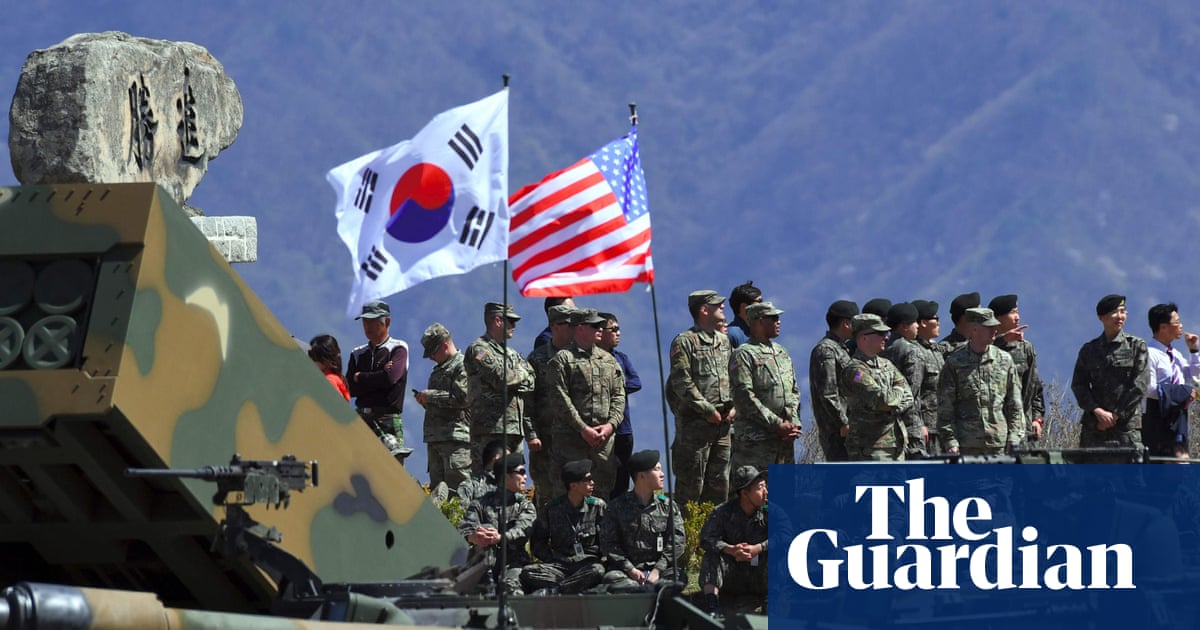
The Pentagon foresees a “more limited” role in deterring North Korea, with South Korea taking primary responsibility for the task, a Pentagon policy document released on Friday said, in a move likely to raise concern in Seoul.South Korea hosts about 28,500 US troops in combined defence against North Korea’s military threat and Seoul has raised its defence budget by 7.5% for this year.“South Korea is capable of taking primary responsibility for deterring North Korea with critical but more limited US support,” said the National Defense Strategy, a document that guides the Pentagon’s policies.“This shift in the balance of responsibility is consistent with America’s interest in updating US force posture on the Korean peninsula,” the document added. In recent years, some US officials have signalled a desire to make US forces in South Korea more flexible to operate outside the Korean peninsula in response to a broader range of threats, such as defending Taiwan and checking China’s growing military reach.South Korea has resisted the idea of shifting the role of US troops, but has worked to grow its defence capabilities in the past 20 years, to take on a wartime command of the combined US-South Korean forces. South Korea has 450,000 troops.The shift is part of what Washington has called “alliance modernisation” under the Trump administration. South Korean president Lee Jae Myung has himself pushed for greater defence autonomy, criticising in September what he called “the submissive mindset that self-reliant defence is impossible without foreign troops”.In a statement on Saturday, South Korea’s defence ministry said US Forces in Korea remained central to the alliance and would continue to deter North Korean aggression.The Pentagon document makes no mention of denuclearising the Korean peninsula, the second major strategy paper to omit the language. The Biden administration in 2022 explicitly stated “complete and verifiable denuclearisation” as a goal, suggesting Washington may be shifting towards managing North Korea’s nuclear arsenal rather than seeking its elimination.The wide-ranging document, which each new administration publishes, said the Pentagon’s priority was defending the homeland. In the Indo-Pacific region, the document said, the Pentagon was focused on ensuring China could not dominate the US or its allies.“This does not require regime change or some other existential struggle. Rather, a decent peace, on terms favourable to Americans but that China can also accept and live under, is possible,” the document said, without mentioning Taiwan by name in the roughly 25-page document.China claims democratically governed Taiwan as its own territory and has not ruled out the use of force to take control of the island. Taiwan rejects Beijing’s sovereignty claims and says only the people of Taiwan can decide their future.With Reuters
SRCThe Guardian - World News
LANGEN
LEANCenter-Left
WORDS440
ENT11
SAT · 2026-01-24 · 06:18 GMTBRIEF NSR-2026-0124-10173
NSR-2026-0124-10173News Report·EN·National Security
Pentagon to reduce its role in deterrence of North Korea
A new Pentagon policy document indicates a planned reduction in the U.S. role in deterring North Korea, shifting primary responsibility to South Korea.
Raphael Rashid and agenciesThe Guardian - World NewsFiled 2026-01-24 · 06:18 GMTLean · Center-LeftRead · 2 min
The Guardian - World NewsFIG 01
Reading time
2min
Word count
440words
Sources cited
3cited
Entities identified
11entities
Quality score
100%
§ 01
Briefing Summary
AI-generatedNEWSAR · AI
A new Pentagon policy document indicates a planned reduction in the U.S. role in deterring North Korea, shifting primary responsibility to South Korea. This move, outlined in the National Defense Strategy, reflects a desire to update the U.S. force posture on the Korean Peninsula and potentially allow U.S. forces to address broader regional threats, such as China. While South Korea has increased its defense capabilities and seeks greater autonomy, it maintains that U.S. forces remain central to deterring North Korean aggression. The document notably omits any mention of denuclearizing the Korean peninsula, suggesting a possible shift in U.S. strategy towards managing, rather than eliminating, North Korea's nuclear arsenal. The Pentagon's priority is defending the homeland and ensuring China cannot dominate the U.S. or its allies in the Indo-Pacific region.
Confidence 0.90Sources 3Claims 5Entities 11
§ 02
Article analysis
Model · rule-basedFraming
National Security
Political Strategy
Tone
Measured
AI-assessed
CalmNeutralAlarmist
Factuality
0.80 / 1.00
Factual
LowHigh
Sources cited
3
Well sourced
FewMany
§ 03
Key claims
5 extracted01
US Forces in Korea remained central to the alliance and would continue to deter North Korean aggression.
quoteSouth Korea’s defence ministry
Confidence
1.00
02
South Korea has 450,000 troops.
statistic
Confidence
1.00
03
South Korea has raised its defence budget by 7.5% for this year.
statistic
Confidence
1.00
04
South Korea hosts about 28,500 US troops.
statistic
Confidence
1.00
05
The Pentagon foresees a “more limited” role in deterring North Korea.
factualPentagon policy document
Confidence
1.00
§ 04
Full report
2 min read · 440 words§ 05
Entities
11 identifiedKey playerOppositionContextPositiveNeutralNegative
Organizations4
§ 06
Keywords & salience
10 termsnorth korea
1.00
south korea
0.90
deterrence
0.90
us troops
0.80
defense capabilities
0.70
denuclearisation
0.60
alliance modernisation
0.60
china
0.50
pentagon
0.50
military threat
0.40
§ 07
Topic connections
Interactive graph Network visualization showing 51 related topics
View Full Graph Person Organization Location Event|Click node to navigate|Edge numbers = shared articles