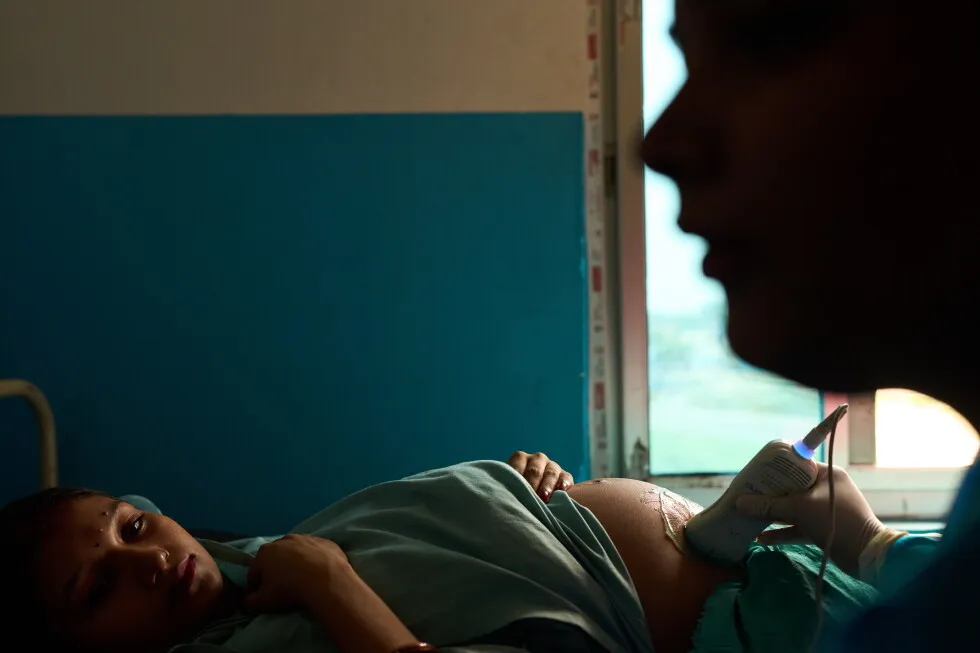
What to know from AP’s report about pregnant women and babies dying in Nepal amid USAID cuts 1 of 5 | Anita Gupta, 20, receives an ultrasound in Gaur, Nepal, on May 20, 2026. (AP Photo/Bram Janssen) 2 of 5 | Lachhiya Devi sits with her 5-year-old granddaughter, Sonam Mukhiya, in her home in Gaur, Nepal, on May 19, 2026. Sonam’s mother, Kabita Mukhiya, died in December while 28-weeks pregnant amid disruptions to nutrition programs and reproductive outreach services following last year’s foreign aid cuts by the United States. (AP Photo/Bram Janssen) 3 of 5 | A photo of Kabita Mukhiya, who died during pregnancy, is displayed on a phone on May 19, 2026, in Gaur, Nepal. (AP Photo/Bram Janssen) 4 of 5 | A woman receives an examination from a doctor inside a clinic in Gaur, Nepal, on May 20, 2026. (AP Photo/Bram Janssen) 5 of 5 | Children play in Gaur, Nepal, on May 19, 2026. (AP Photo/Bram Janssen) By KRISTEN GELINEAU Updated 6:42 AM MESZ, August 13, 2026 Add AP News on Google Add AP News as your preferred source to see more of our stories on Google. Share Share Facebook Copy Link copied Print Email X LinkedIn Bluesky Flipboard Pinterest Reddit Gaur, Nepal (AP) — The United States’ decision to slash its foreign aid program has led to an increase in deaths of pregnant women and babies in Nepal, The Associated Press has found. The decision by U.S. President Donald Trump’s administration to eliminate the United States Agency for International Development last year gutted maternal and child health programs worldwide. In Nepal, the funding cuts led to the closure of nutrition and reproductive outreach programs designed to save mothers’ and babies’ lives. The U.S. State Department says it still supports programs in Nepal aimed at improving maternal and child health. But health workers, government officials, aid workers and families in Nepal say the funding cuts have had a devastating and deadly impact on pregnant women and babies. Here’s what to know from AP’s report on the fallout of the funding cuts: The decision by the Trump administration to dissolve USAID — once the world’s largest humanitarian donor — decimated nutrition programs for millions of pregnant women and children and left scores of birthing centers devoid of equipment, medicine and staff. The U.S. cuts, followed by foreign aid cuts from several other countries, forced 60 percent of women’s organizations to reduce their services, according to the World Health Organization. USAID fallout: In Nepal, when the aid workers stopped coming, the women and babies started dying 13 MIN READ What a reporter learned covering the impact of USAID cuts on aid workers-turned-sex workers in Nepal 1 MIN READ Sex work or starve: Aid workers in Nepal left jobless by USAID cuts turn to sex work to survive 1 MIN READ In Nepal, the funding cuts eliminated nutrition programs that provided supplements and food items to impoverished pregnant women, and closed a program that equipped birthing centers and trained nurses, midwives and outreach workers. Those workers regularly visited pregnant women’s homes, explained the warning signs of complications and urged them to attend prenatal appointments, often escorting them there. That program reached 100,000 women and girls across Nepal in its first three years. Because of cuts by the U.S. and other countries to foreign aid, the Gates Foundation has predicted that 2025 will be the first year this century where child deaths will increase. In Nepal, the program closures meant many pregnant women have found it difficult to adequately feed themselves, and left them to navigate a medical system they struggle to trust or understand. As a result, pregnant women aren’t identifying complications fast enough, leading to emergencies, health workers and government officials say. “The number of deaths of mothers, young mothers, during delivery has really increased,” says Mona Sherpa, country director for the aid group CARE Nepal, which lost more than half its funding from the U.S. cuts. “The expected number within a year is happening within four to six months.” Babies, too, have increasingly died since the program closures. In the village of Prempur Gonahi, for example, it took just 10 months — a touch longer than a typical pregnancy — for newborns to begin dying again after the U.S. cuts, says the officer in charge, Sadho Baitha. Before CARE’s program launched in Rautahat in December 2022, Baitha says, the village averaged 10 to 15 neonatal deaths per year. By 2024, records show, there were zero. But since the program’s cancelation, newborns have begun dying again; the first was in December, and four more followed by March. Yet many deaths linked to the funding cuts will remain invisible, in part because the cuts themselves left scores of mortality data collectors jobless. In some places, there is simply no one left to count people who died. Most of the women helped by these canceled programs are poor, uneducated and isolated. Even if they make it to a doctor, they often struggle to understand what the doctor is saying. The outreach workers who operated under CARE’s program would frequently visit pregnant women’s homes, escort them to prenatal appointments and act as a mediator between the women and their doctors to ensure nothing was lost in translation. Kabita Mukhiya, for example, was a 20-year-old uneducated woman living in a poor village near the India border. When she was pregnant, she experienced excruciating stomach pains, severe swelling and delirium. She was also starving; the U.S.-funded nutrition supplements and food she received in a previous pregnancy had been eliminated by the funding cuts. And the outreach workers who once visited her village to help pregnant women had stopped coming. Not realizing her symptoms constituted an emergency, Mukhiya suffered at home for weeks before her aunt took her to the hospital. By then, it was too late: Both she and her unborn baby died. Mukhiya died from complications of eclampsia, with severe anemia contributing significantly -- both conditions that can often be identified and managed through regular prenatal care, health workers say. Rajkumari Patel, who worked as an outreach worker under CARE’s canceled program, says deaths like Mukhiya’s were precisely what she and her colleagues had been trained to prevent. “I would have asked her, ‘Is the baby kicking? When did you last feel movement?’ I would have checked for swelling in her hands and face. I would have looked at her eyes for signs of anemia,” Patel says. “These are the signs I would have noticed in Kabita and said, ‘This woman needs a hospital today -- not tomorrow.’ Maybe we could have saved her life.” KRISTEN GELINEAU Gelineau is a global investigative reporter for The Associated Press, based in Sydney. She covers human rights issues across the Asia-Pacific. twitter mailto
SRCAssociated Press (AP)
LANGEN
LEANCenter
WORDS1 128
ENT12
THU · 2026-08-13 · 04:53 GMTBRIEF NSR-2026-0813-101818
NSR-2026-0813-101818News Report·EN·Public Health
What to know from AP’s report about pregnant women and babies dying in Nepal amid USAID cuts
A report by The Associated Press details a rise in maternal and infant deaths in Nepal following the U.S. administration's decision to slash foreign aid and eliminate USAID programs.
Associated Press (AP)Filed 2026-08-13 · 04:53 GMTLean · CenterRead · 5 min
Associated Press (AP)FIG 01
Reading time
5min
Word count
1 128words
Sources cited
5cited
Entities identified
12entities
Quality score
100%
§ 01
Briefing Summary
AI-generatedNEWSAR · AI
A report by The Associated Press details a rise in maternal and infant deaths in Nepal following the U.S. administration's decision to slash foreign aid and eliminate USAID programs. These cuts led to the closure of vital nutrition and reproductive outreach services that previously supported impoverished pregnant women and provided essential training and equipment for birthing centers. Health workers, officials, and families in Nepal report devastating and deadly consequences, including increased maternal mortality rates and newborn deaths, with many deaths going uncounted due to the loss of data collectors. The article highlights the plight of vulnerable women who now struggle to access adequate care and identify complications, leading to preventable tragedies.
Confidence 0.90Sources 5Claims 5Entities 12
§ 02
Article analysis
Model · rule-basedFraming
Public Health
Human Interest
Tone
Mixed Tone
AI-assessed
CalmNeutralAlarmist
Factuality
0.70 / 1.00
Factual
LowHigh
Sources cited
5
Well sourced
FewMany
§ 03
Key claims
5 extracted01
In Nepal, funding cuts led to the closure of nutrition and reproductive outreach programs designed to save mothers' and babies' lives.
factualThe Associated Press
Confidence
0.90
02
US foreign aid cuts led to an increase in deaths of pregnant women and babies in Nepal.
factualThe Associated Press
Confidence
0.90
03
Kabita Mukhiya died in December while 28-weeks pregnant amid disruptions to nutrition programs and reproductive outreach services.
factualLachhiya Devi (family member)
Confidence
0.85
04
The Trump administration's decision to eliminate USAID gutted maternal and child health programs worldwide.
factualThe Associated Press
Confidence
0.85
05
Sixty percent of women's organizations in Nepal were forced to reduce their services due to aid cuts.
statisticWorld Health Organization
Confidence
0.80
§ 04
Full report
5 min read · 1 128 words§ 05
Entities
12 identifiedKey playerOppositionContextPositiveNeutralNegative
People4
Organizations3
§ 06
Keywords & salience
10 termsforeign aid cuts
1.00
child health
1.00
maternal health
1.00
usaid
0.90
nepal
0.80
nutrition programs
0.70
reproductive health
0.70
infant mortality
0.60
trump administration
0.50
healthcare access
0.40
§ 07
Topic connections
Interactive graph Network visualization showing 51 related topics
View Full Graph Person Organization Location Event|Click node to navigate|Edge numbers = shared articles