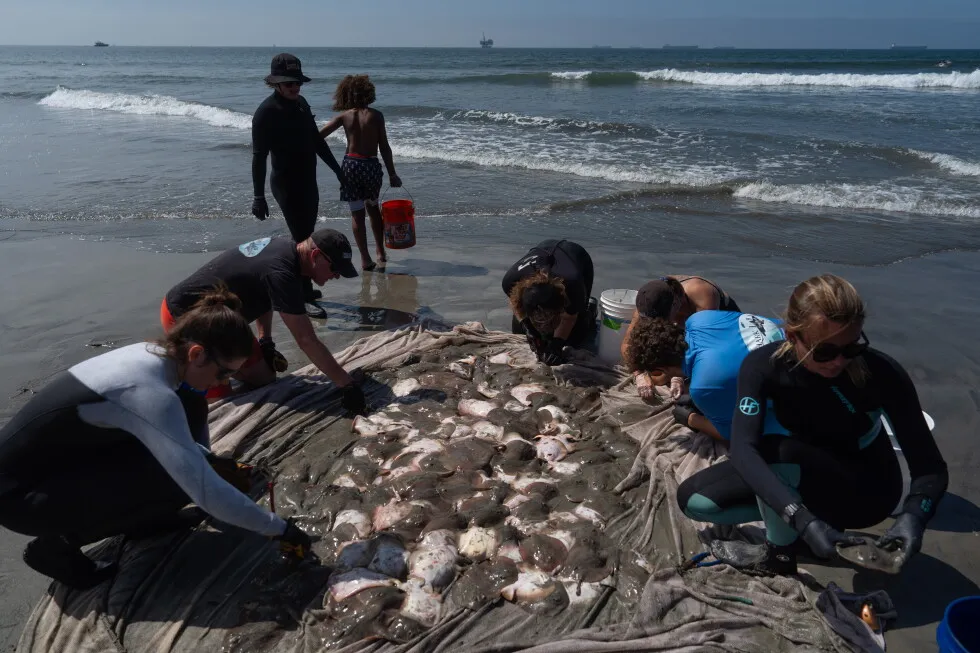
stingray lashings up as marine heat wave off Southern California draws more to shore 1 of 6 | On many beaches in Southern California, stingray incidents have spiked from a year ago thanks to a marine heat wave that has drawn more swimmers and rays to the shore which should only become more frequent due to expected El Niño conditions. (AP Video by Eugene Garcia) 2 of 6 | Researchers gather around a pile of stingrays to clip their barbs after catching them in Seal Beach, Calif., Friday, Aug. 7, 2026. (AP Photo/Jae C. Hong) 3 of 6 | A researcher shows a barb clipped from a stingray in Seal Beach, Calif., Friday, Aug. 7, 2026. (AP Photo/Jae C. Hong) 4 of 6 | Lifeguard Max Voci, center, treats beachgoers for stingray stings at Bolsa Chica State Beach in Huntington Beach, Calif., Friday, July 24, 2026. (AP Photo/Jae C. Hong) 5 of 6 | A beachgoer stands in shallow water at Bolsa Chica State Beach in Huntington Beach, Calif., Friday, July 24, 2026. (AP Photo/Jae C. Hong) 6 of 6 | A stingray warning is displayed at Bolsa Chica State Beach in Huntington Beach, Calif., Friday, July 24, 2026. (AP Photo/Jae C. Hong) 1 of 6 On many beaches in Southern California, stingray incidents have spiked from a year ago thanks to a marine heat wave that has drawn more swimmers and rays to the shore which should only become more frequent due to expected El Niño conditions. (AP Video by Eugene Garcia) Add AP News on Google Add AP News as your preferred source to see more of our stories on Google. Share 2 of 6 | Researchers gather around a pile of stingrays to clip their barbs after catching them in Seal Beach, Calif., Friday, Aug. 7, 2026. (AP Photo/Jae C. Hong) 2 of 6 Researchers gather around a pile of stingrays to clip their barbs after catching them in Seal Beach, Calif., Friday, Aug. 7, 2026. (AP Photo/Jae C. Hong) Add AP News on Google Add AP News as your preferred source to see more of our stories on Google. Share 3 of 6 | A researcher shows a barb clipped from a stingray in Seal Beach, Calif., Friday, Aug. 7, 2026. (AP Photo/Jae C. Hong) 3 of 6 A researcher shows a barb clipped from a stingray in Seal Beach, Calif., Friday, Aug. 7, 2026. (AP Photo/Jae C. Hong) Add AP News on Google Add AP News as your preferred source to see more of our stories on Google. Share 4 of 6 | Lifeguard Max Voci, center, treats beachgoers for stingray stings at Bolsa Chica State Beach in Huntington Beach, Calif., Friday, July 24, 2026. (AP Photo/Jae C. Hong) 4 of 6 Lifeguard Max Voci, center, treats beachgoers for stingray stings at Bolsa Chica State Beach in Huntington Beach, Calif., Friday, July 24, 2026. (AP Photo/Jae C. Hong) Add AP News on Google Add AP News as your preferred source to see more of our stories on Google. Share 5 of 6 | A beachgoer stands in shallow water at Bolsa Chica State Beach in Huntington Beach, Calif., Friday, July 24, 2026. (AP Photo/Jae C. Hong) 5 of 6 A beachgoer stands in shallow water at Bolsa Chica State Beach in Huntington Beach, Calif., Friday, July 24, 2026. (AP Photo/Jae C. Hong) Add AP News on Google Add AP News as your preferred source to see more of our stories on Google. Share 6 of 6 | A stingray warning is displayed at Bolsa Chica State Beach in Huntington Beach, Calif., Friday, July 24, 2026. (AP Photo/Jae C. Hong) 6 of 6 A stingray warning is displayed at Bolsa Chica State Beach in Huntington Beach, Calif., Friday, July 24, 2026. (AP Photo/Jae C. Hong) Add AP News on Google Add AP News as your preferred source to see more of our stories on Google. Share Updated [hour]:[minute] [AMPM] [timezone], [monthFull] [day], [year] Huntington Beach, Calif. (AP) — Jake Hemann grabbed a board and headed out to surf. But an hour later, he wound up sitting at the lifeguard station soaking his foot in a pail of hot water alongside four other beachgoers.It is a common scene at Bolsa Chica State Beach and some other popular beaches in Southern California where the number of people being hit by the sharp, serrated caudal barbs found on the tails of stingrays has gone up significantly from a year ago as a marine heat wave draws more stingrays — and people — to shore. Hemann, a 31-year-old tourist from New Mexico, said he was learning to surf when he hopped off his board and landed on what he thought was a sharp stick. “It hurt pretty bad,” he said, while sinking his throbbing foot into the hottest water tolerable to ease the pain. “It was radiating up to my ankle.”Bolsa Chica and Huntington State Beaches reported more than 3,100 incidents so far this year, twice the number for all of 2025. The city of Huntington Beach’s 3.5-mile (5.6 kilometer) stretch of shoreline has reported more than 2,000 such incidents so far this year, more than during all last year, while more than 900 stings were recorded on San Diego’s beaches during the first half of 2026, more than during the first six months of any of the past five years, lifeguard data shows. “We’re definitely seeing an increase,” said Bryan R. Etnyre, state park superintendent in northern Orange County. “A lot of it is due to warming ocean temperatures that are consistently staying in the 60s. I don’t think there was a week all winter where we dropped below 60 this year.” Warmer water draws rays and peopleRound stingrays are found in Pacific Ocean waters from Panama to Southern California and are known to veer toward the shore when the swell is down and the water warm. In recent years, many species that feed on rays, such as sharks, sea lions and giant sea bass, have seen their populations dwindle, causing the number of stingrays to grow, said Chris Lowe, professor of marine biology and director of the Shark Lab at California State University, Long Beach. 1 MIN READ 2 MIN READ 1 MIN READ Rays are known to prefer warmer water, such as lagoons. Females prefer these waters to reproduce, and during the summer male rays have a higher metabolism that drives them to seek out food in the invertebrates along the shore, Lowe said.“They’re really a subtropical species that is thriving at the end of its range because of climate change,” Lowe said. The ocean already has been warming because of human-caused climate change, according to meteorologists. This year has seen even more rays with a marine heat wave persisting off parts of the West Coast, marking the third time on record that such a large section of coastal waters stayed warm for so long, according to the U.S. National Oceanic and Atmospheric Administration. In June, officials confirmed the formation of an El Niño, the natural warming of parts of the central Pacific that alters weather worldwide, that is expected to grow to historic strength.Meanwhile, more people have been heading to beaches seeking outdoor recreation since the coronavirus pandemic. And when the water is warm, they are more likely to swim.When rays are stepped on, they instinctively flick up their tails, stinging people with venomous barbs. Lifeguards urge bathers to shuffle their feet as they enter the water as the movement often gets rays to slide out of the way without stinging. In Southern California, lifeguards can treat 10,000 stingray injuries a year, Lowe said.In Seal Beach, one area draws so many due to an influx of warm water from a nearby power plant it is known as “ray bay,” though lifeguards there haven’t seen much change in stings this year.Using a 75-foot-long net, researchers swept up some 200 stingrays, each about the size of a dinner plate, on a section of the beach on a recent morning.“There can be so many that they actually carpet the bottom, like you can’t see sand,” Lowe said. “During El Niños, we get more of them up from the south, and they come closer to shore. So this year, we’re expecting record numbers.” Sting advisory and booties aim to helpLowe said he is working with television stations to develop a stingray advisory to help reduce the number of people who get stung, and the number of rays that get squished. Rays help keep the beach healthy by feeding on small clams and aerating sediment.Many beaches use an app to notify bathers when there are multiple stings at a location. Meanwhile, a company has developed surf booties that claim to be barb-resistant — though swimmers are urged to still tread lightly to avoid trampling the rays.At Bolsa Chica State Beach, swimmers suffering stings to the sides of their feet and toes sat in a circle refilling their pails with hot water from a hose. Some were there more than an hour waiting for the pain to ease.Most stings don’t require additional medical attention. If redness and swelling continue more than four or five days, there could be a medical complication such as an infection or a retained barb that can be seen on an X-ray, said Dr. Christanne Coffey, who researches the stings at University of California, San Diego Health.Allen Lowry said he was playing with his 7-year-old grandson when he came down on something squishy. He lifted his foot and saw blood so his wife drove him to the lifeguard station for a hot water soak, which is the remedy for stings. Lowry, 69, said he swims three times a week at another beach, and getting stung, though painful, won’t change that. He said some people in his swim group have been stung multiple times.“Usually, once the pain you feel goes away, you feel fine the next day,” he said. Taxin writes about food, farming and water in California for The Associated Press. She covers coastal issues and general news from California’s Orange County.
SRCAssociated Press (AP)
LANGEN
LEANCenter
WORDS1 674
ENT11
THU · 2026-08-13 · 04:23 GMTBRIEF NSR-2026-0813-101820
NSR-2026-0813-101820News Report·EN·Public Health
Stingray lashings up as marine heat wave off Southern California draws more to shore
Southern California beaches are experiencing a significant increase in stingray incidents due to a persistent marine heat wave. Warmer ocean temperatures are drawing more stingrays closer to shore, coinciding with increased beach attendance.
By
AMY TAXINAssociated Press (AP)Filed 2026-08-13 · 04:23 GMTLean · CenterRead · 7 min
Associated Press (AP)FIG 01
Reading time
7min
Word count
1 674words
Sources cited
1cited
Entities identified
11entities
Quality score
100%
§ 01
Briefing Summary
AI-generatedNEWSAR · AI
Southern California beaches are experiencing a significant increase in stingray incidents due to a persistent marine heat wave. Warmer ocean temperatures are drawing more stingrays closer to shore, coinciding with increased beach attendance. Lifeguard data indicates a doubling of incidents at Bolsa Chica and Huntington State Beaches compared to last year, with San Diego also reporting a five-year high. Researchers attribute the rise in stingray populations partly to dwindling predator numbers. Lifeguards are advising beachgoers to shuffle their feet when entering the water to avoid stepping on the rays, and advisories and specialized booties are being developed to mitigate stings.
Confidence 0.90Sources 1Claims 5Entities 11
§ 02
Article analysis
Model · rule-basedFraming
Public Health
Environmental
Tone
Measured
AI-assessed
CalmNeutralAlarmist
Factuality
0.70 / 1.00
Factual
LowHigh
Sources cited
1
Limited
FewMany
§ 03
Key claims
5 extracted01
Lifeguards are treating beachgoers for stingray stings at Bolsa Chica State Beach.
factual
Confidence
1.00
02
Researchers are clipping stingray barbs in Seal Beach, California.
factual
Confidence
1.00
03
A marine heat wave has drawn more swimmers and stingrays to the shore.
factual
Confidence
0.90
04
Stingray incidents have spiked in Southern California compared to a year ago.
factual
Confidence
0.90
05
Stingray incidents are expected to become more frequent due to anticipated El Niño conditions.
prediction
Confidence
0.70
§ 04
Full report
7 min read · 1 674 words§ 05
Entities
11 identifiedKey playerOppositionContextPositiveNeutralNegative
Organizations1
Locations4
Events1
§ 06
Keywords & salience
9 termsstingray incidents
1.00
marine heat wave
0.90
southern california
0.80
el niño conditions
0.70
stingray barbs
0.60
beachgoers
0.50
swimmers
0.40
seal beach
0.40
bolsa chica state beach
0.40
§ 07
Topic connections
Interactive graph Network visualization showing 7 related topics
View Full Graph Person Organization Location Event|Click node to navigate|Edge numbers = shared articles