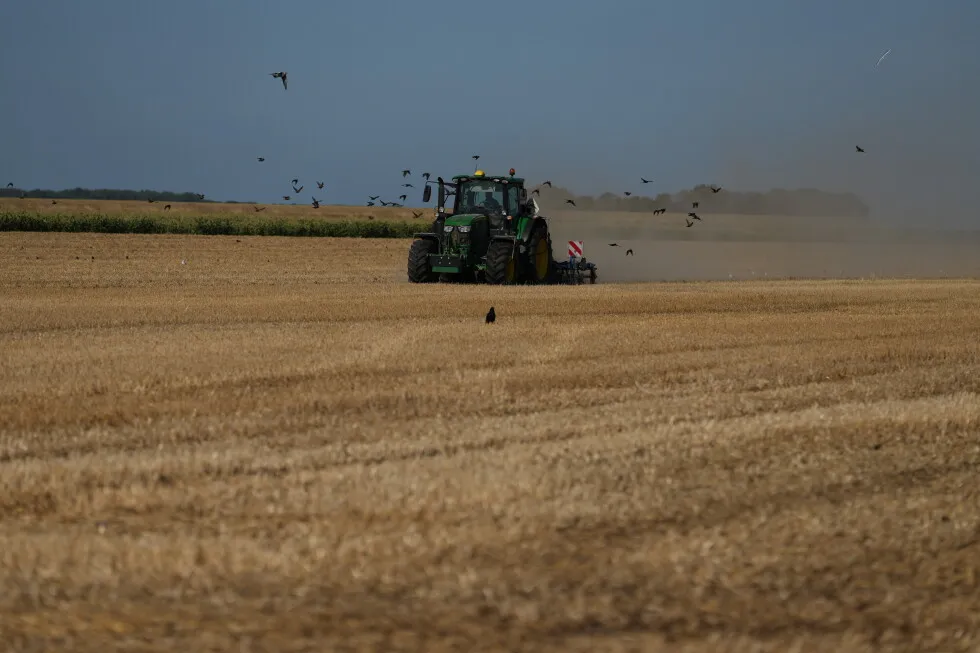
A punishing European Drought shrivels crops from Dutch potatoes to Bosnian corn 0 seconds of 59 secondsVolume 0% Press shift question mark to access a list of keyboard shortcuts Keyboard ShortcutsEnabledDisabled Shortcuts Open/Close/ or ? Play/PauseSPACE Increase Volume↑ Decrease Volume↓ Seek Forward→ Seek Backward← Captions On/Offc Fullscreen/Exit Fullscreenf Mute/Unmutem Decrease Caption Size- Increase Caption Size+ or = Seek %0-9 Next Up GOP Sen. Cassidy says he supports Blanche for attorney general 01:06 00:00 00:59 00:59 More Videos 01:06 GOP Sen. Cassidy says he supports Blanche for attorney general 01:04 GOP Sen. Cassidy says he supports Blanche, likely paving way for AG confirmation 00:30 Todd Blanche is narrowly confirmed as Trump's attorney general in an overnight Senate vote 01:21 Meta 'put profits over children's safety' New Mexico Attorney General says 01:05 Tourists armed with water bottles brave Italy’s extreme heat after dark 01:25 Democrats try to present a united front in Michigan after bitter primary 00:24 Student shoots multiple people at a high school in Thailand, authorities say 01:33 Severe Drought and heat warnings threaten British food production Close 1 of 7 | Burnt corn fields stretch across acres of dry land in north-eastern Bosnia-Herzegovina, where farmers said severe heat and Drought devastated this year’s crop. The country has seen multiple Heat Waves this summer. The most recent heat wave reached its peak across the Balkans Thursday as temperatures neared 40 C (104 F) and authorities battled Drought and Wildfires. (AP Video by Vojislav Stjepanovic and Produced by Radul Radovanovic/ Nadja Lovadinov) More Videos 0 seconds of 1 minute, 33 secondsVolume 90% Press shift question mark to access a list of keyboard shortcuts Keyboard ShortcutsEnabledDisabled Shortcuts Open/Close/ or ? Play/PauseSPACE Increase Volume↑ Decrease Volume↓ Seek Forward→ Seek Backward← Captions On/Offc Fullscreen/Exit Fullscreenf Mute/Unmutem Decrease Caption Size- Increase Caption Size+ or = Seek %0-9 Next Up Severe Heat Waves and Drought devastate Bosnia's corn harvest 00:59 Subtitle Settings OffEnglish(US)_v Font Color White Font Opacity 100% Font Size 100% Font Family Arial Character Edge None Edge Color Black Background Color Black Background Opacity 50% Window Color Black Window Opacity 0% Reset WhiteBlackRedGreenBlueYellowMagentaCyan 100%75%50%25% 200%175%150%125%100%75%50% ArialCourierGeorgiaImpactLucida ConsoleTahomaTimes New RomanTrebuchet MSVerdana NoneRaisedDepressedUniformDrop Shadow WhiteBlackRedGreenBlueYellowMagentaCyan WhiteBlackRedGreenBlueYellowMagentaCyan 100%75%50%25%0% WhiteBlackRedGreenBlueYellowMagentaCyan 100%75%50%25%0% Auto360p1080p720p540p360p270p180p 00:00 01:33 01:33 More Videos Close 2 of 7 | Severe Drought and repeated heat warnings are putting pressure on British food production, with one of the country’s biggest farms watching reservoir levels plummet as it irrigates vegetables for supermarkets and food chains. 3 of 7 | Farmer Maarten Janse drives his tractor on a Drought stricken wheat field in Wolphaartsdijk, Netherlands, Tuesday, Aug. 11, 2026. (AP Photo/Virginia Mayo) 4 of 7 | Farmer Maarten Janse stands next to his tractor on a Drought stricken wheat field in Wolphaartsdijk, Netherlands, Tuesday, Aug. 11, 2026. (AP Photo/Virginia Mayo) 5 of 7 | A potato field affected by the Drought in Poortvliet, Netherlands, Tuesday, Aug. 11, 2026. (AP Photo/Virginia Mayo) 6 of 7 | Farmer Henrik Jan ten Cate stands in his potato field, affected by the Drought, in Poortvliet, Netherlands, Tuesday, Aug. 11, 2026. (AP Photo/Virginia Mayo) 7 of 7 | Farmer Maarten Janse drives his tractor on a Drought stricken wheat field in Wolphaartsdijk, Netherlands, Tuesday, Aug. 11, 2026. (AP Photo/Virginia Mayo) By MIKE CORDER Updated 8:14 AM MESZ, August 13, 2026 Add AP News on Google Add AP News as your preferred source to see more of our stories on Google. Share Share Facebook Copy Link copied Print Email X LinkedIn Bluesky Flipboard Pinterest Reddit WOLPHAARTSDIJK, Netherlands (AP) — A cloud of dust billows behind Maarten Janse’s tractor as he spreads a mixture of compost, straw and manure over a field to nourish the parched soil. Janse’s farm on the fertile land of the Netherlands’ southwestern Zeeland Province is drying out despite his efforts to make it more Drought resistant as accelerated human-caused global warming and a supersized El Nino batter fields across Europe. The Drought that is roasting much of Europe this summer is taking a heavy toll on crops across the continent, from potatoes in the Netherlands to corn in Bosnia and grapes in Italy. Even when farmers try to adapt, the extreme weather is hitting their crops and water supplies. Triodos, a Dutch bank that has a focus on sustainability, published an analysis this week that estimated the heatwaves and Drought could reduce gross domestic product across the European Union by 1% for 2026 or around 180 billion euros ($208 billion). Farmers are among the hardest hit, with their crops set to be badly affected by soaring temperatures and lack of water. In large parts of the Netherlands, farmers are no longer allowed to use water from streams and drainage channels to irrigate fields and orchards. Just add water? Dutch crops suffer from the Drought Another farmer in Zeeland, Hendrik Jan ten Cate, looks at a field full of withered potato plants that are almost all ready for harvest — a month early and with a significantly reduced crop. His potatoes are used to make French fries for companies including McDonald’s, but they’re likely going to be too small this year. Dry, hot summers are putting Dutch dikes at risk and threatening German river trade 2 MIN READ Europe’s hot, dry summer takes its toll with fires in France and Greece, and Drought in the UK 2 MIN READ Record-low Danube River affects tourism and industry as Drought and heat grip Central Europe 2 MIN READ “People want long fries,” he says as he holds one of the potatoes. “That’s going to be tough this year.” Ten Cate is one of the lucky farmers because he is allowed to irrigate his crops. But, even so, he estimates his harvest this year will be down by about one-third compared to average years. “It’s not just the Drought that is the problem,” he says. “It is also the sun, the dry air and especially the hot days we have had this year. The potatoes just can’t handle that combination very well.” Bosnian agriculture, a key driver of the economy, is suffering In Bosnia, where agriculture contributes roughly 5% of annual GDP and 10% of all employment, grain farmer Slavisa Lukic stood in one of his corn fields as stalks blew limply in the breeze. His crops have been hit by repeated Heat Waves and Drought conditions. He said this year’s corn yield would be very poor, if he manages to harvest one at all. Lukic remembers when he grew 6 to 7 tons per hectare on his farm. He expects this year’s corn yield will be around 1.5 to 2 tons per hectare. Pointing to the Drought-stricken land in northeastern Bosnia, Lukic said clover fields that once grew abundantly have all but disappeared. “Now they literally do not exist,” he said. “Nothing.” The Drought is even hitting one of the Czech Republic’s most famous products: beer. Plzeňský Prazdroj, the country’s largest beer producer, expects to incur losses this year due to a stunted hops yield. Jakub Zaoral, the brewer’s sustainability manager, said that changes in rainfall patterns – characterized by long periods of dryness with occasional heavy storms – mean that when rain does fall, it runs off the dry soil. That results in inconsistent yields and increasingly low groundwater levels. “There’s no choice but to simply accept the fact that one year will be great and the next won’t be,” he said. “If it were to happen three times in a row, that could very well become an existential problem for hop growers.” In Romania, some heat and Drought-resistant crops like sunflowers have been less affected by the extreme conditions and yields have been plentiful. But the Drought is still hitting home with record-low water levels on the Danube River disrupting grain transport, causing chronically congested terminals and an increasing pileup of crops with nowhere to go. “In a short time, maximum 10 days, we will enter full blast in sunflower harvest, to be followed by corn,” Cezar Gheorghe, founder of grain consultancy firm Agricolumn, told The Associated Press. “Already farmers are in panic mode. They can’t find a place to store the corn and sunflower seeds.” Cattle grazing plains in Hungary are turning to dust. No rain has fallen on Sándor Molnár’s dairy farm since late May and he is having to buy expensive feed for his 130 cows. “We’re trying to hang in there and hope for the best, hoping next year will be better,” he added. “To be honest, we’ve been saying that for a few years now, but maybe this time it will be.” Huge UK farm that invested in irrigation is feeling the heat Elveden Estate, with more than 10,000 acres of farmland on the Suffolk-Norfolk border in eastern England, has built a reservoir that can hold enough water to fill about 200 Olympic-sized swimming pools. Less than a year after opening, it’s almost dry. Another reservoir is at about 20% capacity. “The fact that we’ve invested significantly in reservoir storage and the infrastructure associated with pumping water has meant that we’ve been in a very strong position to continue to irrigate our crops through this growing season,” the farm’s managing director, Andrew Blenkiron, said. “We’re very concerned that we haven’t got enough water to see us through this season,” Blenkiron said. “We’ve got probably, if this weather stays as it is, six weeks of watering left to do.” Janse uses no-till farming on his fields — not plowing the soil, planting crops to cover the ground year-round and adding organic matter — to help cope with the whims of the weather as climate change triggers more extremes. He has also diversified by running a popular campsite on his farm near the picturesque town of Veere. As he tends to his fields, guests walk by toward a lake where yachts and a river cruise ship sail past. And as dry weather causes an increase in soil salinity in fields, Janse grows samphire, also known as sea asparagus, on a small patch of land. It’s a crop that can thrive in salty conditions. But with no rainfall, even that is struggling this year. “Samphire needs fresh water, and if there is only saltwater it doesn’t grow either,” he said. Nadja Lovadinov in London, Mustakim Hasnath in Suffolk, Stanislav Hodina in Prague, Czech Republic, Justin Spike in Budapest, Hungary, and Stephen McGrath in Leamington Spa, England, contributed to this report. MIKE CORDER Corder is a reporter in the Netherlands who covers international courts in The Hague, Dutch politics, news and sport. He has worked at The AP for more than 30 years, including seven years in Australia covering the Asia-Pacific region. mailto
SRCAssociated Press (AP)
LANGEN
LEANCenter
WORDS1 772
ENT10
THU · 2026-08-13 · 06:23 GMTBRIEF NSR-2026-0813-101848
NSR-2026-0813-101848News Report·EN·Environmental
A punishing European drought shrivels crops from Dutch potatoes to Bosnian corn
A severe drought, exacerbated by human-caused global warming and El Niño, is significantly impacting crops across Europe this summer. Farmers in the Netherlands are experiencing reduced yields of potatoes, while in Bosnia, corn crops are failing.
Associated Press (AP)Filed 2026-08-13 · 06:23 GMTLean · CenterRead · 8 min
Associated Press (AP)FIG 01
Reading time
8min
Word count
1 772words
Sources cited
1cited
Entities identified
10entities
Quality score
100%
§ 01
Briefing Summary
AI-generatedNEWSAR · AI
A severe drought, exacerbated by human-caused global warming and El Niño, is significantly impacting crops across Europe this summer. Farmers in the Netherlands are experiencing reduced yields of potatoes, while in Bosnia, corn crops are failing. The drought is also affecting grape harvests in Italy and hop yields in the Czech Republic, impacting the beer industry. This widespread agricultural crisis is projected to reduce the European Union's GDP by 1% in 2026. Farmers are facing water restrictions and struggling with extreme heat and dry air, leading to early harvests and diminished crop quality. In Romania, record-low water levels on the Danube River are disrupting grain transport, and Hungarian farmers are forced to buy expensive feed for their cattle. Even farms with extensive irrigation systems, like one in the UK, are concerned about water reserves.
Confidence 0.90Sources 1Claims 4Entities 10
§ 02
Article analysis
Model · rule-basedFraming
Environmental
Economic Impact
Tone
Mixed Tone
AI-assessed
CalmNeutralAlarmist
Factuality
0.80 / 1.00
Factual
LowHigh
Sources cited
1
Limited
FewMany
§ 03
Key claims
4 extracted01
Bosnia has seen multiple heat waves this summer, with temperatures nearing 40 C (104 F) during the most recent peak.
factual
Confidence
0.95
02
Severe drought and heat warnings are pressuring British food production, with reservoir levels plummeting at a major farm.
factual
Confidence
0.90
03
A punishing European drought is shriveling crops from Dutch potatoes to Bosnian corn.
factual
Confidence
0.90
04
Farmers in north-eastern Bosnia-Herzegovina reported that severe heat and drought devastated this year's corn crop.
quotefarmers
Confidence
0.85
§ 04
Full report
8 min read · 1 772 words§ 05
Entities
10 identifiedKey playerOppositionContextPositiveNeutralNegative
Locations7
§ 06
Keywords & salience
8 termseuropean drought
1.00
crop shriveling
0.90
heat waves
0.80
food production
0.70
bosnia
0.60
agriculture
0.50
netherlands
0.50
wildfires
0.40
§ 07
Topic connections
Interactive graph Network visualization showing 18 related topics
View Full Graph Person Organization Location Event|Click node to navigate|Edge numbers = shared articles