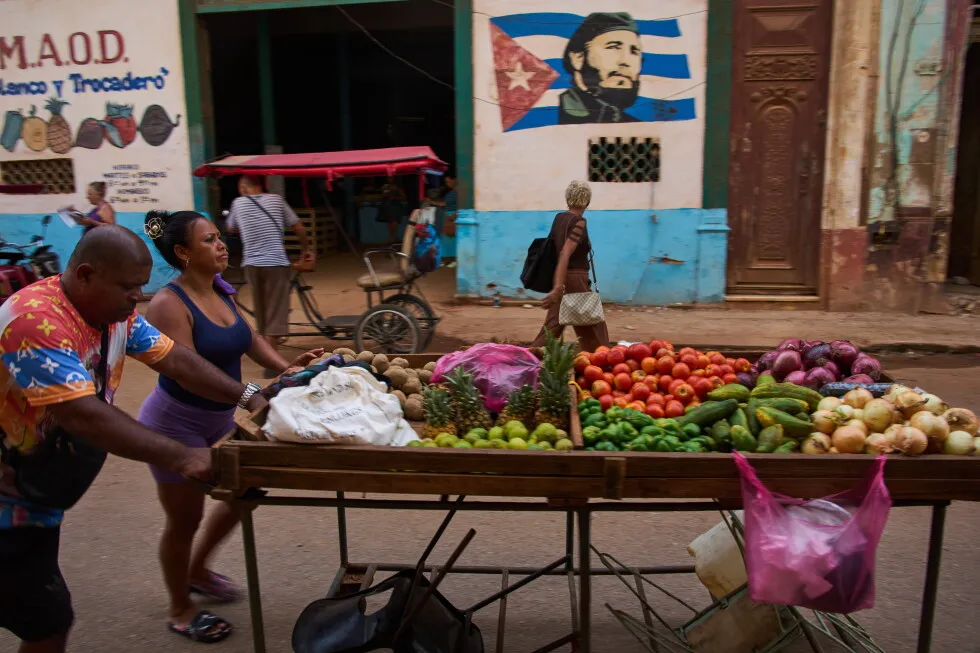
Cuba marks Fidel Castro’s 100th birthday as his shadow still shapes a nation in crisis 0 seconds of 50 secondsVolume 0% Press shift question mark to access a list of keyboard shortcuts Keyboard ShortcutsEnabledDisabled Shortcuts Open/Close/ or ? Play/PauseSPACE Increase Volume↑ Decrease Volume↓ Seek Forward→ Seek Backward← Captions On/Offc Fullscreen/Exit Fullscreenf Mute/Unmutem Decrease Caption Size- Increase Caption Size+ or = Seek %0-9 Next Up Hungary’s Parliament taps András Baka as president as part of Orbán-era purge 00:38 00:00 00:50 00:50 More Videos 00:38 Hungary’s Parliament taps András Baka as president as part of Orbán-era purge 00:54 Trump secretly switched planes via an airport catering truck to leave Ankara 02:06 A 3-story Hoosier cabinet in Indiana celebrates an American kitchen icon 01:22 Progressive Democrats get another win in Minnesota US Senate primary 01:13 Klobuchar pledges to be ‘a transformative governor’ after winning Democratic nomination in Minnesota 01:13 New Zealand Prime Minister Luxon says he survived a leadership vote in his own party 01:20 Addiction drama 'Union County' blurs line between reality and fiction 01:55 Trump says advisers wanted him off Air Force One in Turkey due to threat Close 1 of 6 | Revered by some who miss him in the face of the U.S. energy blockade; blamed by others as the architect of the process that led to Cuba’s current crisis; Fidel Castro would have turned 100 this Thursday, and his long shadow continues to loom over the island. (AP/ Ariel Fernández and Milexsy Durán - OK to publish) More Videos 0 seconds of 1 minute, 47 secondsVolume 90% Press shift question mark to access a list of keyboard shortcuts Keyboard ShortcutsEnabledDisabled Shortcuts Open/Close/ or ? Play/PauseSPACE Increase Volume↑ Decrease Volume↓ Seek Forward→ Seek Backward← Captions On/Offc Fullscreen/Exit Fullscreenf Mute/Unmutem Decrease Caption Size- Increase Caption Size+ or = Seek %0-9 Next Up Trump secretly switched planes via an airport catering truck to leave Ankara 00:54 Subtitle Settings OffEnglish(US)_v Font Color White Font Opacity 100% Font Size 100% Font Family Arial Character Edge None Edge Color Black Background Color Black Background Opacity 50% Window Color Black Window Opacity 0% Reset WhiteBlackRedGreenBlueYellowMagentaCyan 100%75%50%25% 200%175%150%125%100%75%50% ArialCourierGeorgiaImpactLucida ConsoleTahomaTimes New RomanTrebuchet MSVerdana NoneRaisedDepressedUniformDrop Shadow WhiteBlackRedGreenBlueYellowMagentaCyan WhiteBlackRedGreenBlueYellowMagentaCyan 100%75%50%25%0% WhiteBlackRedGreenBlueYellowMagentaCyan 100%75%50%25%0% Auto360p1080p720p540p360p270p180p 00:00 01:47 01:47 More Videos Close 2 of 6 | Revered by some who miss him in the face of the U.S. energy blockade; blamed by others as the architect of the process that led to Cuba’s current crisis; Fidel Castro would have turned 100 this Thursday, and his long shadow continues to loom over the island. (AP/ Ariel Fernández and Milexsy Durán) 3 of 6 | Street vendors push their cart of vegetables past a mural of Fidel Castro in Havana, Cuba, Wednesday, Aug. 12, 2026. (AP Photo/Ramon Espinosa) 4 of 6 | Men argue in front of a weathered mural of Fidel Castro in Havana, Cuba, Wednesday, Aug. 12, 2026. (AP Photo/Ramon Espinosa) 5 of 6 | A man carries a pig at the entrance of a market, decorated with a mural of Fidel Castro, in Havana, Cuba, Wednesday, Aug. 12, 2026. (AP Photo/Ramon Espinosa) 6 of 6 | A weathered mural of Fidel Castro covers a wall in Havana, Cuba, Wednesday, Aug. 12, 2026. (AP Photo/Ramon Espinosa) By ANDREA RODRÍGUEZ Updated 10:01 AM MESZ, August 13, 2026 Add AP News on Google Add AP News as your preferred source to see more of our stories on Google. Share Share Facebook Copy Link copied Print Email X LinkedIn Bluesky Flipboard Pinterest Reddit HAVANA (AP) — Fidel Castro would have turned 100 on Thursday, and his long shadow continues to loom over the island as he remains revered by some who miss him in the face of a crippling U.S. energy blockade and blamed by others who see him as the architect of the system that led to Cuba’s current crisis. This week, Cuba commemorated Castro with events including the International Book Fair, art exhibitions, concerts and gatherings of delegates from leftist organizations across the continent. Posters bearing his image hang in hospitals, while billboards displaying his slogans — including his widely-known “Homeland or Death” — line the streets. His presence is so familiar that many Cubans refer to him simply as Fidel. “I believe (Fidel Castro) leaves Cuba a legacy of dignity, morality, tireless work and concern for the poor,” writer and essayist Miguel Barnet, who also is a member of the National Assembly, told The Associated Press. “And a philosophy that was translated into concrete policies in areas such as culture, education and public health.” Castro’s centennial comes as Cuba faces an ever-intensifying squeeze that began when the Trump administration imposed a fuel blockade in January and followed up with a series of sanctions aimed at pressuring the communist government to make political and economic changes. The measures have deepened a five-year economic crisis fueled by earlier U.S. sanctions and a failed domestic financial overhaul. For Cubans, the effects have been far-reaching: prolonged power outages, shortages of fuel and medicine, declining industrial and tourism activity, flight cancellations, transportation restrictions and reduced work and school hours. Raúl Castro is absent as Cuba celebrates the anniversary of a key revolutionary attack 6 MIN READ Spanish hotel chain Meliá is leaving Cuba because of legal and financial hurdles from US sanctions 2 MIN READ US sends food for Cuban residents while still pressuring island’s government 2 MIN READ Castro governed Cuba for five decades, from 1959 until he handed over the presidency to his brother in 2008, holding massive rallies and making hourslong speeches. He remained influential until his death in 2016. “Fidel left us everything, everything good that came from Cuba’s revolutionary process,” said Argelia Mustelier, a 61-year-old retiree who lives in Old Havana. “In these difficult times we’re living through, he would have found a way to bring some happiness to his country and his people.” Fidel Castro Ruz was born Aug. 13, 1926, in eastern Cuba’s sugar country, where his Spanish immigrant father first worked recruiting labor for U.S. sugar companies and later built up a prosperous plantation of his own. Shortly after graduating as a lawyer, he became politically active. In 1953, Castro and more than 100 others attacked the Moncada Barracks in Santiago de Cuba in an unsuccessful attempt to overthrow dictator Fulgencio Batista. Castro was captured and later released, then went into exile in Mexico. He returned to Cuba with fellow rebels and launched a guerrilla campaign that culminated in Batista’s ouster in 1959 and Castro’s rise to power. Castro took power and radically transformed Cuba through agrarian reform, a massive literacy campaign and the nationalization of private businesses, policies that put his government on a collision course with the U.S. Across Latin America and developing nations, Castro became a symbol of anti-colonial and revolutionary movements. His policies also fueled deep opposition, first among wealthy Cubans, many of whom fled to the United States, and later among those who opposed the Communist Party’s monopoly on political power. “He is a controversial figure,” said historian Manuel Cuesta Murúa, president of the opposition Council for the Democratic Transition in Cuba. “There was no justification for sacrificing freedoms … There was no justification for preventing the rest (of the Cuban people) — and the country’s political diversity and plurality — from expressing themselves,” Cuesta said. “That created a rift whose consequences we are still living with today.” For many younger Cubans, Castro remains an icon, but his influence is less immediate for them than for older generations who lived under his leadership. “Our generation didn’t experience him as an active leader. What we saw was a less visible Fidel, one who rarely appeared in public,” 27-year-old Cristian Cohello said. “What remains of Fidel Castro right now, of what he left behind, is nothing; absolutely nothing.” Speaking of the island’s current crisis, Cohello said there is no solution: “Right now, even if they brought another Fidel, they wouldn’t be able to fix this.” Follow AP’s coverage of Latin America and the Caribbean at https://apnews.com/hub/latin-america
SRCAssociated Press (AP)
LANGEN
LEANCenter
WORDS1 331
ENT11
THU · 2026-08-13 · 08:23 GMTBRIEF NSR-2026-0813-101891
NSR-2026-0813-101891News Report·EN·Political Strategy
Cuba marks Fidel Castro’s 100th birthday as his shadow still shapes a nation in crisis
Cuba is commemorating Fidel Castro's 100th birthday amid a severe national crisis, marked by ongoing power outages, shortages of fuel and medicine, and declining economic activity. Castro remains a revered figure for some who credit him with a legacy of dignity and social progress, while others blame him for the system that led to the current difficulties.
Associated Press (AP)Filed 2026-08-13 · 08:23 GMTLean · CenterRead · 6 min
Associated Press (AP)FIG 01
Reading time
6min
Word count
1 331words
Sources cited
0cited
Entities identified
11entities
Quality score
100%
§ 01
Briefing Summary
AI-generatedNEWSAR · AI
Cuba is commemorating Fidel Castro's 100th birthday amid a severe national crisis, marked by ongoing power outages, shortages of fuel and medicine, and declining economic activity. Castro remains a revered figure for some who credit him with a legacy of dignity and social progress, while others blame him for the system that led to the current difficulties. The commemorations include cultural events and public displays of his image and slogans. This period coincides with intensified U.S. sanctions, particularly an energy blockade imposed by the Trump administration, which has exacerbated Cuba's existing economic challenges. While Castro governed for five decades and remained influential until his death, opinions on his legacy are divided, with younger generations expressing less connection to his active leadership.
Confidence 0.90Claims 4Entities 11
§ 02
Article analysis
Model · rule-basedFraming
Political Strategy
Human Interest
Tone
Measured
AI-assessed
CalmNeutralAlarmist
Factuality
0.40 / 1.00
Mixed
LowHigh
Sources cited
0
No named sources
FewMany
§ 03
Key claims
4 extracted01
Fidel Castro would have turned 100 this Thursday.
factual
Confidence
1.00
02
Fidel Castro's shadow still shapes a nation in crisis.
factual
Confidence
0.80
03
Others blame Castro as the architect of Cuba's current crisis.
factual
Confidence
0.70
04
Some people revere Castro due to the U.S. energy blockade.
factual
Confidence
0.70
§ 04
Full report
6 min read · 1 331 words§ 05
Entities
11 identifiedKey playerOppositionContextPositiveNeutralNegative
People5
§ 06
Keywords & salience
8 termscuba
1.00
fidel castro
1.00
crisis
0.90
nation
0.80
birthday
0.70
shadow
0.60
u.s. energy blockade
0.50
architect
0.40
§ 07
Topic connections
Interactive graph Network visualization showing 9 related topics
View Full Graph Person Organization Location Event|Click node to navigate|Edge numbers = shared articles