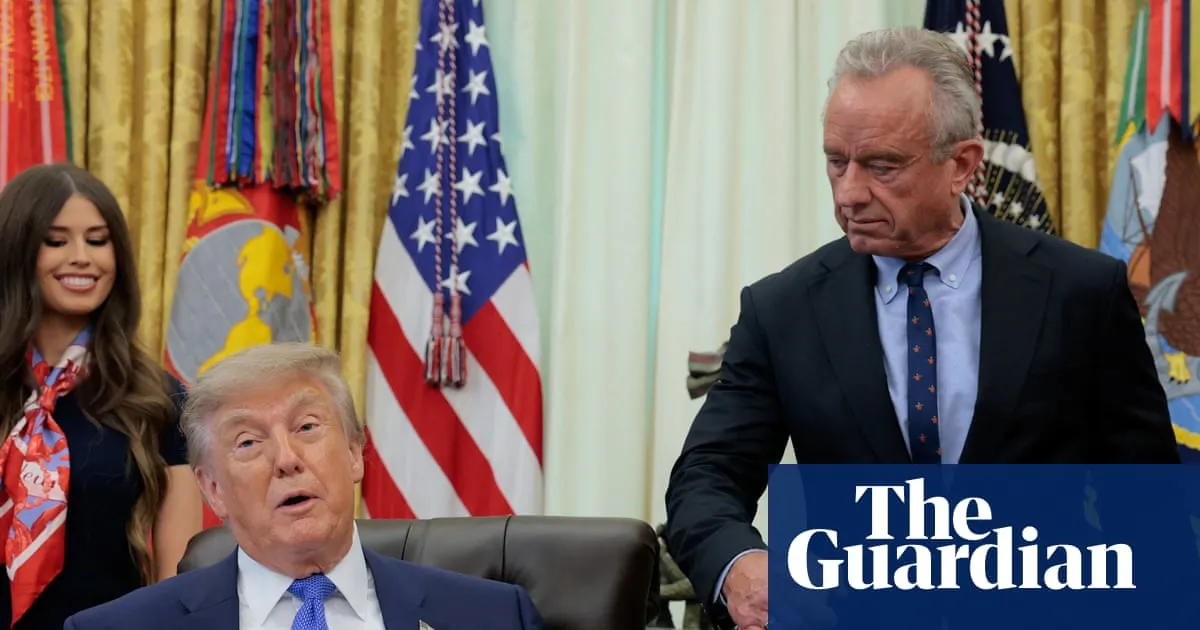
Donald Trump’s executive order on vaccines does not change the US recommendations for the shots – but experts say it does create confusion and doubt about vaccines, which will lead to more illness and possibly deaths among children and will make it harder for families and pediatricians to protect them.The executive order was an attempt to reinstate sweeping changes to the vaccine schedule made earlier this year by Robert F Kennedy Jr, secretary of the US Department of Health and Human Services and a longtime vaccine opponent – changes that were later halted by a federal judge.But an executive order can only offer guidance to agencies; it doesn’t change laws or set recommendations. Recommendations from the US Centers for Disease Control and Prevention (CDC), the federal agency that sets vaccine guidance, remain the same.“Nothing’s changed,” said Noele Nelson, a public health professor at Cornell University and former pediatrician. The primary effect of the order has been “adding unnecessary confusion” and “undermining trust in vaccines without any change in the scientific evidence”, she said.While the science and the recommendations are unchanged, “what is going to change is more people are going to be confused and scared”, said Vincent Iannelli, a pediatrician near Dallas and founder of Vaxopedia, a resource on vaccines.The president is an influential figure, and his inaccurate comments about the dangers of vaccines and a long-disproven connection to autism can have resounding effects, said Wendy Parmet, faculty co-director of the Center for Health Policy and Law at Northeastern University.“People hear Trump is doing this and they think, ‘My God, he’s powerful. He’s doing it. Nobody will be able to have hepatitis B vaccines.’ That isn’t true, but it’s confusing, and it can sow more distrust,” Parmet said.Trump also lacks the authority to recommend spacing doses, she said: “The president can’t tell doctors to say to parents: ‘Why don’t you come back in a week and have the second shot?’ But saying it can certainly lead some parents, maybe many parents, to start asking their doctors for multiple visits.”Adding four or five visits for every round of vaccination will make pediatricians’ schedules even busier, and insurance frequently does not cover additional vaccination visits. It opens up the possibility for errors as pediatricians struggle to understand which vaccines have and haven’t been administered.“It also means that they have to come back to the office more, which means they might be exposed to more illnesses,” Iannelli said. “The biggest risk is they’re going to delay getting protected from that illness that the vaccine protects them from.”vaccines are spaced the way they are based on decades of evidence, Nelson said: “It provides the best immune response to the vaccine, and the spacing is not arbitrary. For some vaccines that are considered to have lifelong immunity – like hepatitis A, hepatitis B, measles – spacing is critical.”Trump’s rhetoric also increases the stigma around autism and may encourage families to seek out dangerous treatments.“Nobody talks enough about how much it hurts kids with autism,” Iannelli said. “Their whole framing about how vaccines cause autism – it makes people think that their kids are damaged. It pushes them into trying unproven and dangerous therapies.”Trump also invoked religious freedom, indicating that the executive order may put pressure on states to reduce vaccination mandates for school attendance. The administration has previously pushed its priorities around “parental authority” on vaccines in communication with states, and it has placed religious freedom at the heart of its health policies.There are no federal mandates on vaccination outside of the military, and states set vaccination requirements for school attendance. Some 46 states and the District of Columbia already have religious exemptions for vaccine requirements; all states have medical exemptions.“This potentially could put pressure on states that don’t have [religious] exemptions right now,” Nelson said. But there would likely be pushback and legal challenges if the administration tried to push states to change its vaccine laws, she said.The few states that don’t have religious exemptions have already litigated the issue, Parmet said. “New York and California and Connecticut, in particular, have been litigating and litigating and litigating, and they’ve been winning and winning and winning on these vaccine cases. And I don’t see those states suddenly folding,” she said. “If Trump tries to coerce the states more, it will get litigated again.”There have been people opposed to immunizations since they were created, and it goes in a cycle, Iannelli pointed out. As soon as a disease is controlled by vaccines, people forget why the vaccines are needed; immunization rates drop, diseases resurge, and people rush to vaccinate once again. “It happens every time,” he said. But in the meantime, children suffer.With announcements like Trump’s, “people are primed to listen because they’re already scared”, he said. “Then they hear something like this, and it reinforces the idea that they should be scared.” Frequently, Iannelli said, they don’t even know why they’re scared; they just know that they are.Recently, he had a visit with parents who said they didn’t think they would get their child vaccinated that day. He asked what their concerns were; they were worried about the information they had seen online, and they thought it might be better to split up the shots. Iannelli listened and told them he could do that, but they would need to schedule several follow-up visits. Tetanus is all around, he added, and there has been an increase in measles. The parents said: “Oh – let’s just get them,” Iannelli said.“It helps you to address it and reassure them, and you just keep asking questions and talking,” Iannelli said. Pediatricians shouldn’t lecture their patients or kick them out of their practices, he said; they should do something called “motivational interviewing”, where they determine the reasons for a patient’s hesitation and help them find the reasons to change.“As pediatricians, that’s our lane,” he said, before adding: “Parents don’t need a lecture; they just want to talk about their concerns.” Concerns, he notes, that are being amplified by misinformation spread at the highest levels of US government. And it doesn’t take much time to listen and respond, he said. “You don’t want to spend a half hour on it. You want to spend a couple minutes on it. And then, after a couple visits, it works.”
SRCThe Guardian - World News
LANGEN
LEANCenter-Left
WORDS1 046
ENT12
THU · 2026-08-13 · 11:00 GMTBRIEF NSR-2026-0813-101898
NSR-2026-0813-101898News Report·EN·Public Health
How Trump’s order on vaccines is sowing confusion, doubt and fear
Donald Trump's executive order on vaccines, intended to reinstate changes proposed by Robert F. Kennedy Jr., does not alter current US vaccine recommendations set by the CDC.
Melody SchreiberThe Guardian - World NewsFiled 2026-08-13 · 11:00 GMTLean · Center-LeftRead · 5 min
The Guardian - World NewsFIG 01
Reading time
5min
Word count
1 046words
Sources cited
3cited
Entities identified
12entities
Quality score
100%
§ 01
Briefing Summary
AI-generatedNEWSAR · AI
Donald Trump's executive order on vaccines, intended to reinstate changes proposed by Robert F. Kennedy Jr., does not alter current US vaccine recommendations set by the CDC. Experts state the order creates confusion and doubt, potentially leading to increased illness and deaths among children by undermining trust in vaccines. While the order cannot change laws or recommendations, it may encourage parents to seek delayed vaccinations, complicating pediatricians' schedules and increasing exposure risks. The order also invokes religious freedom, potentially pressuring states to reduce school vaccination mandates, though legal challenges are anticipated in states with existing exemptions.
Confidence 0.90Sources 3Claims 5Entities 12
§ 02
Article analysis
Model · rule-basedFraming
Public Health
Political Strategy
Tone
Sensational
AI-assessed
CalmNeutralAlarmist
Factuality
0.60 / 1.00
Mixed
LowHigh
Sources cited
3
Well sourced
FewMany
§ 03
Key claims
5 extracted01
Spacing of vaccines is based on decades of evidence and is critical for optimal immune response.
factualNoele Nelson
Confidence
1.00
02
The president lacks the authority to recommend spacing doses for vaccines.
factualWendy Parmet
Confidence
1.00
03
The primary effect of the order has been adding unnecessary confusion and undermining trust in vaccines without changing scientific evidence.
quoteNoele Nelson
Confidence
1.00
04
The executive order does not change US recommendations for vaccines.
factual
Confidence
1.00
05
Trump's executive order on vaccines creates confusion and doubt, potentially leading to more illness and deaths among children.
predictionExperts
Confidence
0.80
§ 04
Full report
5 min read · 1 046 words§ 05
Entities
12 identifiedKey playerOppositionContextPositiveNeutralNegative
People5
Organizations4
Topics1
§ 06
Keywords & salience
9 termsvaccine confusion
1.00
vaccine doubt
0.90
executive order
0.90
public health
0.80
vaccine recommendations
0.70
pediatricians
0.70
trust in vaccines
0.60
donald trump
0.50
cdc
0.40
§ 07
Topic connections
Interactive graph No topic relationship data available yet. This graph will appear once topic relationships have been computed.