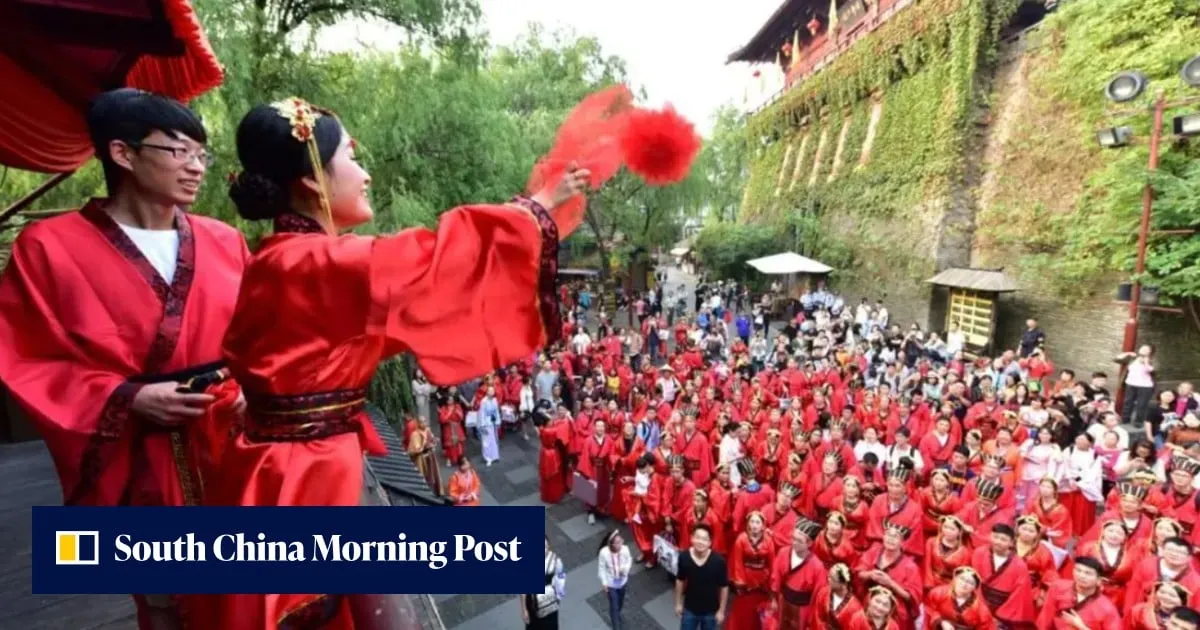
In some classic Chinese novels and period dramas, women of ancient times would throw an embroidered ball from a balcony to the street to randomly choose whoever caught it as their husband.In the classic novel Journey to the West, published in the 16th century, the father of the main character, Buddhist monk Xuanzang, was chosen by his mother by throwing an embroidered ball.In the 1998 Chinese drama My Fair Princess, adapted from Taiwanese writer Chiung Yao’s novel set in the Qing Dynasty (1644–1912), the protagonists also encounter a wealthy family’s daughter, whose father tried to deny their marriage after her embroidered ball hit a poor young man.The plot has appeared in so many classic works that many believe it to be an old marriage tradition without a shadow of doubt. However, studies have revealed that it is a literary adaptation of a custom that is, fortunately, less random.Throwing the embroidered ball is a 2,000-year-old tradition of the Zhuang ethnic group in Guangxi, China. Far from a random game of chance, the practice serves as a beautifully structured courtship ritual. Photo: Taiwan.cnThe tradition of throwing embroidered balls to each other is a popular practice among young Zhuang people in southern China’s Guangxi-zhuang-autonomous-region" class="entity-link entity-location" data-entity-id="44530" data-entity-type="location">Guangxi Zhuang autonomous region.The Zhuang ethnic group accounts for over 30 per cent of Guangxi’s population. Throwing embroidered balls is a way for young people to express their love.It is said that on the third day of the third month, young people gather to attend a singing fair. Only when two people have a crush on each other do they throw their embroidered balls at each other to confess their love. Some also tie presents to the balls.The fist-sized embroidered balls are handmade by joining 12 stuffed petal units. The balls feature auspicious bright colours and are tied with colourful ribbons and red pendants.People usually stuff seeds and rice husks into the petals and sew various kinds of flowers and birds on them.The embroidery reflects the makers – usually women’s craftsmanship – and a more exquisitely made ball would more easily win a man’s admiration.These fist-sized, handmade embroidered balls feature auspicious, vibrant colours that showcase the superb craftsmanship of local women. Historically, a more exquisitely stitched ball would easily capture a suitor’s deepest admiration. Photo: Taiwan.cnThe tradition is said to have existed for 2,000 years in Guangxi, dating back to an ancient hunting tool named fei tuo, or flying weight.Further ReadingThe fei tuo was originally a bronze weight tied to a long rope, which was later adapted into embroidered balls as a toy for entertainment.The toy also spread to the central plains of China. It was documented in ancient Chinese literature, such as The Joy of Playing the Embroidered Ball by Tang poet Liu Yuxi (772–842), which goes, “The five-coloured embroidered ball rolls in reunion, attending your sumptuous banquet... Thankfully we have this ball-tossing game of joy; please do not refuse this cup of wine.”Nowadays, while throwing and catching embroidered balls is no longer a promise to tie the knot, some believe that it is widely featured in costume dramas to express modern people’s opposition to feudal marriage rules.A woman holds an oversized embroidered ball, a dramatic contrast to the traditionally fist-sized original versions. Photo: Taiwan.cnIn feudal China, marriage was a strict patriarchal alliance between families, and women could not freely choose their own love.The act of throwing embroidered balls instead leaves marriage to fate, regardless of a person’s rank or wealth.“To some extent, deciding one’s future husband by throwing an embroidered ball shows a modern belief that it is the universe that brings us together,” one person commented.
SRCSouth China Morning Post
LANGEN
LEANCenter-Right
WORDS599
ENT10
THU · 2026-08-13 · 10:00 GMTBRIEF NSR-2026-0813-101909
NSR-2026-0813-101909News Report·EN·Human Interest
Chinese custom sees women throw embroidered balls from balconies to choose husbands
A 2,000-year-old tradition of the Zhuang ethnic group in Guangxi, China, involves young people throwing handmade embroidered balls to express love and courtship. While often depicted in classic Chinese literature and dramas as a random method for women to choose husbands from balconies, studies reveal it's a structured ritual.
Fran LuSouth China Morning PostFiled 2026-08-13 · 10:00 GMTLean · Center-RightRead · 3 min
South China Morning PostFIG 01
Reading time
3min
Word count
599words
Sources cited
0cited
Entities identified
10entities
Quality score
100%
§ 01
Briefing Summary
AI-generatedNEWSAR · AI
A 2,000-year-old tradition of the Zhuang ethnic group in Guangxi, China, involves young people throwing handmade embroidered balls to express love and courtship. While often depicted in classic Chinese literature and dramas as a random method for women to choose husbands from balconies, studies reveal it's a structured ritual. During singing fairs, individuals with mutual affection throw balls at each other as a confession of love, sometimes attaching presents. Historically, these fist-sized, elaborately embroidered balls originated from a hunting tool called the "fei tuo." Although no longer a binding marriage promise, the practice is believed to symbolize opposition to feudal marriage rules and a belief in fate bringing couples together.
Confidence 0.90Claims 5Entities 10
§ 02
Article analysis
Model · rule-basedFraming
Human Interest
Social Justice
Tone
Measured
AI-assessed
CalmNeutralAlarmist
Factuality
0.70 / 1.00
Factual
LowHigh
Sources cited
0
No named sources
FewMany
§ 03
Key claims
5 extracted01
The embroidered balls are handmade, fist-sized, feature auspicious colors, and reflect the maker's craftsmanship.
factual
Confidence
0.95
02
The Zhuang tradition is a courtship ritual where young people confess love by throwing balls, sometimes with presents.
factual
Confidence
0.90
03
The practice of throwing embroidered balls is a 2,000-year-old tradition of the Zhuang ethnic group in Guangxi, China.
factual
Confidence
0.90
04
Women in ancient China would throw embroidered balls from balconies to choose husbands, as depicted in classic novels and dramas.
factual
Confidence
0.80
05
The tradition may have originated from an ancient hunting tool called 'fei tuo' or 'flying weight'.
factual
Confidence
0.70
§ 04
Full report
3 min read · 599 words§ 05
Entities
10 identifiedKey playerOppositionContextPositiveNeutralNegative
Organizations1
Locations4
§ 06
Keywords & salience
8 termsembroidered balls
1.00
courtship ritual
0.90
zhuang ethnic group
0.80
chinese tradition
0.70
marriage custom
0.60
literary adaptation
0.50
guangxi
0.40
qing dynasty
0.40
§ 07
Topic connections
Interactive graph Network visualization showing 51 related topics
View Full Graph Person Organization Location Event|Click node to navigate|Edge numbers = shared articles