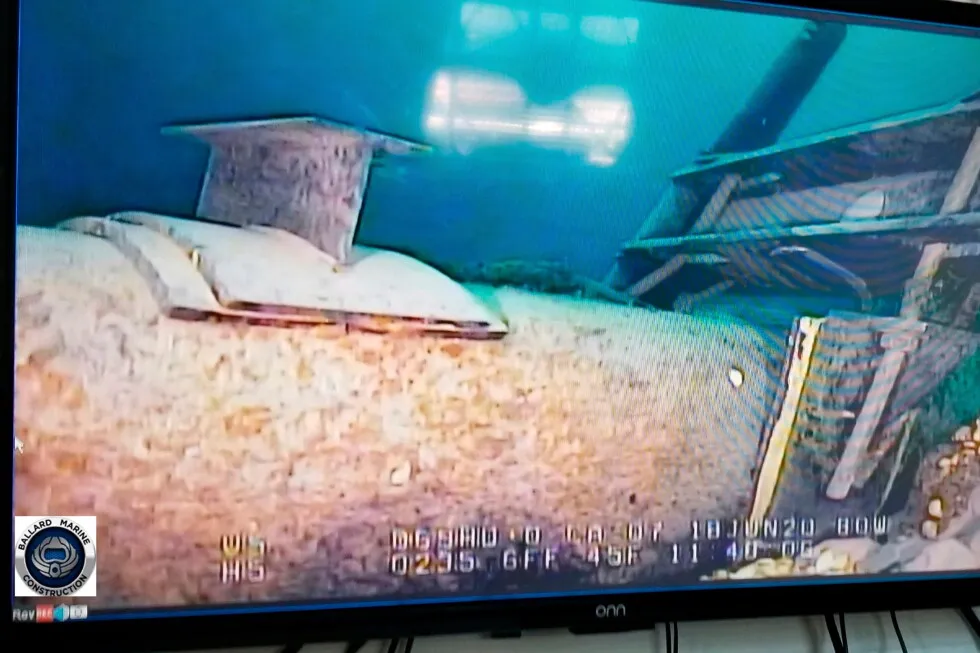
This photo provided by the Michigan-department-of-environment-great-lakes-and-energy" class="entity-link entity-organization" data-entity-id="176298" data-entity-type="organization">Michigan Department of Environment, Great Lakes, and Energy in June 2020 shows damage to anchor support EP-17-1 on the east leg of the Enbridge Line 5 pipeline in the Straits of Mackinac in Michigan, displayed on a television screen. (Michigan-department-of-environment-great-lakes-and-energy" class="entity-link entity-organization" data-entity-id="176298" data-entity-type="organization">Michigan Department of Environment, Great Lakes, and Energy via AP, File) By LAURA HERBERG, JUSTIN A. HINKLEY and KELLY HOUSE/Bridge Michigan Updated 7:17 PM MESZ, August 13, 2026 Add AP News on Google Add AP News as your preferred source to see more of our stories on Google. Share Share Facebook Copy Link copied Print Email X LinkedIn Bluesky Flipboard Pinterest Reddit The US Army Corps of Engineers has permitted construction of the controversial Line 5 tunnel project in the Straits of Mackinac. The project, which would divert a section of the Line 5 petroleum pipeline from the open waters of the Straits into a concrete tunnel beneath the lakebed, is “not contrary to the public interest” and would not harm tribal treaty rights, the Army Corps said in announcing its permit. Nonetheless, the Corps noted the project would have adverse effects on endangered species and archaeological sites, that it would contribute to “long-term impacts of habitat loss” and have “long-term detrimental impacts on land use.” While the federal approval clears a big hurdle for the nearly decade-old proposal, don’t expect shovels in the ground anytime soon. The Michigan-supreme-court" class="entity-link entity-organization" data-entity-id="176295" data-entity-type="organization">Michigan Supreme Court recently ordered state energy regulators to reconsider a separate key permit, the project remains tied up in state and federal court, and new lawsuits have been promised by opponents. Still, Line 5 owners Enbridge Energy praised Wednesday’s decision. The federal permit “represents the highest standard of environmental review required for major critical energy and other infrastructure projects,” Enbridge said in a written statement. “Line 5 is safe. Enbridge will continue operating Line 5 safely and responsibly, incorporating enhanced safety measures in the Straits, and protecting Michigan’s natural and cultural resources.” A coalition of Native American tribes that has opposed the project, meanwhile, slammed the decision. Michigan issues Line 5 permits despite conceding its ‘significant impacts’ 6 MIN READ 232 Michigan-supreme-court" class="entity-link entity-organization" data-entity-id="176295" data-entity-type="organization">Michigan Supreme Court rejects permit for Enbridge oil pipeline under Great Lakes 1 MIN READ Trump’s ‘energy emergency’ could fast-track massive expansion of Plaquemines LNG export terminal 1 MIN READ “Our federal government has a solemn obligation to uphold and protect Treaty rights and is supposed to protect American waters and sacred spaces,” Managing Attorney David Gover with the Native American Rights Fund said in a statement. “Instead, the U.S. Army Corps just rubber-stamped a Canadian oil project that desecrates a Tribal sacred space and threatens to pollute the Great Lakes.” The tunnel project would likely “adversely affect” Houghton’s goldenrod and dwarf lake iris, which are listed as threatened species under the federal Endangered Species Act, the Corps said, but that “reductions in the overall recovery, numbers, or distribution” are not expected after mitigation efforts. The project site is culturally and spiritually significant to the Anishinaabe tribal nations. The Corps noted there would be “major, permanent, adverse effects on historic properties, including archaeological sites” that the tribal nations said “cannot be mitigated.” The Corps’ decision is in line with the Trump administration’s goal of bolstering fossil fuel energy and preventing renewable energy development. “The approval of the Enbridge Line 5 Tunnel Project is a testament to President Trump’s vision to ensure our nation’s energy dominance,” said Assistant Secretary of the Army for Civil Works Adam Telle in an emailed statement. “By cutting unneeded red tape and overhauling our regulatory process, to provide fast, clear, and consistent decisions that implement our regulatory authorities just as Congress intended, we are able to help projects like this move forward with regulatory certainty.” David Holtz, coalition coordinator for the group Oil & Water Don’t Mix said in an email the Corps’ decision was “driven by the Trump Administration’s phony ‘national energy emergency.’” He said the decision — which did not consider what would happen if the tunnel was not built and Line 5 was decommissioned — was reminiscent of the Michigan Public Service Commission’s permit review that the Michigan-supreme-court" class="entity-link entity-organization" data-entity-id="176295" data-entity-type="organization">Michigan Supreme Court recently said was erroneous. The court called the review overly narrow and said it failed to consider whether it would harm public rights to the Great Lakes and that it failed to study whether Line 5 would shut down if the tunnel isn’t built. On July 15, Michigan’s departments of Natural Resources and Environment, Great Lakes and Energy issued two key permits for the tunnel project, despite noting disruption to Native American burial sites and harm to wetlands and rare species. Enbridge is also seeking a permit to discharge millions of gallons of treated wastewater per day into Lake Michigan during tunnel construction. EGLE is expected to rule on that by Sept. 30. Meanwhile, the state is battling in court with Enbridge over Whitmer’s 2020 order to shut the existing pipeline down for fear that it could cause an oil spill in the Straits. A federal judge in December ruled that Michigan had no authority to order a shutdown, but the state has appealed the ruling. Separately, Michigan Attorney General Dana Nessel has sought a shutdown since 2019 in a case that has pingponged from state to federal court and back again. The case now sits in the 30th Circuit Court in Ingham County, where deliberations are paused pending resolution of the case stemming from Whitmer’s shutdown order. This story was originally published by Bridge Michigan and distributed through a partnership with The Associated Press.
SRCAssociated Press (AP)
LANGEN
LEANCenter
WORDS926
ENT11
THU · 2026-08-13 · 17:23 GMTBRIEF NSR-2026-0813-102024
NSR-2026-0813-102024News Report·EN·Legal & Judicial
Feds issue Line 5 tunnel permit, call it ‘not contrary to the public interest’
The U.S. Army Corps of Engineers has issued a permit for the controversial Line 5 tunnel project in the Straits of Mackinac, stating it is "not contrary to the public interest" and would not harm tribal treaty rights.
Associated Press (AP)Filed 2026-08-13 · 17:23 GMTLean · CenterRead · 4 min
Associated Press (AP)FIG 01
Reading time
4min
Word count
926words
Sources cited
3cited
Entities identified
11entities
Quality score
100%
§ 01
Briefing Summary
AI-generatedNEWSAR · AI
The U.S. Army Corps of Engineers has issued a permit for the controversial Line 5 tunnel project in the Straits of Mackinac, stating it is "not contrary to the public interest" and would not harm tribal treaty rights. The project aims to reroute a section of the Line 5 petroleum pipeline into a concrete tunnel beneath the lakebed. However, the Corps acknowledged the project would have adverse effects on endangered species, archaeological sites, habitat loss, and land use. Despite this federal approval, the project faces significant hurdles, including a Michigan Supreme Court order to reconsider a separate state permit, ongoing legal challenges, and promised new lawsuits from opponents. Enbridge Energy praised the decision, while a coalition of Native American tribes criticized it, citing desecration of sacred spaces and threats to the Great Lakes.
Confidence 0.90Sources 3Claims 5Entities 11
§ 02
Article analysis
Model · rule-basedFraming
Legal & Judicial
Environmental
Tone
Mixed Tone
AI-assessed
CalmNeutralAlarmist
Factuality
0.70 / 1.00
Factual
LowHigh
Sources cited
3
Well sourced
FewMany
§ 03
Key claims
5 extracted01
A coalition of Native American tribes slammed the decision, stating the U.S. Army Corps 'rubber-stamped a Canadian oil project that desecrates a Tribal sacred space and threatens to pollute the Great Lakes'.
quoteDavid Gover, Native American Rights Fund
Confidence
1.00
02
Line 5 owners Enbridge Energy praised the decision, calling it the 'highest standard of environmental review'.
quoteEnbridge Energy
Confidence
1.00
03
The Corps noted the project would have adverse effects on endangered species and archaeological sites, and contribute to long-term impacts of habitat loss and detrimental impacts on land use.
factualUS Army Corps of Engineers
Confidence
1.00
04
The project is “not contrary to the public interest” and would not harm tribal treaty rights, the Army Corps said.
quoteUS Army Corps of Engineers
Confidence
1.00
05
The US Army Corps of Engineers has permitted construction of the controversial Line 5 tunnel project in the Straits of Mackinac.
factualUS Army Corps of Engineers
Confidence
1.00
§ 04
Full report
4 min read · 926 words§ 05
Entities
11 identifiedKey playerOppositionContextPositiveNeutralNegative
People3
Organizations5
§ 06
Keywords & salience
10 termsline 5 pipeline
1.00
tunnel project
0.90
straits of mackinac
0.80
us army corps of engineers
0.70
public interest
0.60
environmental review
0.50
tribal treaty rights
0.50
habitat loss
0.40
enbridge energy
0.40
endangered species
0.40
§ 07
Topic connections
Interactive graph No topic relationship data available yet. This graph will appear once topic relationships have been computed.