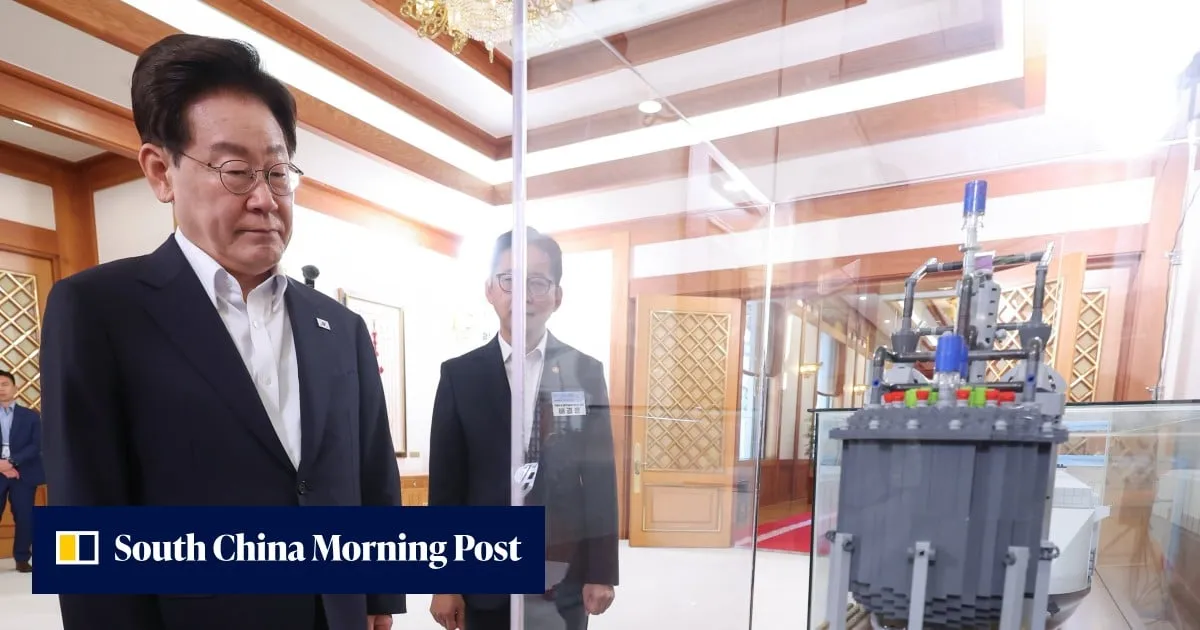
South Korea is banking on moonshots in a post-AI economy to stem sluggish growth potential amid an ageing population and deepening reliance on its semiconductor exports.From quantum chips and fusion power to a lunar landing, Seoul this week unveiled a strategy to build seven next-generation industries over the coming decades.The aim is to secure a foothold in technologies shaping a post-AI world before superpowers the United States and China pull further ahead.The move marks mounting urgency for a country whose potential growth, according to the Organisation for Economic Cooperation and Development (OECD), could fall to a record-low 1.52 per cent next year. Economists also warn that a recent semiconductor export boom is not enough to sustain the economy.The plan, announced by the Ministry of Trade, Industry and Resources on Wednesday, identifies seven “Strategic Emerging Engines for Disruptive Innovation,” or SEEDs: small modular reactors, nuclear fusion, breakthrough renewable energy, quantum technology, space and aviation, advanced biotechnology and advanced supply chains.It aims to turn the seven areas into major growth industries over the next 10 to 20 years, with President Lee Jae Myung reportedly telling his cabinet “the seeds of advanced technologies we plant today will grow into giant trees in the future”.
SRCSouth China Morning Post
LANGEN
LEANCenter-Right
WORDS201
ENT12
FRI · 2026-08-14 · 00:00 GMTBRIEF NSR-2026-0814-102130
NSR-2026-0814-102130News Report·EN·Technology
South Korea’s moon landing, quantum chips: Seoul bets big on post-AI economy
South Korea has announced a strategy to develop seven next-generation industries over the next decades to address sluggish growth and reduce reliance on semiconductor exports. The plan, unveiled by the Ministry of Trade, Industry and Resources, aims to establish a strong position in technologies shaping a post-AI economy before the United States and China advance further.
Park Chan-kyongSouth China Morning PostFiled 2026-08-14 · 00:00 GMTLean · Center-RightRead · 1 min
South China Morning PostFIG 01
Reading time
1min
Word count
201words
Sources cited
1cited
Entities identified
12entities
Quality score
100%
§ 01
Briefing Summary
AI-generatedNEWSAR · AI
South Korea has announced a strategy to develop seven next-generation industries over the next decades to address sluggish growth and reduce reliance on semiconductor exports. The plan, unveiled by the Ministry of Trade, Industry and Resources, aims to establish a strong position in technologies shaping a post-AI economy before the United States and China advance further. These seven "Strategic Emerging Engines for Disruptive Innovation" (SEEDs) include small modular reactors, nuclear fusion, breakthrough renewable energy, quantum technology, space and aviation, advanced biotechnology, and advanced supply chains. This initiative reflects growing urgency, as the OECD projects South Korea's potential growth to reach a record low of 1.52% next year, with economists warning that the current semiconductor export boom is insufficient for sustained economic growth. The government intends for these areas to become major growth industries within 10 to 20 years.
Confidence 0.90Sources 1Claims 5Entities 12
§ 02
Article analysis
Model · rule-basedFraming
Technology
Economic Impact
Tone
Measured
AI-assessed
CalmNeutralAlarmist
Factuality
0.70 / 1.00
Factual
LowHigh
Sources cited
1
Limited
FewMany
§ 03
Key claims
5 extracted01
President Lee Jae Myung stated that 'the seeds of advanced technologies we plant today will grow into giant trees in the future'.
quotePresident Lee Jae Myung
Confidence
1.00
02
The seven identified industries are: small modular reactors, nuclear fusion, breakthrough renewable energy, quantum technology, space and aviation, advanced biotechnology, and advanced supply chains.
factualMinistry of Trade, Industry and Resources
Confidence
1.00
03
South Korea's potential growth could fall to a record-low 1.52 percent next year, according to the OECD.
statisticOrganisation for Economic Cooperation and Development (OECD)
Confidence
1.00
04
South Korea unveiled a strategy to build seven next-generation industries over the coming decades.
factual
Confidence
1.00
05
Seoul aims to secure a foothold in technologies shaping a post-AI world before the US and China pull further ahead.
factual
Confidence
0.90
§ 04
Full report
1 min read · 201 words§ 05
Entities
12 identifiedKey playerOppositionContextPositiveNeutralNegative
Organizations2
§ 06
Keywords & salience
10 termspost-ai economy
1.00
next-generation industries
0.90
quantum technology
0.80
semiconductor exports
0.70
economic growth
0.60
disruptive innovation
0.50
nuclear fusion
0.40
advanced biotechnology
0.40
south korea
0.40
space and aviation
0.40
§ 07
Topic connections
Interactive graph Network visualization showing 51 related topics
View Full Graph Person Organization Location Event|Click node to navigate|Edge numbers = shared articles