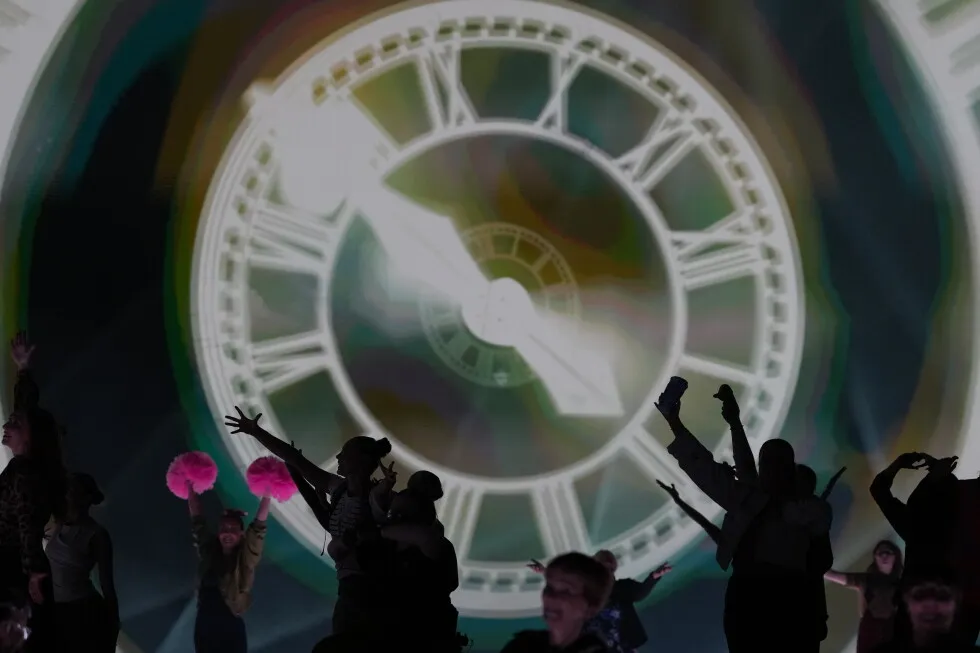
The hidden politics of time: How clocks, calendars and time zones came to be 1 of 3 | Performers celebrate the Glasgow Central railway station clock during the Commonwealth Games opening ceremony in Glasgow, Scotland, July 23, 2026. (AP Photo/Kin Cheung, File) 2 of 3 | A sundial of golfer Bobby Jones sits outside the Augusta-national-golf-club" class="entity-link entity-location" data-entity-id="101038" data-entity-type="location">Augusta National Golf Club house during a practice round for the Masters golf tournament April 9, 2013, in Augusta, Ga. (AP Photo/David Goldman, File) 3 of 3 | People gather on top of the Feldberg mountain to watch the sunset near Frankfurt, Germany, June 21, 2025. (AP Photo/Michael Probst, File) 1 of 3 | Performers celebrate the Glasgow Central railway station clock during the Commonwealth Games opening ceremony in Glasgow, Scotland, July 23, 2026. (AP Photo/Kin Cheung, File) 1 of 3 Performers celebrate the Glasgow Central railway station clock during the Commonwealth Games opening ceremony in Glasgow, Scotland, July 23, 2026. (AP Photo/Kin Cheung, File) Add AP News on Google Add AP News as your preferred source to see more of our stories on Google. Share 2 of 3 | A sundial of golfer Bobby Jones sits outside the Augusta-national-golf-club" class="entity-link entity-location" data-entity-id="101038" data-entity-type="location">Augusta National Golf Club house during a practice round for the Masters golf tournament April 9, 2013, in Augusta, Ga. (AP Photo/David Goldman, File) 2 of 3 A sundial of golfer Bobby Jones sits outside the Augusta-national-golf-club" class="entity-link entity-location" data-entity-id="101038" data-entity-type="location">Augusta National Golf Club house during a practice round for the Masters golf tournament April 9, 2013, in Augusta, Ga. (AP Photo/David Goldman, File) Add AP News on Google Add AP News as your preferred source to see more of our stories on Google. Share 3 of 3 | People gather on top of the Feldberg mountain to watch the sunset near Frankfurt, Germany, June 21, 2025. (AP Photo/Michael Probst, File) 3 of 3 People gather on top of the Feldberg mountain to watch the sunset near Frankfurt, Germany, June 21, 2025. (AP Photo/Michael Probst, File) Add AP News on Google Add AP News as your preferred source to see more of our stories on Google. Share Updated [hour]:[minute] [AMPM] [timezone], [monthFull] [day], [year] NEW YORK (AP) — It flies. It heals all wounds. It can be of the essence, and it can be money. We thrill in the best of it, lament the worst. We’re warned not to waste it, since we can’t turn it back — even as we try to make up for when it’s lost.And probably more than anything when it comes to time, most of us try to manage it — in our everyday lives and on a global scale, from the biology of our circadian rhythms to what constitutes a work day. Clocks. Calendars. Pendulums. Hourglasses. Sundials. Time zones. For something that’s been a pretty universal impulse to mark the shift of light and dark, the movement of the stars and the rhythms of the tides, the cycles of summer heat and winter cold, one might assume there’s been a universal way of measuring time. That assumption would be wrong.Take the shifting of the clock twice a year in most of the United States, once forward and then back again, a system that “moves” the time to let people enjoy daylight hours later into the evening. While people love the light, a lot of them loathe having to make the change. So much so that the House of Representatives last month overwhelmingly passed legislation calling for the shift to become permanent year-round. Its prospects for passage in the Senate aren’t high, and when the country tried it in the 1970s it was wildly unpopular and short-lived. But it continues to be brought up, an indication that the way we keep the clock counts.The methods different peoples and communities have used to track their lives haven’t existed in a vacuum. They’ve been impacted by culture, by religion, by economics and technology, by the governing principles both within nations and among them.Turns out, like pretty much anything where people are involved, there’s a politics to time. 5 MIN READ 7 MIN READ 1 MIN READ Measurements of time are made up, but they matter“Every measurement of time is arbitrary,” says Elizabeth Cohen, a political science professor at Boston University who has written about how we chronicle time and how it impacts the way people relate to each other. “Every deadline could have been a fraction of a second or a large increment of time different than it was,” she says. “None of it is natural.” Take calendars. We use them to give a structure to our lives, but the spectrum of what that has looked like is vast through human existence. Some followed the sun, others the moon, and others still a combination of both. Maybe all the months were the same length, maybe they weren’t. What we call a seven-day week might have had four, or six, or some other number of days in other timekeeping systems.Even today, when the main calendar in use globally is what we know as the Gregorian calendar, with its 12 months and leap years, other calendars are still consulted for religious or cultural purposes in places from Israel to Thailand. And daylight saving time? With its connection to our perceptions of what hours of light become available to us, it reflects “a desire for natural time,” says Michael O’Malley, professor of history at George Mason University.People “are outside longer, so they feel it as a connection to nature,” he says. “But it only makes sense in a society that’s completely hypnotized by clocks so you think the clock is time.” The culture of the clock is evolvingIt’s not just about the how. When we think about how culture evolved around time, there’s also the why.For most of human history, there were ties to the rhythms of the natural world: the phases of the moon, the rising and setting of the sun, the ebb and flow of the tides. And in agricultural societies, the importance of when to plant and when to harvest. Tracking the sun’s journey across the sky was a local endeavor. While the idea of a day broken down into 24 equal segments was important to groups like astronomers or seafarers, daily life was broken into “systems that tended to expand and contract based on the time of year and the location,” says Kevin Birth, a professor of anthropology at Queens College.“But since people weren’t really traveling back and forth with any great rapidity back,” he says, “then it really didn’t matter.”Industrialization — in the form of the Industrial Revolution that started in 18th-century England and spread — pushed people to shift notions of time. No longer was it about the sun’s cycle or the turn of the seasons. Industrial production meant schedules — people paying attention to the clock because they were due for specific shifts. “It was one of the goals of industrialization to instill in people this regular, unvarying sense of time,” O’Malley says. Contrast that to a preindustrial farmer, he says. “You could have an ethic of hard work, but that work is not going to be governed by a clock. It’s typically going to governed by natural cues. The clock establishes this external authority that’s not you.”In the United States, by the mid-1800s, another issue arose: time zones. There were more than 40 based around cities, which O’Malley says forced railroad companies to switch dynamically as trains traveled.Worried that other entities would standardize the zones and disrupt their businesses, the companies acted. “The American Railway Association got all the American railroads to agree that on Nov. 18, 1883, they would declare a four-zone system in effect in America,” O’Malley says. “And they just announced it.” Time can be a cudgelIt’s hardly the only occasion where the perception of time has involved national or global concerns.Take the Prime Meridian, the entirely made-up longitude line running from the North Pole to the South Pole, that divides Earth into eastern and western hemispheres and is used as the basis for global timekeeping as well as navigation.It runs through Greenwich, England, and was selected at an international conference in 1884. Was that because Greenwich was the ideal place? No, Birth says — it simply was established during “a period when the British Empire was one of the dominant empires in the world.”Time zones themselves “are about politics,” he says, pointing out that they are not divided in a standard format. Countries decide their own, and in the U.S., the individual states can decide if they observe Daylight Saving or not.A prime example is China, which stretches more than 3,000 miles (5,000 kilometers) across Asia. It has one official time zone for the country, instituted when the Communist Party took power in 1949 as a form of national unity.The entire country runs officially on Beijing time, but the reality on the ground when the sun rises in eastern China hours before it rises in western China is people adjust with their own local times for daily life, Birth says.Time can also be a tool used in a society to manage dissent and protest, Cohen says. She pointed to examples like governments instituting curfews or protesters engaging in slowdowns or strikes.“Time has a lot of power,” she says, “and people are battling over it to try and impose themselves on others or remove the yoke that has been imposed on them.” Hajela writes about the ways in which America is changing as part of the AP’s Trends+Culture team. She is based in New York City.
SRCAssociated Press (AP)
LANGEN
LEANCenter
WORDS1 587
ENT12
FRI · 2026-08-14 · 07:53 GMTBRIEF NSR-2026-0814-102219
NSR-2026-0814-102219News Report·EN·Human Interest
The hidden politics of time: How clocks, calendars and time zones came to be
The article "The hidden politics of time: How clocks, calendars and time zones came to be" explores how our systems for measuring time are not natural but rather human constructs influenced by culture, religion, economics, and politics. Historically, timekeeping varied greatly, with different societies using solar, lunar, or combined methods, and even the length of a week differed.
By
DEEPTI HAJELAAssociated Press (AP)Filed 2026-08-14 · 07:53 GMTLean · CenterRead · 7 min
Associated Press (AP)FIG 01
Reading time
7min
Word count
1 587words
Sources cited
0cited
Entities identified
12entities
Quality score
100%
§ 01
Briefing Summary
AI-generatedNEWSAR · AI
The article "The hidden politics of time: How clocks, calendars and time zones came to be" explores how our systems for measuring time are not natural but rather human constructs influenced by culture, religion, economics, and politics. Historically, timekeeping varied greatly, with different societies using solar, lunar, or combined methods, and even the length of a week differed. The Industrial Revolution shifted focus from natural cues to clock-based schedules. The establishment of time zones, like the four-zone system in America implemented by railroad companies in 1883, and the Prime Meridian in 1884, were political decisions driven by practical needs and imperial power. Even daylight saving time reflects a societal desire for more daylight hours, demonstrating that how we perceive and manage time is deeply intertwined with societal values and power dynamics.
Confidence 0.90Claims 4Entities 12
§ 02
Article analysis
Model · rule-basedFraming
Human Interest
Political Strategy
Tone
Measured
AI-assessed
CalmNeutralAlarmist
Factuality
0.60 / 1.00
Mixed
LowHigh
Sources cited
0
No named sources
FewMany
§ 03
Key claims
4 extracted01
Time can be considered 'of the essence' and also 'money'.
factual
Confidence
0.90
02
There is not a universal way of measuring time, despite the common impulse to do so.
factual
Confidence
0.90
03
Time management is a universal impulse, applied from personal biology to global scales.
factual
Confidence
0.90
04
The practice of shifting clocks twice a year in the United States is a system that 'moves' time.
factual
Confidence
0.80
§ 04
Full report
7 min read · 1 587 words§ 05
Entities
12 identifiedKey playerOppositionContextPositiveNeutralNegative
Organizations1
Locations8
§ 06
Keywords & salience
8 termspolitics of time
1.00
time zones
0.90
clocks
0.80
calendars
0.80
time management
0.70
circadian rhythms
0.60
global scale
0.50
sundial
0.40
§ 07
Topic connections
Interactive graph Network visualization showing 51 related topics
View Full Graph Person Organization Location Event|Click node to navigate|Edge numbers = shared articles