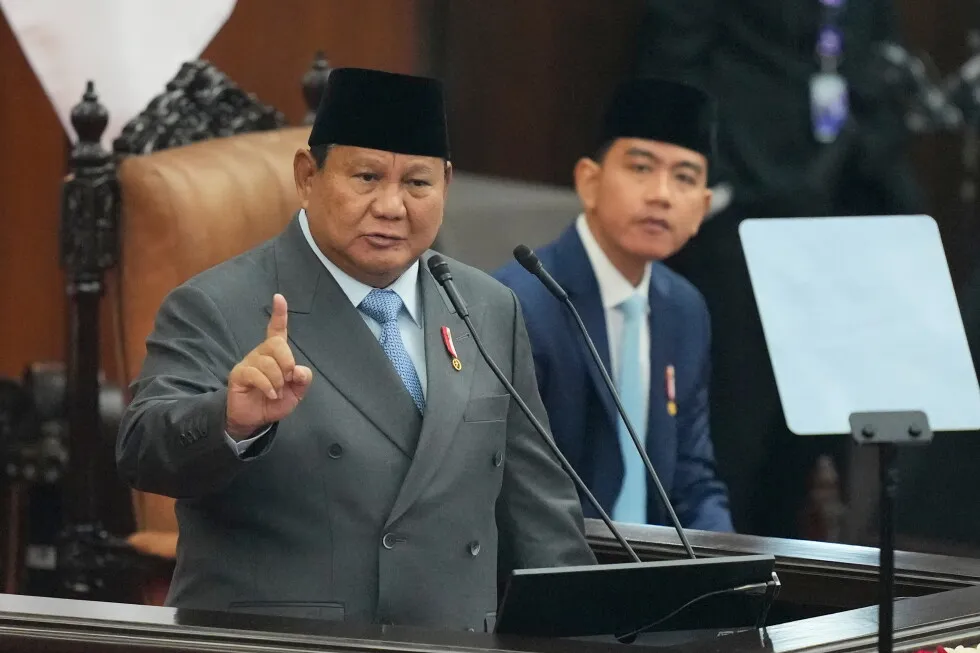
Prabowo touts Indonesia’s economic growth and investment gains in State of the Nation Address 1 of 5 | Indonesian President Prabowo Subianto, left, delivers his annual State of the Nation Address as Indonesian Vice President Gibran Rakabuming Raka listens ahead of the country’s Independence Day at the parliament building in Jakarta, Indonesia, Friday, Aug. 14, 2026. (AP Photo/Dita Alangkara) 2 of 5 | Indonesian President Prabowo Subianto, center, delivers his annual State of the Nation Address ahead of the country’s Independence Day, at the parliament building in Jakarta, Indonesia, Friday, Aug. 14, 2026. (AP Photo/Dita Alangkara) 3 of 5 | Indonesian President Prabowo Subianto raises his fist while delivering his annual State of the Nation Address ahead of the country’s Independence Day at the parliament building in Jakarta, Indonesia, Friday, Aug. 14, 2026. (AP Photo/Dita Alangkara) 4 of 5 | Indonesian President Prabowo Subianto, left, shakes hands with former president Joko Widodo after delivering his State of the Nation Address ahead of the country’s Independence Day at the parliament building in Jakarta, Indonesia, Friday, Aug. 14, 2026. (AP Photo/Dita Alangkara) 5 of 5 | Indonesian President Prabowo Subianto, right, gestures after delivering his State of the Nation Address as, from left, the Chairman of the People’s Consultative Assembly Ahmad Muzani, House Speaker Puan Maharani, and the Chairman of Regional Representative Council Sultan Bachtiar Najamudin applaud at the parliament building Jakarta, Indonesia, Friday, Aug. 14, 2026. (AP Photo/Dita Alangkara) By NINIEK KARMINI Updated 9:52 AM MESZ, August 14, 2026 Add AP News on Google Add AP News as your preferred source to see more of our stories on Google. Share Share Facebook Copy Link copied Print Email X LinkedIn Bluesky Flipboard Pinterest Reddit Jakarta, Indonesia (AP) — President Prabowo Subianto on Friday touted Indonesia’s strongest first-half economic growth in more than a decade, saying the country could achieve 6% growth by the end of this year despite global uncertainty, while stressing that economic expansion must translate into jobs and higher living standards. In his annual State of the Nation Address before members of the Parliament in the capital Jakarta, Prabowo said Southeast Asia’s largest economy grew 5.61% in the first quarter this year and 5.45% in the first half of the year. “This is the highest first-quarter and first-semester growth in the last 13 years,” Prabowo said in the fiery, televised speech. “With the right policies, rational policies and policies based on common sense, I am confident our economic growth can reach 6% by the end of this year.” But Prabowo said economic growth and rising investment were not goals in themselves, arguing their success should be measured by whether they improved the lives of ordinary Indonesians. “For me, growth and investment are not the final goal. Our goal is the welfare of our people,” Prabowo said. “High growth that cannot be enjoyed by most of our people is of no benefit to us.” Ahead of Indonesia’s 81st Independence Day celebrations on Monday, he said every rupiah of investment should create jobs and improve living standards, particularly for lower-income Indonesians, by generating employment opportunities and expanding access to basic services and government assistance. FBI Director Patel returns looted cultural artifacts to Indonesian President Prabowo 2 MIN READ Chief of troubled Indonesian nutrition agency replaced for second time in 2 months 3 MIN READ Indonesia battles growing wildfires as Mount Bromo blaze spreads 3 MIN READ As evidence, Prabowo said investment remained strong despite global economic uncertainty. Realized investment reached 1,931 trillion rupiah ($108 billion) last year, creating more than 2.7 million jobs, while investment totaled 1,010 trillion rupiah ($56.7 billion) in the first half of this year and generated more than 1.4 million additional jobs. Prabowo also pointed to several of his administration’s flagship programs that he said were delivering direct benefits to Indonesians, including the Free Nutritious Meals program, social assistance schemes and policies aimed at increasing domestic processing of the country’s natural resources. “Our promise of nutritious meals, social assistance and down-streaming (processing) is no longer merely a plan on paper,” he said. “It is already underway, and the people are feeling the benefits.” The Free Nutritious Meals program, launched last year to combat malnutrition, aims to provide meals to nearly 90 million schoolchildren and pregnant women and has become one of Prabowo’s signature policies. The government says the program is intended to improve nutrition while creating demand for local agricultural products and supporting jobs across the food supply chain. However, the program has faced growing scrutiny after food-poisoning incidents affecting thousands of students across the country. On Thursday, about 269 students from three high schools in North Sumatra’s Karo regency reportedly suffered suspected food poisoning after consuming meals provided under the program. Some economists questioned whether the government’s growth figures reflected conditions facing many Indonesians. Nailul Huda, a researcher at the Center of Economic and Law Studies, or Celios, said slowing household consumption, rising layoffs and difficulties finding work suggested the benefits of growth were not being broadly shared. Weakening consumer confidence and concerns about the labor market indicated a disconnect between headline economic growth and the realities faced by many households, particularly poorer Indonesians, he said. “The government always claims the economy is growing strongly, but lower-income communities do not feel it,” Huda said.
SRCAssociated Press (AP)
LANGEN
LEANCenter
WORDS877
ENT11
FRI · 2026-08-14 · 08:23 GMTBRIEF NSR-2026-0814-102263
NSR-2026-0814-102263News Report·EN·Economic Impact
Prabowo touts Indonesia’s economic growth and investment gains in State of the Nation address
In his State of the Nation address, Indonesian President Prabowo Subianto highlighted the country's strongest first-half economic growth in over a decade, projecting 6% growth for the year despite global uncertainty. He emphasized that economic expansion and investment must translate into improved living standards and job creation for Indonesians, stating that welfare is the ultimate goal.
Associated Press (AP)Filed 2026-08-14 · 08:23 GMTLean · CenterRead · 4 min
Associated Press (AP)FIG 01
Reading time
4min
Word count
877words
Sources cited
1cited
Entities identified
11entities
Quality score
100%
§ 01
Briefing Summary
AI-generatedNEWSAR · AI
In his State of the Nation address, Indonesian President Prabowo Subianto highlighted the country's strongest first-half economic growth in over a decade, projecting 6% growth for the year despite global uncertainty. He emphasized that economic expansion and investment must translate into improved living standards and job creation for Indonesians, stating that welfare is the ultimate goal. Prabowo cited significant investment figures from the previous year and the first half of this year, which he claims created millions of jobs. He also promoted flagship programs like the Free Nutritious Meals initiative, social assistance, and resource processing policies as directly benefiting citizens. However, some economists expressed concerns that the economic growth figures do not reflect the realities faced by many Indonesians, citing issues like slowing household consumption and job market difficulties.
Confidence 0.90Sources 1Claims 4Entities 11
§ 02
Article analysis
Model · rule-basedFraming
Economic Impact
Political Strategy
Tone
Measured
AI-assessed
CalmNeutralAlarmist
Factuality
0.70 / 1.00
Factual
LowHigh
Sources cited
1
Limited
FewMany
§ 03
Key claims
4 extracted01
Economic growth and investment are not the final goal; the goal is the welfare of the people.
quotePrabowo Subianto
Confidence
1.00
02
Indonesia's economy grew 5.61% in the first quarter and 5.45% in the first half of the year.
statisticPrabowo Subianto
Confidence
1.00
03
Indonesia achieved its strongest first-half economic growth in over a decade.
statisticPrabowo Subianto
Confidence
1.00
04
Indonesia could achieve 6% economic growth by the end of this year.
predictionPrabowo Subianto
Confidence
0.90
§ 04
Full report
4 min read · 877 words§ 05
Entities
11 identifiedKey playerOppositionContextPositiveNeutralNegative
People6
Organizations1
§ 06
Keywords & salience
8 termseconomic growth
1.00
state of the nation address
0.90
indonesia
0.80
investment gains
0.70
prabowo subianto
0.60
global uncertainty
0.50
living standards
0.40
jobs
0.40
§ 07
Topic connections
Interactive graph Network visualization showing 51 related topics
View Full Graph Person Organization Location Event|Click node to navigate|Edge numbers = shared articles