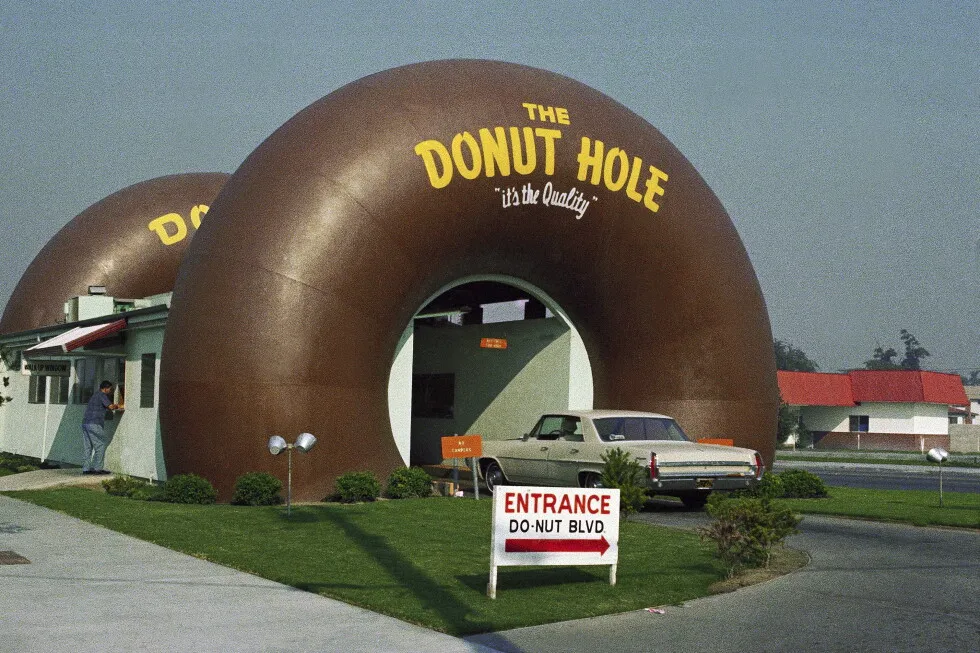
By ASHRAF KHALIL Updated 8:32 PM MESZ, August 14, 2026 Add AP News on Google Add AP News as your preferred source to see more of our stories on Google. Share Share Facebook Copy Link copied Print Email X LinkedIn Bluesky Flipboard Pinterest Reddit WASHINGTON (AP) — Full disclosure: this should really be two tales. How better to pay tribute to the natural and perhaps inevitable combination of two distinctly American icons: fast food and cars? Those two massive sociological forces had already joined up, Voltron-style, early in the 20th century with the development of the drive-in restaurant – that classic scene evocative of “Happy Days” where customers sat in their cars while servers (ideally on skates) brought out food that was consumed on site from window trays. But the real innovation dates to the late 1940s and is the brainchild of either (depending on which source you trust) an In-N-Out Burger in California in 1948 or Red’s Giant Hamburg in Springfield, Missouri in 1947. (In comparison, the first reported drive-thru in Europe didn’t open until 1985 in Dublin.) By the mid 1960s, this had mushroomed into a robust American market, spawning imitators and innovators. Jack in the Box pioneered the drive-thru exclusive restaurant with no indoor seats and no parking — and a talking mechanical clown to take your order. In Western states, residents of a certain age will recall the Wienershnitzel chain with its distinctive A-frame structures specially built with a tunnel down the middle for cars. A customer orders a meal at a drive-thru at McDonald's restaurant in Palo Alto, Calif., Wednesday, Oct. 18, 2006. (AP Photo/Paul Sakuma, File) A customer receives her burger and fries from the drive-thru at In-N-Out Burger on Friday, June 11, 2010, in the Hollywood area of Los Angeles. (AP Photo/Adam Lau, File) The innovation sparked unexpected knock-on developments. Restaurant menus shifted heavily toward sandwiches, fries, chicken strips and other portables that could be consumed on the go. The cars themselves adjusted over the years to accommodate larger and larger drink holders. What sociological (and nutritional) impact this has all had on the actual consumers would be the subject of a much longer essay. The innovation hasn’t stopped. Modern drive-thrus have evolved into tightly coordinated multi-lane affairs. At Chick-fil-As around the country, actual humans with electronic tablets now stand – breathing in exhaust fumes all day – to ensure a seamless ordering process with no mechanical speaker garbles. The bagel’s journey from Jewish immigrant food to American breakfast staple 1 MIN READ Beyond keeping out bugs, the screen door safeguards Americans’ trust in others 5 MIN READ 627 Malls, once symbols of American consumer culture, are splitting. Some are dying as others thrive 5 MIN READ 627 The drive-thru, with its distinctly American creative spelling, has become woven into the fabric of the culture. It has been enshrined in the Smithsonian Museum of American History and has played a memorable role in recent and successful Presidential campaigns. As one historian put it, somewhat pointedly: “The drive-in was less a pure novelty than an expression of great American passions that go hand in hand: speed, efficiency and, sometimes, laziness.” American Objects These are among the items that have shaped the nation. Here are their stories. ASHRAF KHALIL Khalil writes about local issues in Washington, D.C., for The Associated Press and covers the social safety net around the country. twitter instagram mailto
SRCAssociated Press (AP)
LANGEN
LEANCenter
WORDS568
ENT12
FRI · 2026-08-14 · 18:53 GMTBRIEF NSR-2026-0814-102402
NSR-2026-0814-102402News Report·EN·Human Interest
Pull up to the window, please, for a glimpse of an American icon: The drive-thru
The drive-thru, a distinctly American innovation combining fast food and cars, emerged in the late 1940s, with In-N-Out Burger in California (1948) and Red's Giant Hamburg in Missouri (1947) cited as early pioneers. This concept evolved from the earlier drive-in restaurant model.
Associated Press (AP)Filed 2026-08-14 · 18:53 GMTLean · CenterRead · 3 min
Associated Press (AP)FIG 01
Reading time
3min
Word count
568words
Sources cited
0cited
Entities identified
12entities
Quality score
100%
§ 01
Briefing Summary
AI-generatedNEWSAR · AI
The drive-thru, a distinctly American innovation combining fast food and cars, emerged in the late 1940s, with In-N-Out Burger in California (1948) and Red's Giant Hamburg in Missouri (1947) cited as early pioneers. This concept evolved from the earlier drive-in restaurant model. By the mid-1960s, the drive-thru market had grown significantly, with companies like Jack in the Box developing drive-thru exclusive restaurants. This innovation led to menu shifts towards portable foods and adaptations in car design for convenience. Modern drive-thrus have become more sophisticated, with some employing staff to take orders outside. The drive-thru has become a cultural icon, recognized by the Smithsonian Museum of American History.
Confidence 0.90Claims 5Entities 12
§ 02
Article analysis
Model · rule-basedFraming
Human Interest
Technology
Tone
Measured
AI-assessed
CalmNeutralAlarmist
Factuality
0.70 / 1.00
Factual
LowHigh
Sources cited
0
No named sources
FewMany
§ 03
Key claims
5 extracted01
Modern drive-thrus have evolved into multi-lane operations with humans taking orders on tablets.
factual
Confidence
0.90
02
Restaurant menus shifted toward portable items like sandwiches and fries due to the drive-thru innovation.
factual
Confidence
0.90
03
Jack in the Box pioneered the drive-thru exclusive restaurant with no indoor seats or parking.
factual
Confidence
0.90
04
The drive-thru is a distinctly American icon, a combination of fast food and cars.
factual
Confidence
0.90
05
The first drive-thru restaurant may have originated in 1947 (Red's Giant Hamburg) or 1948 (In-N-Out Burger).
factualarticle's synthesis of conflicting sources
Confidence
0.70
§ 04
Full report
3 min read · 568 words§ 05
Entities
12 identifiedKey playerOppositionContextPositiveNeutralNegative
People1
Organizations6
Locations4
Topics1
§ 06
Keywords & salience
10 termsdrive-thru
1.00
american icon
0.90
fast food
0.80
cars
0.70
sociological forces
0.60
drive-in restaurant
0.50
innovation
0.50
in-n-out burger
0.40
jack in the box
0.40
restaurant menus
0.40
§ 07
Topic connections
Interactive graph No topic relationship data available yet. This graph will appear once topic relationships have been computed.