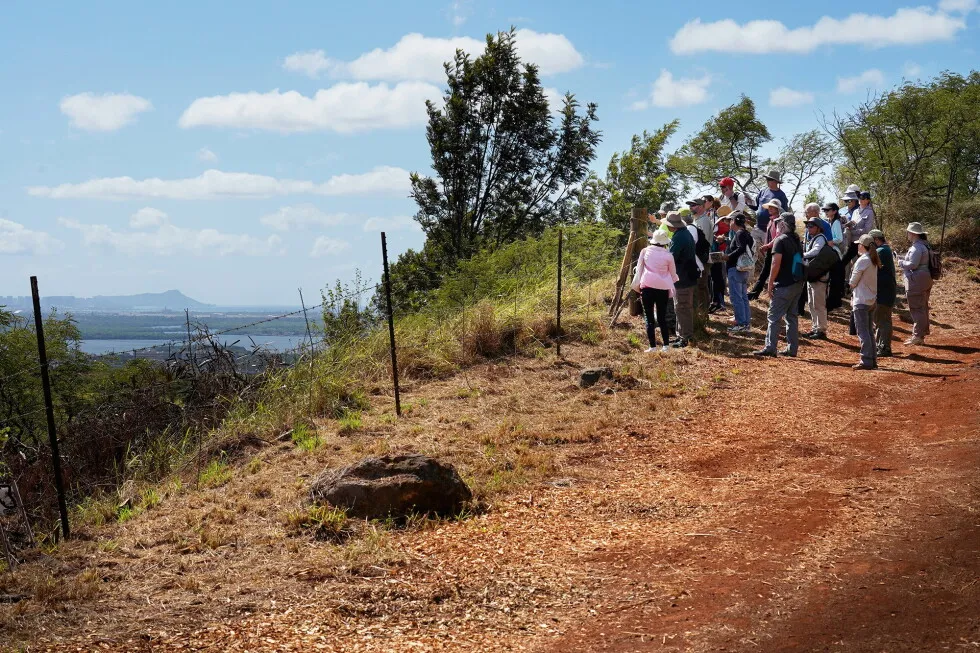
Honouliuli National Historic Site Superintendent Christine Ogura orients docents during training Saturday, Aug. 8, 2026, at Hawai’i Plantation Village in Waipahu, Hawaii. (Kevin Fujii/Civil Beat via AP) By HIKARI MAE HIDA and KEVIN FUJII/Honolulu Civil Beat Updated 11:09 PM MESZ, August 14, 2026 Add AP News on Google Add AP News as your preferred source to see more of our stories on Google. Share Share Facebook Copy Link copied Print Email X LinkedIn Bluesky Flipboard Pinterest Reddit Hours after Japanese war planes bombed Pearl Harbor and military installations across Oʻahu on December 7, 1941, martial law fell over the Hawaiian Islands. The military took control of the territory almost overnight. And the FBI, which had a list of suspects, began arresting people, including American citizens who had committed no crime. Within two years, in March 1943, the largest and longest-operating of Hawaiʻi’s 17 known wartime detention sites opened in a remote, sweltering gulch in central Oʻahu. It closed three years later. The prisoners who lived at Honouliuli gave it a bitter nickname: Jigoku Dani, or “Hell Valley” in Japanese, for the heat that pooled, windless, at the bottom of the ravine. This year marks 80 years since Honouliuli closed. On July 18, for the first time, the National Park Service opened its gates to the public in a pilot program. Free guided tours by a rotation of a dozen docent volunteers are held for up to 22 people once a month through the end of the year. More than 1,800 are already on the waiting list. “I don’t want local kids growing up not knowing that this happened in Hawaiʻi,” said Christine Ogura, superintendent with the National Park Service, in charge of Honouliuli since 2021. “It didn’t just happen on the mainland.” Executive Order 9066 was signed by President Franklin D. Roosevelt on February 19, 1942. It gave the military authority to remove people from designated areas of the country, and became the basis for forcibly relocating and incarcerating roughly 120,000 Japanese Americans on the West Coast and farther inland. This mainland incarceration is the story many know. Hawaii raises truck bed-riding age to 16 as roads get faster, testing a cherished island tradition 3 MIN READ Tropical Storm Genevieve forms in the Pacific Ocean as Hurricane Fausto strengthens to Category 2 4 MIN READ 40 The atomic bomb, a world-changing invention, inflicted suffering and launched the nuclear age 4 MIN READ 40 While most of the more than 2,000 Japanese Americans arrested in Hawaiʻi after Pearl Harbor were shipped to camps on the continent, roughly 400 were held in Hawaiʻi – first at a camp on Sand Island, and eventually at Honouliuli. The location was chosen because of its close proximity to Schofield Barracks. By the time it closed, the 160 acres of Honouliuli had also become the territory’s largest prisoner of war camp, holding close to 4,000 people at once. Most of those POWs were not Japanese soldiers at all, but Koreans and Okinawans who were conscripted into Japan’s imperial army, as well as Italian, German and other European Americans, who were taken on suspicion of disloyalty. At the time, almost 40% of Hawaiʻi’s population was of Japanese ancestry, so it would have been impossible to incarcerate them all. A large chunk of the labor force would have disappeared. Instead, there was a selective choosing process: Those who were influential to Japanese communities, such as journalists, politicians and religious leaders, were taken as individuals, as opposed to families, like on the West Coast. In total, less than 1% of those with Japanese ancestry were incarcerated in Hawaiʻi during the war. Walking a stretch of red dirt trail recently, cleared of the shoulder-high guinea grass and haole koa that once choked the path, Ogura, the superintendent, gestured at the tangle of non-native brush still crowding the slopes beyond, lined with barbed wire on the side. Ogura is Nisei, or second generation Japanese, and grew up in Hawaiʻi. She spent more than a decade working in wildlife conservation on the mainland before returning home for the job. She recalled reading about Honouliuli and realizing she had never learned this history. “It could have been me,” she said, “because it’s people exactly like me – my mom, my grandparents — who were targeted.” For decades after the war, almost no trace of the camp remained visible. The army tore down the buildings when it closed Honouliuli. The site’s location was essentially lost, known only through the memories of the dwindling number of people who had lived there. That changed in the late 1990s, when the Japanese Cultural Center of Hawaiʻi began to search for the site. In 2002, working from old photographs and sketches made by the internees, they matched the terrain to a gulch in Kunia. President Barack Obama designated Honouliuli a national monument in 2015. “While the treatment of Japanese Americans in Hawai’i differed from the treatment of Japanese Americans on the U.S. mainland,” he said at the time, “the legacy of racial prejudice, wartime hysteria and failure of political leadership during this period is common to the history of both Hawai’i and the mainland United States.” Congress designated it a National Historic Site in 2019. Among those who have spent years trying to keep the history of Honouliuli from disappearing again is Sharon Fujimoto-Johnson, a children’s book author, whose grandfather was incarcerated at the site. He was 29 and a U.S. citizen. As a little girl, her father had given her a small collection of shells that his father had gathered while he was incarcerated. Those objects eventually became the seed of her illustrated book, “ Shell Song,” which traces his story. When she finally visited Honouliuli in person last year with her younger daughter, she was struck by how deeply hidden the place still is. “You hike down, and it’s so deep down in this gulch,” she said. “You look up and you can’t really see anything, just walls of mountain on both sides.” Standing there, she thought of her grandfather arriving with no idea when, or if, he would ever leave. “I could feel more strongly, maybe, just a sense of despair that could have been something he felt,” she said. Her hope is that the park’s opening lets visitors reckon with the camp’s impact on many individual lives. “So often the Japanese American incarceration is talked about in this lump sum, the story that happened to this group of people,” she said. “But I really feel like when it’s broken down into individual stories, that hits at a different level.” Even as the first tours begin, much of Honouliuli’s physical record remains unexamined. The tour route itself is modest for now. Beginning at the Hawaii-plantation-village" class="entity-link entity-location" data-entity-id="185711" data-entity-type="location">Hawaiʻi Plantation Village, a shuttle sponsored by Pacific Historic Parks drives through University of Hawaiʻi-West Oʻahu land before arriving at the entrance. The trail runs down into the gulch, across the rehabilitated aqueduct, past a rock wall from the plantation days, and a low concrete slab that was once a mess hall where those incarcerated could meet visiting relatives, but only if they spoke English. The whole tour takes about 90 minutes. A mural at UH-West Oʻahu illustrates native plants such as wiliwili, which the park hopes to someday restore at scale. For now, a few seedlings survive on their own along a rocky embankment at the site, a small sign of what native habitat once looked like before sugar cane, and later guinea grass, took over the valley floor. Honouliuli was a part of the largest ahupuaʻa on island before James Campbell, an Irish real estate developer, purchased 41,000 acres of the ranch land in 1887. “I’m one of the many that didn’t quite know the history, especially with it being pretty much in our own backyard,” said Brandon Akiona, a graduate student and docent volunteer who led the first public tour last month. “It wasn’t really covered in school.” His own great-grandfather, he learned only recently, had been incarcerated at Sand Island, and then on the mainland. “Essentially, the time was taken away from them for nothing,” he said. “We want their story to have a purpose and for their experiences to be heard.” At the site, tiny yellow ʻilima flowers blossom in the foreground of a view of Pearl Harbor, which can be seen overlooking the gulch, a visual reminder of how the U.S. entered the war. “But what I think my park does to complement that,” Ogura, the superintendent, said, “is to show the true impact of that day on local communities.” This story was originally published by Honolulu Civil Beat and distributed through a partnership with The Associated Press.
SRCAssociated Press (AP)
LANGEN
LEANCenter
WORDS1 443
ENT12
FRI · 2026-08-14 · 21:23 GMTBRIEF NSR-2026-0814-102424
NSR-2026-0814-102424News Report·EN·Human Interest
In A Hidden Hawaiʻi Gulch, A Wartime Secret Opens To The Public
The Honouliuli National Historic Site in Hawaiʻi, a former wartime detention and prisoner of war camp, has opened to the public for the first time through a pilot program. Established in March 1943 and closing three years later, the site, nicknamed "Hell Valley," held approximately 400 Japanese Americans and nearly 4,000 prisoners of war, including Koreans, Okinawans, Italians, and Germans.
Associated Press (AP)Filed 2026-08-14 · 21:23 GMTLean · CenterRead · 6 min
Associated Press (AP)FIG 01
Reading time
6min
Word count
1 443words
Sources cited
1cited
Entities identified
12entities
Quality score
100%
§ 01
Briefing Summary
AI-generatedNEWSAR · AI
The Honouliuli National Historic Site in Hawaiʻi, a former wartime detention and prisoner of war camp, has opened to the public for the first time through a pilot program. Established in March 1943 and closing three years later, the site, nicknamed "Hell Valley," held approximately 400 Japanese Americans and nearly 4,000 prisoners of war, including Koreans, Okinawans, Italians, and Germans. Unlike the mainland, Hawaiʻi incarcerated less than 1% of its Japanese ancestry population, focusing on influential individuals. The site, designated a national monument in 2015 and historic site in 2019, aims to educate the public about this often-overlooked history. Free guided tours are now offered monthly, with significant public interest and a long waiting list.
Confidence 0.90Sources 1Claims 5Entities 12
§ 02
Article analysis
Model · rule-basedFraming
Human Interest
Social Justice
Tone
Measured
AI-assessed
CalmNeutralAlarmist
Factuality
0.80 / 1.00
Factual
LowHigh
Sources cited
1
Limited
FewMany
§ 03
Key claims
5 extracted01
Christine Ogura, superintendent of Honouliuli, stated, 'I don’t want local kids growing up not knowing that this happened in Hawaiʻi. It didn’t just happen on the mainland.'
quoteChristine Ogura
Confidence
1.00
02
Roughly 400 Japanese Americans arrested in Hawaiʻi after Pearl Harbor were held in Hawaiʻi, with some eventually incarcerated at Honouliuli.
factual
Confidence
1.00
03
More than 1,800 people are already on the waiting list for free guided tours of Honouliuli.
statistic
Confidence
1.00
04
The National Park Service opened Honouliuli National Historic Site to the public for the first time on July 18 in a pilot program.
factual
Confidence
1.00
05
Honouliuli, Hawaiʻi's largest and longest-operating wartime detention site, opened in March 1943 and closed three years later.
factual
Confidence
1.00
§ 04
Full report
6 min read · 1 443 words§ 05
Entities
12 identifiedKey playerOppositionContextPositiveNeutralNegative
People3
Organizations2
Locations6
§ 06
Keywords & salience
10 termshonouliuli national historic site
1.00
wartime detention
0.90
japanese americans
0.80
pearl harbor attack
0.70
martial law
0.60
world war ii
0.50
public access
0.50
incarceration
0.40
hawaiʻi
0.40
executive order 9066
0.40
§ 07
Topic connections
Interactive graph Network visualization showing 41 related topics
View Full Graph Person Organization Location Event|Click node to navigate|Edge numbers = shared articles