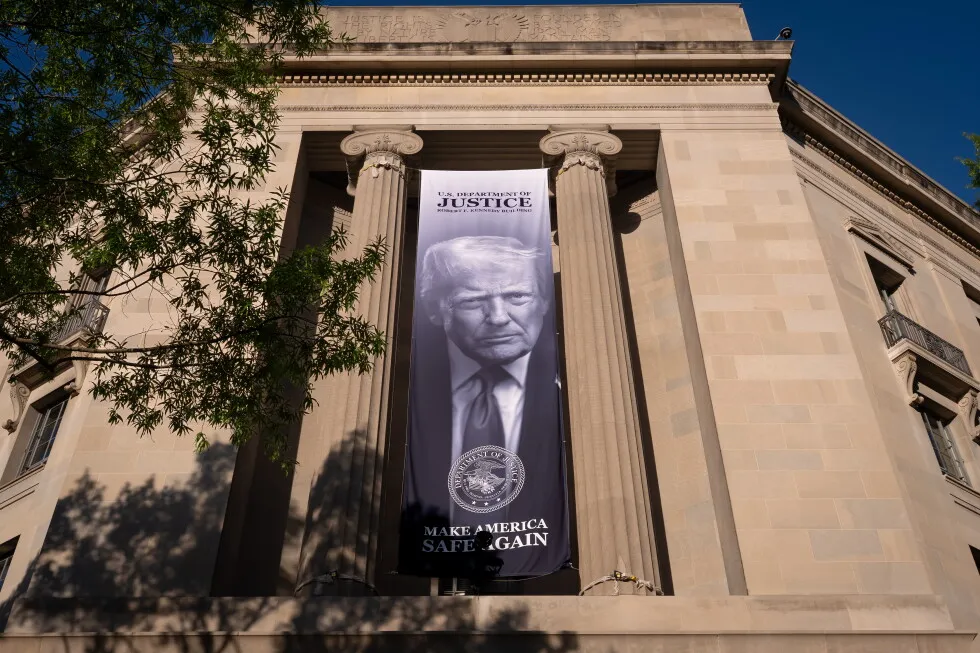
A portrait of President Donald Trump is displayed at the Justice Department building in Washington, June 2, 2026. (AP Photo/J. Scott Applewhite, File) Updated [hour]:[minute] [AMPM] [timezone], [monthFull] [day], [year] President Donald Trump’s goal of ending gender-affirming care is not improper and cannot be the basis for quashing a subpoena issued by the Justice Department against a provider of medical treatment for transgender youth, a divided federal appeals court ruled Friday.The Justice Department announced last year that it had issued more than 20 subpoenas to doctors and clinics that provide gender-affirming care as part of an effort to investigate healthcare fraud. Federal judges have quashed many of the subpoenas as illegitimate efforts to intimidate providers into ending care.In a 2-1 decision, a panel of the 9th U.S. Circuit Court of Appeals said the efficacy and long-term risks of the treatments are “uncertain,” and the president has the power to align the Justice Department’s enforcement priorities with his broader policy goals.“Every President has law enforcement priorities, just as every President has signature policies (often, the former are components of the latter),” Judge Carlos Bea wrote. Bea, a nominee of Republican President George W. Bush, was joined in the opinion by Daniel Bress, a Trump nominee. They reversed a ruling that quashed the subpoena against telemedicine provider QueerDoc, sending the case back to the district court to consider other arguments.The subpoena seeks QueerDoc’s personnel files, billing documents, communications with drug manufacturers and records of patients who were prescribed puberty blockers or hormone therapy, among other information, according to the 9th Circuit decision. 2 MIN READ 2 MIN READ 3 MIN READ American Civil Liberties Union attorney Adrien Leavitt, who represented Washington state-based QueerDoc, said the ACLU would continue fighting the subpoena in district court. QueerDoc has also argued the subpoena is overbroad and burdensome. The Justice Department has said it has reason to believe the company may be misleading people about puberty blockers and hormones. “We’re ready to continue defending one of the most fundamental principles of healthcare: every patient’s right to confidential medical care,” Leavitt said in a statement. He said the San Francisco-based 9th Circuit was the first appeals court to weigh in on the subpoenas. Trump has signed one executive order defining sex as only male or female — and as unchangeable — and another that seeks to end federal funding of the care for patients under 19. The latter order also directs the Justice Department to “prioritize investigations” into violations of a drug safety law by “any entity that may be misleading the public about long-term side effects of chemical and surgical mutilation.”gender-affirming care includes a range of medical and mental health services to support a person’s gender identity, including when it’s different from the sex they were assigned at birth. It encompasses counseling, medications that block puberty and hormone therapy to produce physical changes as well as surgeries to transform chests and genitals, though those are rare for minors.Most major medical groups say access to the treatment is important for those with gender dysphoria and see gender as existing along a spectrum. The 9th Circuit majority called discussion around gender-affirming care “an unsettled scientific debate,” and said the Trump administration could also justify its opposition to the treatment on ethical or philosophical grounds.
SRCAssociated Press (AP)
LANGEN
LEANCenter
WORDS546
ENT12
FRI · 2026-08-14 · 20:53 GMTBRIEF NSR-2026-0814-102429
NSR-2026-0814-102429News Report·EN·Legal & Judicial
Appeals court sides with Trump in fight over subpoena of gender-affirming care provider
A divided federal appeals court ruled that President Trump's goal of ending gender-affirming care is not improper and cannot be the basis for quashing a Justice Department subpoena. The Justice Department issued over 20 subpoenas to gender-affirming care providers as part of a healthcare fraud investigation.
By
SUDHIN THANAWALAAssociated Press (AP)Filed 2026-08-14 · 20:53 GMTLean · CenterRead · 3 min
Associated Press (AP)FIG 01
Reading time
3min
Word count
546words
Sources cited
3cited
Entities identified
12entities
Quality score
100%
§ 01
Briefing Summary
AI-generatedNEWSAR · AI
A divided federal appeals court ruled that President Trump's goal of ending gender-affirming care is not improper and cannot be the basis for quashing a Justice Department subpoena. The Justice Department issued over 20 subpoenas to gender-affirming care providers as part of a healthcare fraud investigation. In a 2-1 decision, the 9th U.S. Circuit Court of Appeals stated that the president can align enforcement priorities with policy goals, reversing a lower court's decision to quash a subpoena against telemedicine provider QueerDoc. The subpoena seeks patient records, billing documents, and communications. The ACLU, representing QueerDoc, plans to continue fighting the subpoena, arguing it is overbroad and burdensome. The court majority cited "uncertain" efficacy and risks of the treatments, while the Justice Department suspects misleading information about puberty blockers and hormones.
Confidence 0.90Sources 3Claims 5Entities 12
§ 02
Article analysis
Model · rule-basedFraming
Legal & Judicial
Political Strategy
Tone
Measured
AI-assessed
CalmNeutralAlarmist
Factuality
0.80 / 1.00
Factual
LowHigh
Sources cited
3
Well sourced
FewMany
§ 03
Key claims
5 extracted01
Trump has signed executive orders seeking to end federal funding for gender-affirming care for patients under 19.
factualArticle
Confidence
1.00
02
The ACLU will continue fighting the subpoena in district court, arguing it is overbroad and burdensome.
factualAdrien Leavitt (ACLU)
Confidence
1.00
03
The efficacy and long-term risks of gender-affirming treatments are uncertain.
quoteJudge Carlos Bea
Confidence
1.00
04
The Justice Department issued more than 20 subpoenas to doctors and clinics providing gender-affirming care as part of a healthcare fraud investigation.
factualJustice Department
Confidence
1.00
05
A divided federal appeals court ruled that President Trump's goal of ending gender-affirming care is not improper and cannot be the basis for quashing a DOJ subpoena.
factual9th U.S. Circuit Court of Appeals
Confidence
1.00
§ 04
Full report
3 min read · 546 words§ 05
Entities
12 identifiedKey playerOppositionContextPositiveNeutralNegative
People5
Organizations4
§ 06
Keywords & salience
10 termsgender-affirming care
1.00
subpoena
0.90
justice department
0.80
donald trump
0.80
healthcare fraud
0.70
transgender youth
0.70
queerdoc
0.60
appeals court
0.60
puberty blockers
0.50
hormone therapy
0.50
§ 07
Topic connections
Interactive graph Network visualization showing 51 related topics
View Full Graph Person Organization Location Event|Click node to navigate|Edge numbers = shared articles