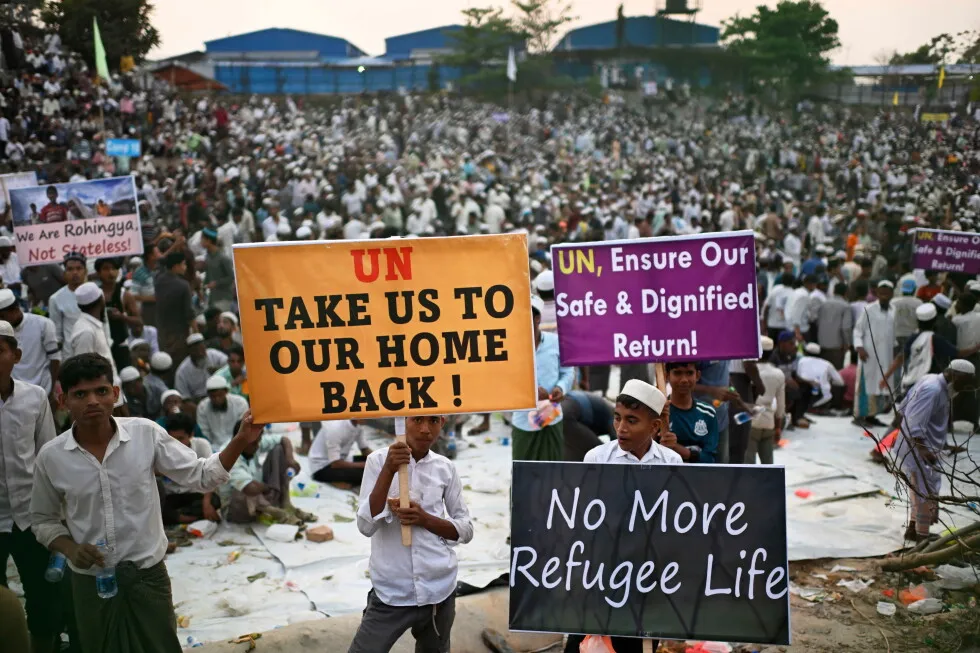
FILE- Rohingya refugee children carry banners during a visit by U.N. Secretary-General António Guterres at the Ukhiya camp in Cox’s Bazar, in Bangladesh, March 14, 2025. (AP Photo/Mahmud Hossain Opu, File) Updated 7:47 AM MESZ, August 15, 2026 Add AP News on Google Add AP News as your preferred source to see more of our stories on Google. Share Share Facebook Copy Link copied Print Email X LinkedIn Bluesky Flipboard Pinterest Reddit BANGKOK (AP) — Myanmar’s military-backed government said Saturday that more than 300,000 Rohingya refugees living in camps in Bangladesh are former residents of western Rakhine State and that it will accept their return once security conditions improve. The Ministry of Foreign Affairs statement comes as the Rohingya refugee crisis enters its ninth year, with hundreds of thousands of refugees still living in camps in Bangladesh after fleeing Myanmar in August 2017 when the military launched a crackdown following attacks by a Rohingya-insurgent-group" class="entity-link entity-organization" data-entity-id="185932" data-entity-type="organization">Rohingya insurgent group on guard posts in Rakhine. The operation drove more than 700,000 Rohingya across the border into Bangladesh, joining hundreds of thousands of others already living there for decades in the wake of waves of previous violence perpetrated by Myanmar’s military. The scale, organization and ferocity of the operation led to accusations of ethnic cleansing and genocide from the international community, including the U.N. Myanmar, formerly known as Burma, does not recognize the Rohingya as one of the country’s 135 lawful ethnic minorities, instead referring to them as Bengalis to imply they are natives from Bangladesh and are illegally settled in Myanmar. Myanmar said it had verified 426,545 of the 828,824 refugees on a list provided by Bangladesh as of the end of July, and determined that 308,797 of those verified were former residents of Rakhine. More than 500 feared dead as officials investigate reports of boats capsizing with Rohingya refugees 5 MIN READ Malaysia begins screening 5,000 refugees for their planned return to Myanmar 1 MIN READ Myanmar’s military has escalated airstrikes against civilians, UN investigation finds 1 MIN READ The Ministry of Foreign Affairs said 113,507 people could not be verified and that 4,241 people were found to have been involved in what it called terrorist activities. The statement said it will continue working with Bangladesh to receive verified former residents when the security situation in Rakhine becomes more stable. The ministry also rejected claims that more than 1 million people were displaced from Rakhine, saying that more than 540,000 people crossed into Bangladesh after the violence in 2017 while more than 200,000 remained in northern Rakhine. Myanmar and Bangladesh agreed to a two-year repatriation process in 2018. However, security in Myanmar worsened following an army takeover in 2021 that ousted the elected government of Aung San Suu Kyi, triggering widespread armed resistance. Plans to repatriate the refugees have not succeeded. The renewed chaos brought about by fighting between the Rakhine-based ethnic Arakan Army group and the military over control of the region in 2023 forced more refugees to flee toward Bangladesh and elsewhere in a desperate move to save their lives. The Arakan Army controls much of Rakhine after capturing territory from the military in recent years. In recent years, poor conditions in refugee camps, steep cuts to foreign aid and the lack of safe prospects for returning to Myanmar have led to an increasing number of Rohingya refugees attempting to make the dangerous ocean crossing to Malaysia and Indonesia on rickety boats. Malaysian Prime Minister Anwar Ibrahim said in late July that Myanmar had agreed to take back 5,000 Rohingya refugees currently living in Malaysia as part of a repatriation program. However, an official from Myanmar’s foreign ministry, Han Win Aung, told The Associated Press at the time that the repatriation program was focused solely on verified Myanmar nationals currently held in detention centers in Malaysia and rejected reports that the government would accept Rohingya.
SRCAssociated Press (AP)
LANGEN
LEANCenter
WORDS644
ENT12
SAT · 2026-08-15 · 05:53 GMTBRIEF NSR-2026-0815-102500
NSR-2026-0815-102500News Report·EN·Conflict
Myanmar says over 300,000 Rohingya refugees verified for repatriation as exodus enters ninth year
Myanmar's military-backed government announced that over 300,000 Rohingya refugees in Bangladesh have been verified as former residents of Rakhine state and are eligible for repatriation once security improves. This statement comes as the Rohingya refugee crisis enters its ninth year, following a 2017 military crackdown that displaced over 700,000 people.
Associated Press (AP)Filed 2026-08-15 · 05:53 GMTLean · CenterRead · 3 min
Associated Press (AP)FIG 01
Reading time
3min
Word count
644words
Sources cited
2cited
Entities identified
12entities
Quality score
100%
§ 01
Briefing Summary
AI-generatedNEWSAR · AI
Myanmar's military-backed government announced that over 300,000 Rohingya refugees in Bangladesh have been verified as former residents of Rakhine state and are eligible for repatriation once security improves. This statement comes as the Rohingya refugee crisis enters its ninth year, following a 2017 military crackdown that displaced over 700,000 people. Myanmar stated it verified 308,797 individuals from a list provided by Bangladesh, with others unverified or deemed involved in terrorist activities. Repatriation plans agreed upon in 2018 have been unsuccessful, exacerbated by Myanmar's 2021 military takeover and subsequent fighting in Rakhine. Recent years have seen increased dangerous sea crossings by Rohingya due to poor camp conditions and lack of safe return prospects.
Confidence 0.90Sources 2Claims 5Entities 12
§ 02
Article analysis
Model · rule-basedFraming
Conflict
Diplomatic
Tone
Measured
AI-assessed
CalmNeutralAlarmist
Factuality
0.80 / 1.00
Factual
LowHigh
Sources cited
2
Limited
FewMany
§ 03
Key claims
5 extracted01
International community has accused Myanmar of ethnic cleansing and genocide.
factualinternational community
Confidence
1.00
02
Myanmar stated it verified 426,545 out of 828,824 refugees provided by Bangladesh.
statisticMyanmar's Ministry of Foreign Affairs
Confidence
1.00
03
Myanmar does not recognize the Rohingya as a lawful ethnic minority, calling them 'Bengalis'.
factual
Confidence
1.00
04
Rohingya refugee crisis enters its ninth year.
factual
Confidence
1.00
05
Myanmar's government claims over 300,000 Rohingya refugees verified for repatriation.
statisticMyanmar's military-backed government
Confidence
1.00
§ 04
Full report
3 min read · 644 words§ 05
Entities
12 identifiedKey playerOppositionContextPositiveNeutralNegative
Organizations3
Locations6
§ 06
Keywords & salience
8 termsrohingya refugees
1.00
myanmar repatriation
0.90
rakhine state
0.80
rohingya crisis
0.70
ethnic cleansing
0.60
bangladesh camps
0.50
military crackdown
0.50
genocide accusations
0.40
§ 07
Topic connections
Interactive graph Network visualization showing 51 related topics
View Full Graph Person Organization Location Event|Click node to navigate|Edge numbers = shared articles