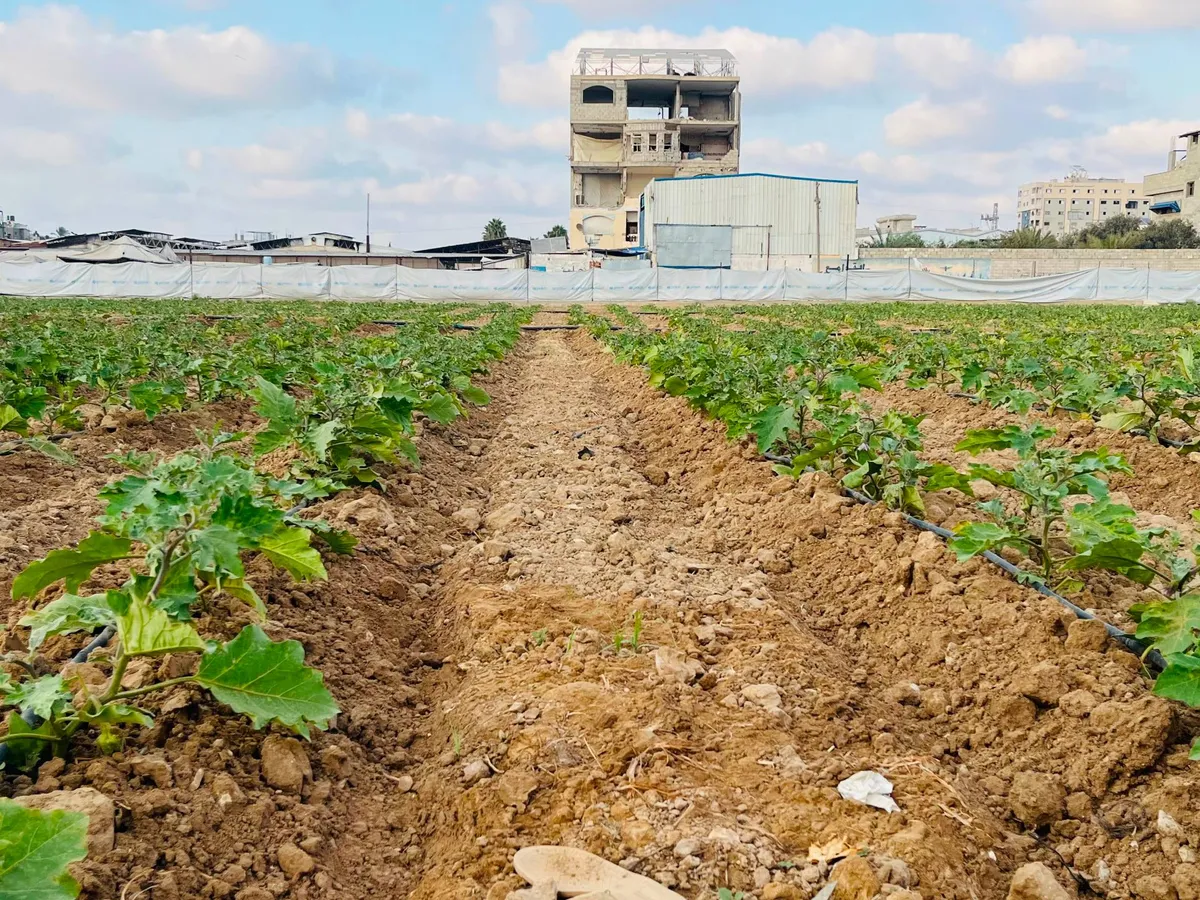
Greenhouses and rented plots are lifelines for Gaza’s farmers, helping them grow crops despite the extensive destruction.Many farmers in Gaza have set up new plots after losing their farms to Israeli attacks [Eman Abu Zayed/Al Jazeera]Published On 15 Aug 2026Nuseirat, Gaza Strip – Mohammad al-Halabi, 50, bends over tomato and eggplant seedlings in a 300-square-metre plot in the middle of central Gaza’s Nuseirat refugee camp, inspecting the leaves, watering the plants and monitoring their growth.The small plot he is tending is an attempt to reclaim his old profession as a farmer with his father, Marwan, on their land in northern Gaza’s Jabalia.Recommended Stories list of 4 itemslist 1 of 4Palestine weekly: West Bank in flames after Tal killingslist 2 of 4Who is behind settler violence in the occupied West Bank?list 3 of 4Palestinians in occupied West Bank hold firm on Indigenous Peoples’ Daylist 4 of 4Fear and attacks grip Taybeh, the last all-Christian town in the West Bankend of listAl-Halabi once owned a much bigger plot of farmland – around 40,000 square metres (about 10 acres) – in northern Gaza, where he grew strawberries, tomatoes, flowers, potatoes and eggplants. His four children – Mahmoud, 30, Reham, 27, Issa, 24, and Omar, 20 – also worked with him and relied on farming as a source of income for the family.“I have been working in agriculture since I was a child,” al-Halabi said. “The land is my life, and I have spent my whole life farming it.”Al-Halabi says his entire farmland was bulldozed in February 2024 by Israeli forces, as part of their general destruction of Jabalia. Al-Halabi’s land there is now covered with rubble and remnants of war, including what he described as remnants of missiles and other weapons.He believes it will require extensive rehabilitation work before it can be farmed again.So, for now, al-Halabi’s focus is on his small plot in Nuseirat, which he began renting at the start of the war, after his displacement. He began growing whatever he could obtain.“Agriculture is my profession,” al-Halabi said. “Even after being displaced, I couldn’t leave it. I found a small piece of land and planted whatever I could get.”The plot produces only a few kilogrammes of each crop he grows, barely enough for his family, and is too small to generate enough produce for sale.“When I see the plant growing and producing a fruit, I feel that I can still farm,” al-Halabi said. “The land is small, but it has potential, and hopefully it will produce a crop.”Data from Gaza’s Government Media Office illustrates the scale of the damage to the agricultural sector.Farmers work on a patch of land in Gaza [Eman Abu Zayed]More than 87 percent of Gaza’s agricultural land has been destroyed. About 8,700 agricultural wells have also been destroyed and put out of service, while 7,748 cattle, sheep and poultry farms have been destroyed. More than 87 percent of greenhouses have also been damaged. Annual vegetable and fruit production has fallen from about 524,000 tonnes to approximately 20,000.Naser Deeb, director-general of the Agricultural Extension at Gaza’s Ministry of Agriculture, says the damage extends beyond crops to farmland, water sources, irrigation networks, wells and agricultural facilities. Deeb says he has visited and assessed several damaged agricultural sites across Gaza, though he did not inspect al-Halabi’s land.Deeb said damaged farmland would need extensive rehabilitation before production could resume.“Farmers today are facing several problems at the same time,” Deeb says. “Even if a farmer returns to his land, that does not mean the land is ready for cultivation. The soil needs to be rehabilitated, water sources and irrigation systems repaired, and seeds, fertilisers and equipment provided.”And the impact of these issues, Deeb says, is affecting farming families and markets across Gaza, reducing the availability of fresh vegetables and making it harder for farmers to restore their livelihoods.New farmSome farmers are trying to rebuild through small-scale projects.Mohammad Abdul Naser Hassan al-Jadba, 40, from Sheikh Ajleen in Gaza City, lost his source of income during the war after his farmland ended up on the wrong side of the “Yellow Line”, the boundary in Gaza behind which Israeli forces operate and control.Israeli soldiers have killed Palestinians who have strayed too close to the line, and al-Jadba knows that it is too dangerous for him to even try to access his farmland. Instead, he resigned himself to renting a small plot in Deir el-Balah, where he has established a nursery and greenhouse to grow tomatoes, eggplants and peppers.Al-Jadba received some funding from a Belgian development fund, which he used to build the greenhouse and obtain agricultural supplies.“Before renting the farm, my income was zero,” al-Jadba said. “Today, I can support my family, and my monthly income has reached around 3,000 shekels [$1,015] a month.”He has also been able to employ two farmers on a permanent basis inside the greenhouse. Both had previously been unemployed.“For me, this project was not just agricultural support,” al-Jadba said. “It was a real opportunity to return to work, regain my source of income and become self-reliant again.”
SRCAl Jazeera
LANGEN
LEANCenter
WORDS837
ENT12
SAT · 2026-08-15 · 06:10 GMTBRIEF NSR-2026-0815-102540
NSR-2026-0815-102540News Report·EN·Human Interest
Small-scale projects offer hope for Gaza farmers rebuilding lives
Gaza's farmers are attempting to rebuild their livelihoods through small-scale agricultural projects following extensive destruction of their land and farms. Many, like Mohammad al-Halabi, have lost large farms to Israeli forces and are now renting small plots or utilizing greenhouses to grow crops.
Eman Abu ZayedAl JazeeraFiled 2026-08-15 · 06:10 GMTLean · CenterRead · 4 min
Al JazeeraFIG 01
Reading time
4min
Word count
837words
Sources cited
1cited
Entities identified
12entities
Quality score
100%
§ 01
Briefing Summary
AI-generatedNEWSAR · AI
Gaza's farmers are attempting to rebuild their livelihoods through small-scale agricultural projects following extensive destruction of their land and farms. Many, like Mohammad al-Halabi, have lost large farms to Israeli forces and are now renting small plots or utilizing greenhouses to grow crops. This shift is a response to the widespread damage, with over 87 percent of agricultural land and most greenhouses destroyed, severely impacting food production. Despite these challenges, initiatives like renting plots and establishing nurseries are providing some farmers with income and a sense of continuity. These efforts aim to overcome the obstacles of damaged soil, water sources, and lack of resources, offering a glimmer of hope for the future of farming in Gaza.
Confidence 0.90Sources 1Claims 5Entities 12
§ 02
Article analysis
Model · rule-basedFraming
Human Interest
Economic Impact
Tone
Measured
AI-assessed
CalmNeutralAlarmist
Factuality
0.60 / 1.00
Mixed
LowHigh
Sources cited
1
Limited
FewMany
§ 03
Key claims
5 extracted01
The small plot Mohammad al-Halabi is currently tending produces barely enough for his family and is too small for sale.
quoteMohammad al-Halabi
Confidence
1.00
02
Mohammad al-Halabi's 40,000 square meter farm in northern Gaza was bulldozed by Israeli forces in February 2024.
quoteMohammad al-Halabi
Confidence
1.00
03
Farmers are using small plots and greenhouses to grow crops despite extensive destruction in Gaza.
factual
Confidence
0.95
04
About 8,700 agricultural wells in Gaza have been destroyed and put out of service.
statisticGaza's Government Media Office
Confidence
0.90
05
Over 87 percent of Gaza's agricultural land has been destroyed.
statisticGaza's Government Media Office
Confidence
0.90
§ 04
Full report
4 min read · 837 words§ 05
Entities
12 identifiedKey playerOppositionContextPositiveNeutralNegative
People6
§ 06
Keywords & salience
8 termsgaza farmers
1.00
rebuilding lives
0.90
small-scale projects
0.80
agricultural destruction
0.70
crop cultivation
0.60
displacement
0.50
food security
0.40
resilience
0.40
§ 07
Topic connections
Interactive graph Network visualization showing 51 related topics
View Full Graph Person Organization Location Event|Click node to navigate|Edge numbers = shared articles