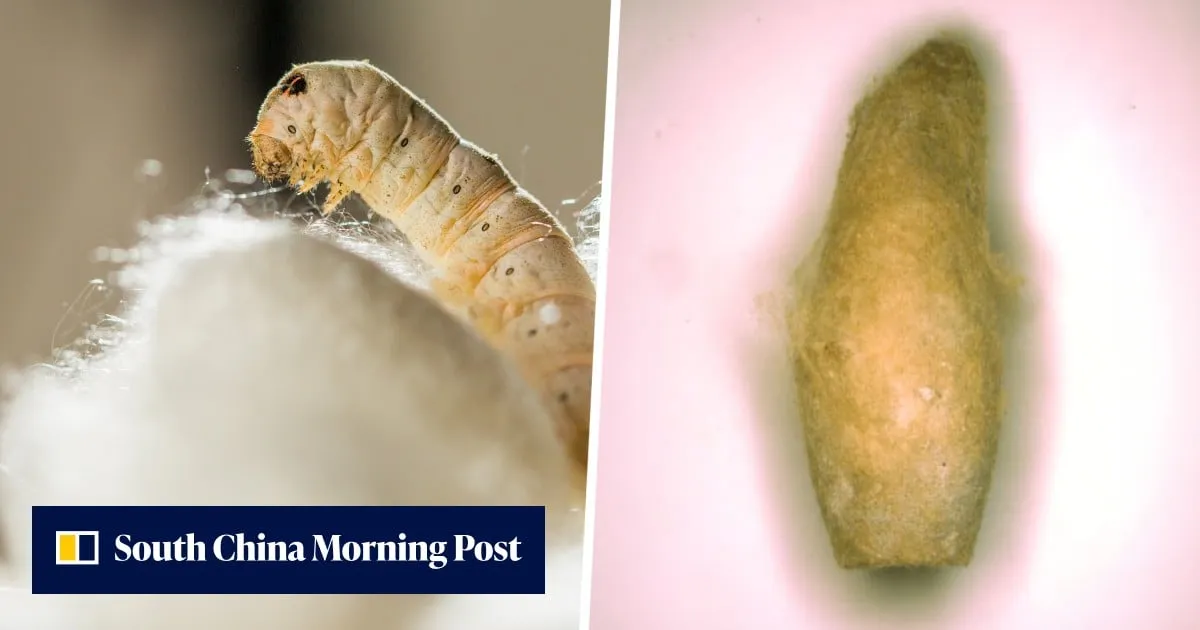
It may not be the most majestic creature on our beautiful planet, but the humble Silkworm deserves a place alongside horses, cattle, cats, and dogs due to its profound impact on human civilisation.The luxurious fabric spun from the Silkworm’s natural secretion ignited the creation of a vast global trade network, connecting Asia with the Mediterranean. This network became a catalyst for transformative exchanges of goods, ideas, and technologies across continents, significantly shaping the course of world history.However, the history of silk predates the Silk Road, with archaeological excavations suggesting its origins lie within the Yangshao culture (5000 BC–3000 BC) during Neolithic China.A comparative analysis of ancient Silkworm cocoons discovered at the Sapalli Tepe site, a significant Bronze Age archaeological location in southern Uzbekistan. Photo: X. Zhou/IVPP, CASNow, a new study from Washington University in St. Louis suggests that the Silkworm cocoons left China far earlier than previously thought.The researchers, whose work was published in the peer-reviewed scientific journal Science Advances, discovered three Silkworm cocoons along the Surkhan-Darya River, which flows across southeast Uzbekistan between Tajikistan and Afghanistan.The scientists estimated that these cocoons are about 4,000 years old, indicating they were transferred to Central Asia around 2,000 years before the traditional narrative of the luxurious garb’s spread along the Silk Road.A map indicating the locations of sites associated with pre-Han silk findings in the Old World. Photo: X. Zhou/IVPP, CASXinyi Liu, a professor of archaeology at Washington University and lead author for the study, stated that the Silkworm artefact in question is the oldest known reliable example of a Silkworm cocoon.“Even in China, where the Silkworm moth was domesticated, we don’t have preserved cocoons as old as this, partly due to challenges with archaeological preservation,” he explained.The cocoons were identified as Bombyx mori, the species that was first domesticated in China thousands of years ago and remains the primary insect used in Chinese silk production.Found in an arid region alongside wood charcoal and plant seed remains, the wood charcoal is significant because some pieces were confirmed to belong to mulberry trees, which are the principal food source for silkworms.The Silkworm, the larval stage of the domestic silk moth (Bombyx mori), plays a crucial economic role as a primary silk producer, particularly in Thailand. Photo: Shutterstock“The evidence of the mulberry tree is quite important,” Liu noted. “Ecologically, these trees are not native to Central Asia and could adapt to the southern Himalayan environment much better than the northern arid environment.”The mulberry remains were discovered alongside fossilised pieces of citrus trees, leading researchers to propose that the cocoons likely arrived in Uzbekistan via Himalayan or South Asian routes, as citrus trees would struggle to thrive in the harsh desert environment of Western China.What perplexed Liu was the apparent disconnect: clear evidence of early silk cultivation in Uzbekistan 4,000 years ago, yet little indication that this knowledge resulted in sustained sericulture (silk production) in the region.The cocoon discovery also added a vital data point to the increasingly nuanced discussion about the origins of silk. While all archaeological evidence still points to its emergence from ancient China, there is growing belief that other silk-manufacturing cultures developed in different parts of the world during similar times, likely using distinct insect cocoons.The Silkworm, the caterpillar of the domestic silk moth (Bombyx mori), is a vital economic contributor, recognised as a major silk producer. Photo: Shutterstock“Other claims for pre-Han (before 202 BC) silks have been reported from several European and African sites. However, many of these purported pre-Han silk occurrences outside China have been challenged on methodological grounds or remain subject to further scrutiny,” the authors noted.Further ReadingThe team emphasised that the research provides another opportunity to re-examine the traditional Silk Road timeline. This news, along with discoveries related to millet trade, suggests vibrant trade relationships between China and Central Asia well before the formal establishment of the Silk Road.“Our results also raise the question of whether multiple forms of sericulture were widespread across Asia during the second and third millennia BC, earlier than has been previously recognised,” the authors concluded.
SRCSouth China Morning Post
LANGEN
LEANCenter-Right
WORDS673
ENT12
SAT · 2026-08-15 · 08:00 GMTBRIEF NSR-2026-0815-102547
NSR-2026-0815-102547News Report·EN·Economic Impact
Evidence of earliest silkworm farming outside China found, upending Silk Road timeline
Archaeologists have discovered approximately 4,000-year-old silkworm cocoons in southern Uzbekistan, suggesting silk production knowledge spread from China much earlier than previously believed. These cocoons, identified as *Bombyx mori*, predate the traditional Silk Road timeline by about 2,000 years.
Kevin McSpaddenSouth China Morning PostFiled 2026-08-15 · 08:00 GMTLean · Center-RightRead · 3 min
South China Morning PostFIG 01
Reading time
3min
Word count
673words
Sources cited
2cited
Entities identified
12entities
Quality score
100%
§ 01
Briefing Summary
AI-generatedNEWSAR · AI
Archaeologists have discovered approximately 4,000-year-old silkworm cocoons in southern Uzbekistan, suggesting silk production knowledge spread from China much earlier than previously believed. These cocoons, identified as *Bombyx mori*, predate the traditional Silk Road timeline by about 2,000 years. The discovery, published in *Science Advances*, also includes evidence of mulberry trees, the silkworms' primary food source, which are not native to the region. Researchers propose the cocoons likely arrived in Central Asia via Himalayan or South Asian routes. This finding challenges existing timelines and raises questions about the potential for multiple, independent sericulture developments across Asia during the second and third millennia BC.
Confidence 0.90Sources 2Claims 5Entities 12
§ 02
Article analysis
Model · rule-basedFraming
Economic Impact
Technology
Tone
Mixed Tone
AI-assessed
CalmNeutralAlarmist
Factuality
0.80 / 1.00
Factual
LowHigh
Sources cited
2
Limited
FewMany
§ 03
Key claims
5 extracted01
Mulberry tree remains were found alongside the silkworm cocoons, indicating their food source was present.
factual
Confidence
0.95
02
Three silkworm cocoons estimated to be 4,000 years old were discovered in southeast Uzbekistan.
factualWashington University in St. Louis researchers
Confidence
0.95
03
The discovered silkworm cocoons are the oldest known reliable example of a silkworm cocoon.
quoteXinyi Liu
Confidence
0.90
04
Evidence of earliest silkworm farming outside China found, upending Silk Road timeline.
factual
Confidence
0.90
05
Cocoons likely arrived in Uzbekistan via Himalayan or South Asian routes, based on associated citrus tree fossils.
factualResearchers
Confidence
0.75
§ 04
Full report
3 min read · 673 words§ 05
Entities
12 identifiedKey playerOppositionContextPositiveNeutralNegative
People1
Organizations2
Locations7
Topics1
§ 06
Keywords & salience
10 termssilk road timeline
1.00
silkworm farming
1.00
archaeological findings
0.90
central asia
0.80
uzbekistan
0.70
bombyx mori
0.70
bronze age
0.60
ancient trade
0.50
mulberry trees
0.40
human civilization
0.40
§ 07
Topic connections
Interactive graph No topic relationship data available yet. This graph will appear once topic relationships have been computed.