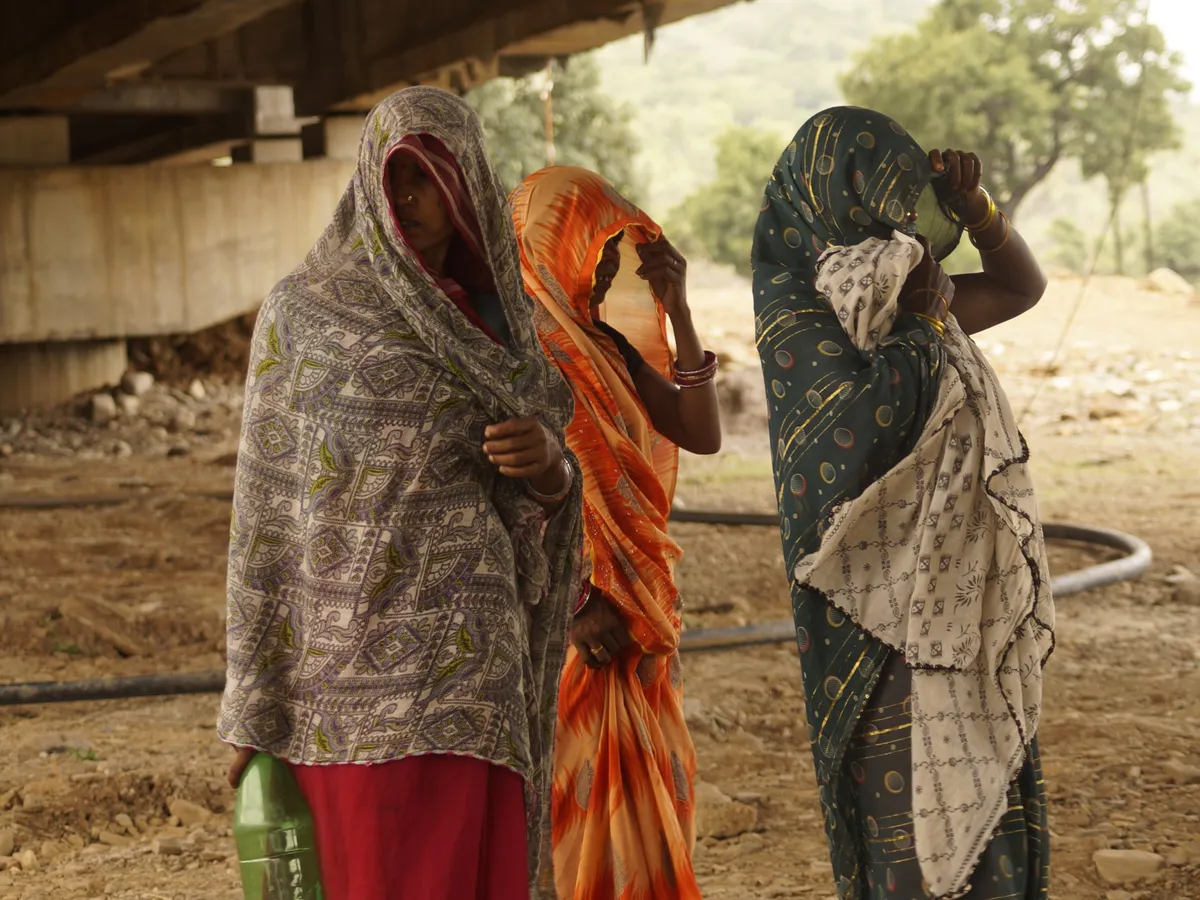
In the village, Gyan Rani’s daughter-in-law Pooja Gond meets a visitor at the door of her home and offers a cup of sweet black tea.Pooja is 21 years old, slight and soft-spoken, with a swelling on the right side of her face from a bee sting the night before. She speaks in a quiet, flat voice, the kind that comes not from shyness alone but from a deeper exhaustion, the exhaustion of someone who has already lost too much to spend energy on expression.She was one year into her marriage when her husband Parshuram died. He was a daily wage labourer. He developed severe abdominal swelling. The family sought treatment from a local doctor, but Parshuram's condition worsened. No formal diagnosis or post-mortem was ever carried out. Their one-year-old son later died after what the family believes was typhoid fever, although there was no formal medical confirmation.Pooja has not received a single rupee in compensation. Neither has her sister-in-law, who has voted but whom officials describe as underage. Pooja herself does not receive a widow's pension. Officials tell her she is too young for that too.The compensation built two small rooms. That is all the family has to show for the home they are losing.When Pooja approached officials after Parshuram's death, she was told her name was not on the compensation list. If she wanted it added, the Gram Panchayat secretary told her, she would need to pay 100,000 Indian rupees [$1,050]. She did not have this money.The secretary sits in Kishangarh, 10km (6 miles) from Pathapur. Pooja walked there. She also travelled by bus to the district headquarters in Chhatarpur, carrying her documents. She spent 800 Indian rupees ($8) of her own money on the journeys.Each time, officials collected her papers. Each time, nothing happened.“Bina paise ke koi baat nahi sunta,” she says quietly. Without money, nobody listens.The remains of one of the two homes occupied by Pooja Gond’s family in Pathapur village [Chandra Pratap Tiwari/Al Jazeera]One of the two houses her family occupied was demolished without notice. Pooja was there as neighbours watched and the family asked officials to stop. Nobody listened.Officials told her mother-in-law they were demolishing this house first. Nobody told the family where they were expected to go.They moved into the house that remains.It is a small mud house with white walls and a hay-and-terracotta-tiled roof. Faded tribal hand-painted art runs along the walls, its colours worn thin by rain and time. A wooden door opens into a small courtyard. Inside, a wood-fired mud oven sits in the kitchen.This house is next. Pooja knows that, but she does not know where she will go.If relocation becomes unavoidable, she says she wants to remain close to the forest. She does not want to move to a city.“It would have been much better if they had given us land in exchange for land,” she adds. “We don’t just want money. We want land.”Then there is also Muliya, Gyan Rani's 18-year-old daughter. She has a voter ID. She has voted. Officials told her she was too young for compensation.She has sores inside her mouth that have not healed. Her sister-in-law Pooja speaks for her. If compensation comes, Pooja says, Muliya would use it for treatment. For an 18-year-old fighting to be recognised as an adult by the state, compensation means something immediate: The chance to see a doctor.Every summer, she collects mahua flowers and chironji from the forest to sell. Mahua also feeds the family, is used in traditional cooking and medicine, and forms part of Gond cultural life. "The forest gives us everything," she says.Pooja Gond’s remaining mud house in Pathapur, where she lives while awaiting displacement [Chandra Pratap Tiwari/Al Jazeera]What happened to Gyan Rani, Pooja and Muliya is not an administrative oversight, says Bina Agarwal, professor of development economics and environment at the University of Manchester and author of A Field of One's Own. It reflects a contradiction in how the law defines a family."Article 3(m) of the LARR Act defines the family conventionally," Agarwal says. "But the explanation that follows treats every adult as a separate family. If the explanation became the main text of the law, it would unambiguously benefit women."In practice, officials apply only the conventional definition of the family, she says, meaning wives, widows and adult daughters are routinely excluded from compensation lists.The solution, Agarwal argues, requires no new legislation."Financial compensation should go into the bank accounts of all adults in the family separately," she says. "Land should also be registered jointly, with equal rights for women."
SRCAl Jazeera
LANGEN
LEANCenter
WORDS755
ENT12
SAT · 2026-08-15 · 08:22 GMTBRIEF NSR-2026-0815-102557
NSR-2026-0815-102557News Report·EN·Human Interest
The women India’s biggest river project forgot
Thousands of people are being displaced by India's Ken-Betwa river project, with legal protections regarding compensation being ignored. Pooja Gond, a young widow whose husband and son died, has not received any compensation for the home she is losing, despite officials collecting her documents multiple times.
Diwash Gahatraj,Chandra Pratap TiwariAl JazeeraFiled 2026-08-15 · 08:22 GMTLean · CenterRead · 4 min
Al JazeeraFIG 01
Reading time
4min
Word count
755words
Sources cited
1cited
Entities identified
12entities
Quality score
100%
§ 01
Briefing Summary
AI-generatedNEWSAR · AI
Thousands of people are being displaced by India's Ken-Betwa river project, with legal protections regarding compensation being ignored. Pooja Gond, a young widow whose husband and son died, has not received any compensation for the home she is losing, despite officials collecting her documents multiple times. She was told to pay a bribe to be added to the compensation list. Her sister-in-law, Muliya, is also denied compensation due to her age, despite having a voter ID. Experts state that officials often exclude women from compensation lists by applying a conventional definition of family, rather than recognizing all adult members as separate entities. This practice denies women their rightful compensation and land rights.
Confidence 0.90Sources 1Claims 5Entities 12
§ 02
Article analysis
Model · rule-basedFraming
Human Interest
Social Justice
Tone
Measured
AI-assessed
CalmNeutralAlarmist
Factuality
0.60 / 1.00
Mixed
LowHigh
Sources cited
1
Limited
FewMany
§ 03
Key claims
5 extracted01
Pooja Gond states that her family does not just want money but land in exchange for their displacement.
quotePooja Gond
Confidence
1.00
02
One of Pooja Gond's family homes was demolished without notice as part of the river project's displacement.
factualPooja Gond
Confidence
0.90
03
Pooja Gond has not received any compensation or widow's pension despite her husband's death during India's biggest river project.
factualPooja Gond
Confidence
0.90
04
Officials allegedly demanded a bribe of 100,000 Indian rupees for Pooja Gond's name to be added to the compensation list.
factualPooja Gond
Confidence
0.80
05
Pooja Gond's one-year-old son died after what the family believes was typhoid fever, though no formal medical confirmation was made.
factualPooja Gond's family
Confidence
0.70
§ 04
Full report
4 min read · 755 words§ 05
Entities
12 identifiedKey playerOppositionContextPositiveNeutralNegative
Locations4
§ 06
Keywords & salience
10 termscompensation
0.90
river project
0.90
displacement
0.80
daily wage labourer
0.70
widow's pension
0.70
corruption
0.60
bureaucracy
0.50
gyan rani
0.40
pooja gond
0.40
india
0.40
§ 07
Topic connections
Interactive graph No topic relationship data available yet. This graph will appear once topic relationships have been computed.