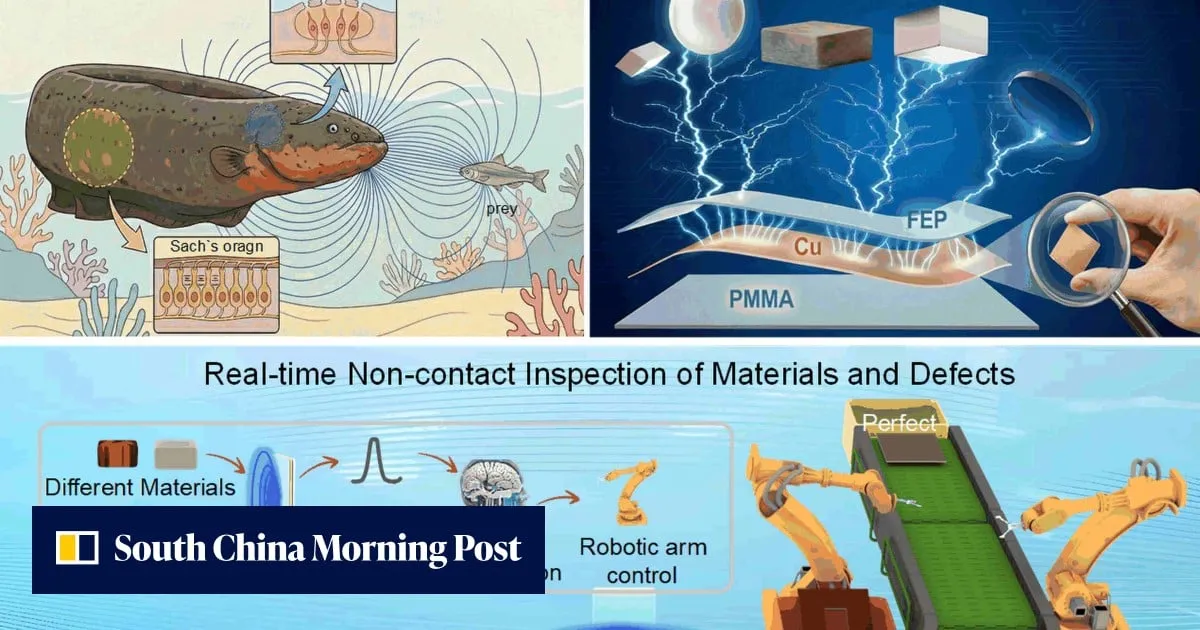
Electric eels hunt in pitch-black, murky waters by generating electric fields around their bodies. Now, Chinese scientists have mimicked this natural radar, giving robots the ability to “feel” objects without making physical contact.“We want the machine to sense an approaching target – distinguish its material and surface condition – before any physical contact,” said Zhang Weiqiang, a professor at Xidian University, in a video interview last week.Their work was published last month in the peer-reviewed journal Advanced Materials.The team drew inspiration from the eel’s locating system. The hunter generates an electric field around itself and reads distortions in that field caused by nearby objects. The researchers borrowed the same logic – build a field, detect disturbances and extract information.The sensor is made of a specially treated fluoropolymer that acts like a tiny static battery. Once charged, it keeps its charge for a long time, creating a steady electric field around it – like an invisible spider’s web.“When an object draws near, the sensor picks up changes in the field and from those changes, it can infer the object’s electrical conductivity, dielectric properties and geometric shape,” Zhang said.01:48US bans imports of new Chinese robots and power inverters in latest tech crackdown
SRCSouth China Morning Post
LANGEN
LEANCenter-Right
WORDS200
ENT8
SUN · 2026-08-16 · 04:00 GMTBRIEF NSR-2026-0816-102723
NSR-2026-0816-102723News Report·EN·Technology
China’s ‘electric eel’ sensor allows robots to feel an object without touching it
Chinese scientists have developed a new sensor for robots, inspired by the electric eel's hunting method. Published in Advanced Materials, this sensor allows robots to detect objects without physical contact by generating and reading disturbances in an electric field.
Zhang TongSouth China Morning PostFiled 2026-08-16 · 04:00 GMTLean · Center-RightRead · 1 min
South China Morning PostFIG 01
Reading time
1min
Word count
200words
Sources cited
1cited
Entities identified
8entities
Quality score
100%
§ 01
Briefing Summary
AI-generatedNEWSAR · AI
Chinese scientists have developed a new sensor for robots, inspired by the electric eel's hunting method. Published in Advanced Materials, this sensor allows robots to detect objects without physical contact by generating and reading disturbances in an electric field. The sensor, made from a specially treated fluoropolymer, can infer an object's electrical conductivity, dielectric properties, and shape by analyzing changes in the field. Professor Zhang Weiqiang of Xidian University stated the goal is for machines to sense approaching targets, including their material and surface condition, before touching them. This innovation aims to enhance robots' ability to perceive their environment in a manner similar to how electric eels navigate murky waters.
Confidence 0.90Sources 1Claims 5Entities 8
§ 02
Article analysis
Model · rule-basedFraming
Technology
Human Interest
Tone
Measured
AI-assessed
CalmNeutralAlarmist
Factuality
0.80 / 1.00
Factual
LowHigh
Sources cited
1
Limited
FewMany
§ 03
Key claims
5 extracted01
The work was published in the peer-reviewed journal Advanced Materials.
factual
Confidence
1.00
02
The sensor can infer an object’s electrical conductivity, dielectric properties, and geometric shape from changes in the electric field.
factualZhang Weiqiang
Confidence
1.00
03
The sensor is made of a specially treated fluoropolymer that acts like a tiny static battery and creates a steady electric field.
factual
Confidence
1.00
04
The goal is for machines to sense an approaching target, distinguishing its material and surface condition before physical contact.
quoteZhang Weiqiang
Confidence
1.00
05
Chinese scientists have developed a sensor that mimics electric eels to allow robots to sense objects without physical contact.
factual
Confidence
1.00
§ 04
Full report
1 min read · 200 words§ 05
Entities
8 identifiedKey playerOppositionContextPositiveNeutralNegative
§ 06
Keywords & salience
9 termselectric eel sensor
1.00
robotics
0.90
non-contact sensing
0.90
biomimicry
0.80
electric fields
0.70
xidian university
0.60
advanced materials
0.50
object detection
0.50
material properties
0.40
§ 07
Topic connections
Interactive graph No topic relationship data available yet. This graph will appear once topic relationships have been computed.