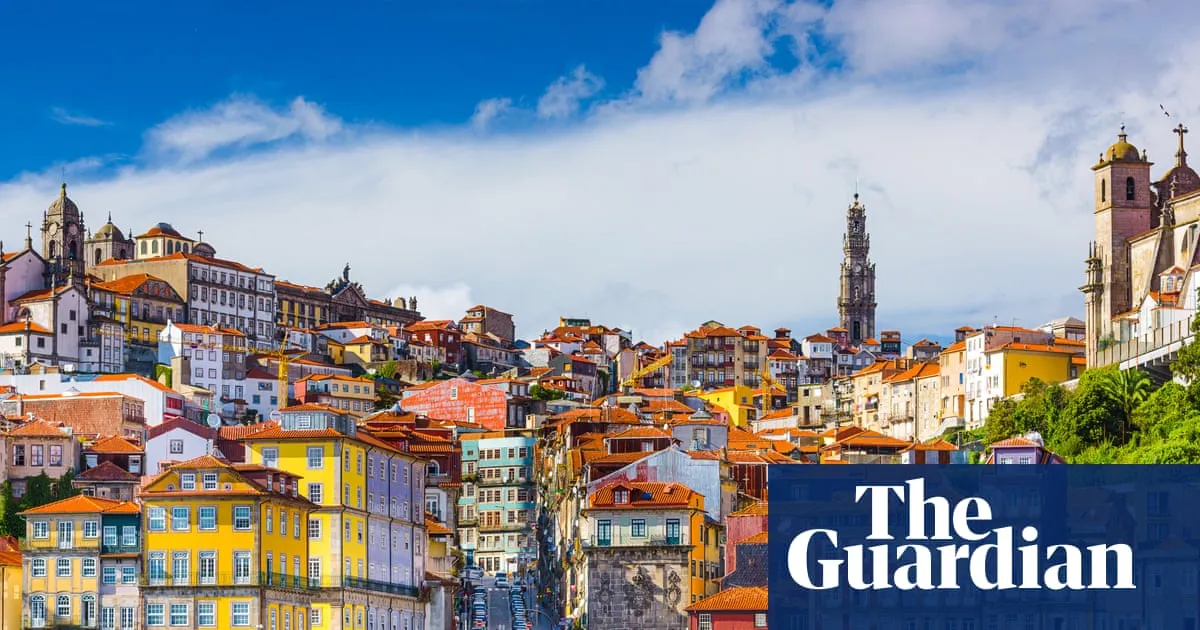
You are on a short break in Porto and post some pictures of your family on Instagram or Facebook. With a small section of the Douro River in the background, you think it could have been taken anywhere.A few days later, you get a text saying that your card was compromised. “We detected unusual activity while you were travelling in Porto – please verify immediately,” says the message.You click on the link to confirm your bank details. Since you have not put any details of your trip on any of your social networks – bar the indistinct pictures – you don’t suspect there is anything suspicious about the messages.But the text was a fraud designed to extract your financial details. The criminals behind it figured out where you had been on holidays – lending credibility to their text – by using AI to analyse the image for the most sparse signs of where it was taken.Image showing how AI identifies the location where holiday pictures were taken. Photograph: McAfee LabsNew research has shown that by picking up on details in the picture – such as the background, the architecture, the signage or the light – the AI agent can pinpoint where it was taken. For criminals, this information gives attempts to defraud by text message or email an added legitimacy.McAfee, the producer of anti-virus software, used two freely available AI models to test more than 21,000 travel images. One of the models identified 91% of images accurately while the other got 87%. Staff were then asked to replicate the experiment with their own pictures and became uncomfortable with how easy their travels were pinpointed.The company says that it shows that computers don’t need photos to be tagged or attached metadata to identify where they are taken.“What AI does is give context … so that makes the scam [and] makes the threats credible,” says Vonny Gamot, the head of EMEA at McAfee.What it looks likePictures are more likely to be identified by AI if they have recognisable landmarks, skylines, signage and street markings. Food stalls and storefronts can also pinpoint quickly where the picture was taken.If the picture is taken on a beach or a hotel room, the accuracy of the AI is lowered. But McAfee reports that it is likely that the system can identify which country they were taken in – which is all the scammers need.Image showing how AI identifies the location where holiday pictures were taken. Photograph: McAfee LabsWhen a staff member tested ChatGPT to identify a picture of a river with some trees in the foreground, it correctly pinpointed it as Hastings-on-Hudson, an area in New York state.Another picture of a group of flowers was identified as the Keukenhof gardens in the Netherlands. The AI agent correctly deduced that the layout of the tulips, along with smaller blue flowers planted between them, meant that it was the famous gardens in the picture.Criminals can use the information to make their approaches more convincing. They might say that your card was flagged for unusual activity while you were somewhere. Or that they are calling you after your stay in a particular hotel. Or that they want to confirm your identity because there has been an attempt to log in to your account from that country.What to doIf you want to post pictures, delay until after you get home and change your settings so that only the people you know can see them.As with all scams, be wary about any urgency in the messages you are sent, such as being told that you need to act immediately. Fraudsters use this as a tactic in the hope that people react without thinking something through fully.Don’t click on links that are provided in texts or emails; instead contact the company or bank through the details on their website or on the back of your bank card.
SRCThe Guardian - World News
LANGEN
LEANCenter-Left
WORDS645
ENT9
SUN · 2026-08-16 · 06:00 GMTBRIEF NSR-2026-0816-102733
NSR-2026-0816-102733News Report·EN·Technology
‘We detected unusual activity’: the scam that uses AI to exploit your holiday photos
Fraudsters are using AI to analyze holiday photos posted on social media to pinpoint locations and lend credibility to phishing scams. By examining details like landmarks, architecture, and signage in images, AI models can accurately identify where pictures were taken.
Shane HickeyThe Guardian - World NewsFiled 2026-08-16 · 06:00 GMTLean · Center-LeftRead · 3 min
The Guardian - World NewsFIG 01
Reading time
3min
Word count
645words
Sources cited
2cited
Entities identified
9entities
Quality score
100%
§ 01
Briefing Summary
AI-generatedNEWSAR · AI
Fraudsters are using AI to analyze holiday photos posted on social media to pinpoint locations and lend credibility to phishing scams. By examining details like landmarks, architecture, and signage in images, AI models can accurately identify where pictures were taken. Criminals then use this information to craft convincing text messages or emails, claiming unusual activity or login attempts from those specific locations to trick victims into revealing bank account details. McAfee research demonstrated AI's high accuracy in identifying locations from travel images. To protect yourself, delay posting travel photos until after returning home, adjust privacy settings to limit visibility, and be wary of urgent requests to click links; instead, contact your bank directly using verified contact information.
Confidence 0.90Sources 2Claims 5Entities 9
§ 02
Article analysis
Model · rule-basedFraming
Technology
Human Interest
Tone
Mixed Tone
AI-assessed
CalmNeutralAlarmist
Factuality
0.80 / 1.00
Factual
LowHigh
Sources cited
2
Limited
FewMany
§ 03
Key claims
5 extracted01
Two freely available AI models tested on over 21,000 travel images identified locations with 91% and 87% accuracy.
statisticMcAfee
Confidence
0.95
02
AI can identify locations even if photos are not tagged or have attached metadata.
factualMcAfee
Confidence
0.90
03
Scammers can use AI-identified location data to make fraudulent text messages or emails more credible.
factualMcAfee
Confidence
0.90
04
AI can analyze images to identify the location where they were taken by analyzing background, architecture, signage, or light.
factualMcAfee Labs
Confidence
0.90
05
AI identified a picture of a river with trees as Hastings-on-Hudson, New York, and a picture of flowers as Keukenhof gardens in the Netherlands.
factualMcAfee
Confidence
0.85
§ 04
Full report
3 min read · 645 words§ 05
Entities
9 identifiedKey playerOppositionContextPositiveNeutralNegative
People1
Organizations5
§ 06
Keywords & salience
9 termsholiday photo scam
1.00
ai image analysis
1.00
location identification
0.90
social media exploitation
0.80
fraudulent texts
0.70
cybersecurity
0.60
mcafee
0.50
ai models
0.50
data privacy
0.40
§ 07
Topic connections
Interactive graph Network visualization showing 51 related topics
View Full Graph Person Organization Location Event|Click node to navigate|Edge numbers = shared articles