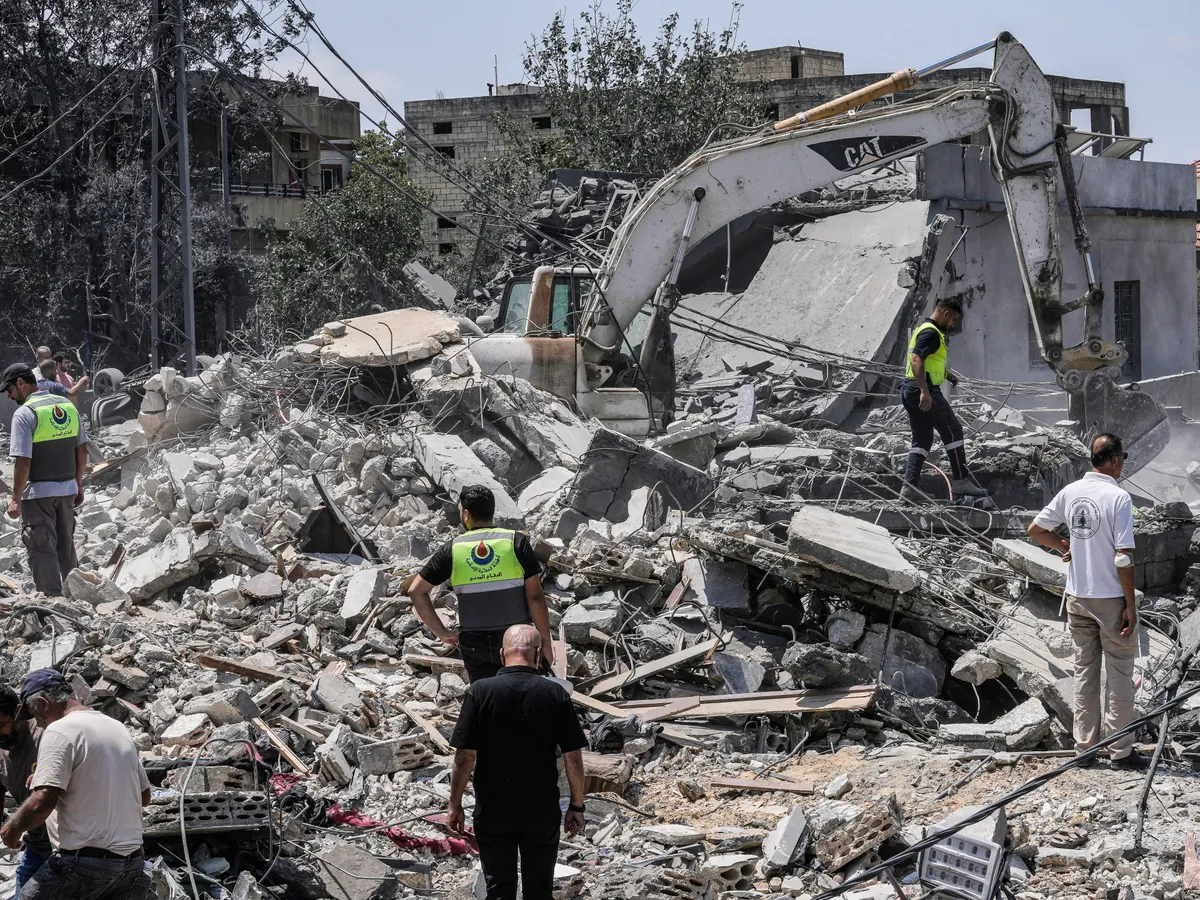
EXPLAINERAt least 11 people killed in one day of Israeli attacks despite truce extension brokered by US in June.People and rescue workers gather at a house in Deir al-Zahrani in southern Lebanon on August 15, 2026, after it was destroyed in an Israeli air strike [Mohammed Zaatari/AP]Published On 16 Aug 2026Lebanese leaders have condemned the Israeli bombing of southern Lebanon that has killed at least 11 people in the worst attacks since the renewal of a ceasefire was brokered in June by the United States.Lebanon and Israel have agreed to two truce agreements – June 4 and 26 – mediated by US President Donald Trump’s administration. June 4 ceasefire was contingent on a “complete cessation” of Hezbollah fire and the evacuation of its fighters. The June 26 framework agreement did not specifically call for the withdrawal of the Israeli forces and instead tied it to the disarmament of Hezbollah.Recommended Stories list of 3 itemslist 1 of 3Lebanon’s PM urges timetable for Israeli withdrawal as Hezbollah slams deallist 2 of 3Israeli strikes kill 11 in southern Lebanon as attacks intensifylist 3 of 3A Syrian intervention in Lebanon would be too costly for Damascusend of listThe agreements came after another truce announced in April had unravelled. Both the ceasefires, opposed by Hezbollah, have not stopped the Israeli military from expanding its control over Lebanese territory and carrying out deadly attacks.An Israeli escalation came as the Lebanese government is planning to hold another round of talks with Israel next month.So what is behind the latest Israeli escalation, and where do the talks stand?Here’s what we know:What happened?Lebanon’s Ministry of Public Health said at least 11 people, including several children, were killed on Saturday in Israeli strikes in the southern district of Nabatieh.Lebanon’s National News Agency (NNA) reported that seven people were killed and three wounded when Israeli warplanes struck a house on the outskirts of Ansar village, destroying the building. Four other people were killed in a strike on the village of Deir al-Zahrani.Reporting from Nabatieh on Saturday, Al Jazeera’s Ali Hashem said the Israeli attack came, after midnight, killing members of a family and creating more fear for other people who live in this area.“This is an area seen by people as safe, but an air attack has now hit. There’s now this escalation, along with apparently more Israeli attacks in southern Lebanon. We are seeing many demolitions. They are erasing towns and villages in the south,” he said.“There are villages, especially those on the border with Israel, that have been completely erased, including graveyards and historic monuments,” he added.The Israeli army carried out an air strike on the Ali al-Taher ridge in the Nabatieh district near the UNESCO-listed Beaufort Castle.Footage verified by Al Jazeera showed flames and smoke rising from the area between the Ali al-Taher hills and the Dabsha area amid the sound of explosions.Al-Manar, Hezbollah’s TV channel, said the blasts were a result of Israeli air attacks in the area while the Nabatieh news channel reported that the raids took place near the town of Kfar Reman.The area has seen increased Israeli army activity in recent days and weeks after a lull following the June truce. Israel said the area has strategic significance and it is targeting Hezbollah infrastructure.Explosions have also been reported in Lebanon’s southern towns of Bint Jbeil and Taybeh, according to the NNA.Israeli drones also targeted the outskirts of the town of al-Mansouri. Artillery shelling was reported in the towns of Sarbin, Barashit, al-Mansouri and Wadi Zibqin.What has Israel said?The Israeli military claimed the attacks were carried out in response to what it described as an action by Hezbollah against Israeli soldiers at the Ali al-Taher Ridge.The office of Israeli Prime Minister Benjamin Netanyahu said in a statement on X that the Israeli military responded by striking the Hezbollah terror headquarters which ordered the attack”. It added that “only later” did the Israeli military “learn that Hezbollah deliberately put civilians in that military compound”.Israel has repeatedly targeted civilians in Lebanon and during its genocidal war in Gaza, but it often claims that armed groups operate from civilian areas. These claims have been proved to be wrong on most occasions.The Israeli military also said it killed Abu Hassan Alaa, whom it described as a senior commander in Hezbollah’s “Badder Unit”, and Hezbollah commander Ali Samir al-Haj Hassan in its strikes in southern Lebanon.Hezbollah has not yet commented on the Israeli claims.Ziad Abu Rish, an associate professor of Middle Eastern Studies at Bard College in the US state of New York, told Al Jazeera most observers believe Netanyahu wants to escalate strikes on Lebanon “to demonstrate an undeterred resolve” to occupy the country’s south and to “pummel” Hezbollah and Lebanese civilians.He said Saturday’s attacks follow “a pattern that has been in place since the so-called ceasefire” in which Israel is “allowed by the US” to attack Hezbollah and civilians in Lebanon “without any consequences”.He noted that Israeli forces have killed more than 4,300 people in Lebanon since March 2 and wounded more than 12,000. About 90,000 houses have been damaged or destroyed while roughly 600,000 people remain displaced.March 2 was the day the latest Israeli escalation in its war on Lebanon began. It started after Hezbollah launched rockets into Israel in retaliation for United States-Israeli air strikes that killed Iranian Supreme Leader Ali Khamenei.“People’s lives have been broken,” Abu Rish said. “And it is clear that the Israeli policy has been to collectively punish the Lebanese population and in particular Shia majority parts of Lebanon and south Lebanon as it wages a campaign not just against Hezbollah but against the Lebanese people.”The professor added that Israel’s actions in Lebanon should also be put in the context of what is happening in Gaza. Israel has killed more than 1,200 people in Gaza since an October “ceasefire”.“We saw that Israel was able to continue its genocide in Gaza with no consequences,” he said.“So people should really not be surprised to see that it is really able to carry out a campaign of effectively depopulating and making south Lebanon uninhabitable, as has been documented by numerous journalists and human rights organisations.”What has Lebanon said?Lebanese President Joseph Aoun has criticised Israel’s continuing attacks on southern Lebanon, particularly in Nabatieh and the surrounding areas, saying they repeatedly violate the ceasefire reached with the US and Israel.Aoun said the attacks constituted “a clear message to the negotiation track” and to US efforts to implement the agreement, and he accused Israel of repeatedly violating international laws protecting civilians.Prime Minister Nawaf Salam condemned continued Israeli attacks on southern Lebanon and called them a matter of “utmost gravity”. Israel, he said, must “halt” its escalation in the area.Parliament Speaker Nabih Berri, meanwhile, called the Israeli attacks a “massacre” and said they represented the continuation of a “war aimed at extermination” in southern Lebanon.A Hezbollah statement on Saturday alleged that the escalation reflected Netanyahu’s desire “to escalate the war in order to bolster his domestic political standing, serve his electoral goals and appease the far-right”. A general election in Israel is scheduled for October 27.Hezbollah also criticised Lebanese authorities, calling on them to seek ways to halt Israeli attacks rather than pursuing direct negotiations.
SRCAl Jazeera
LANGEN
LEANCenter
WORDS1 196
ENT12
SUN · 2026-08-16 · 10:59 GMTBRIEF NSR-2026-0816-102768
NSR-2026-0816-102768News Report·EN·Conflict
Why has Israel escalated attacks in southern Lebanon despite ceasefire?
Despite a US-brokered ceasefire extension in June, Israel escalated attacks in southern Lebanon on August 15, 2026, killing at least 11 people, including children. The Israeli military stated the strikes were in response to Hezbollah actions at Ali al-Taher Ridge and claimed to have targeted Hezbollah infrastructure and commanders.
Al Jazeera StaffAl JazeeraFiled 2026-08-16 · 10:59 GMTLean · CenterRead · 5 min
Al JazeeraFIG 01
Reading time
5min
Word count
1 196words
Sources cited
3cited
Entities identified
12entities
Quality score
100%
§ 01
Briefing Summary
AI-generatedNEWSAR · AI
Despite a US-brokered ceasefire extension in June, Israel escalated attacks in southern Lebanon on August 15, 2026, killing at least 11 people, including children. The Israeli military stated the strikes were in response to Hezbollah actions at Ali al-Taher Ridge and claimed to have targeted Hezbollah infrastructure and commanders. Lebanon's Ministry of Public Health confirmed the casualties, with reports of houses being destroyed. These attacks occurred as Lebanon was preparing for further talks with Israel. Hezbollah has not yet commented on the Israeli claims. Observers suggest Israel's escalation aims to demonstrate resolve to occupy southern Lebanon and pressure Hezbollah.
Confidence 0.90Sources 3Claims 5Entities 12
§ 02
Article analysis
Model · rule-basedFraming
Conflict
Diplomatic
Tone
Mixed Tone
AI-assessed
CalmNeutralAlarmist
Factuality
0.70 / 1.00
Factual
LowHigh
Sources cited
3
Well sourced
FewMany
§ 03
Key claims
5 extracted01
Lebanon and Israel have agreed to two truce agreements on June 4 and June 26, mediated by the US.
factual
Confidence
1.00
02
Four other people were killed in a strike on the village of Deir al-Zahrani.
statisticLebanon’s National News Agency (NNA)
Confidence
1.00
03
Seven people were killed and three wounded when Israeli warplanes struck a house on the outskirts of Ansar village.
statisticLebanon’s National News Agency (NNA)
Confidence
1.00
04
At least 11 people, including several children, were killed in Israeli strikes in the southern district of Nabatieh on Saturday.
statisticLebanon’s Ministry of Public Health
Confidence
1.00
05
Israeli attacks have expanded control over Lebanese territory and carried out deadly attacks despite recent ceasefires.
factual
Confidence
0.90
§ 04
Full report
5 min read · 1 196 words§ 05
Entities
12 identifiedKey playerOppositionContextPositiveNeutralNegative
Organizations1
Locations7
§ 06
Keywords & salience
9 termsisraeli escalation
1.00
ceasefire
0.90
southern lebanon
0.80
hezbollah
0.70
israeli attacks
0.60
truce agreements
0.60
us mediation
0.50
lebanese leaders
0.40
disarmament
0.40
§ 07
Topic connections
Interactive graph Network visualization showing 51 related topics
View Full Graph Person Organization Location Event|Click node to navigate|Edge numbers = shared articles