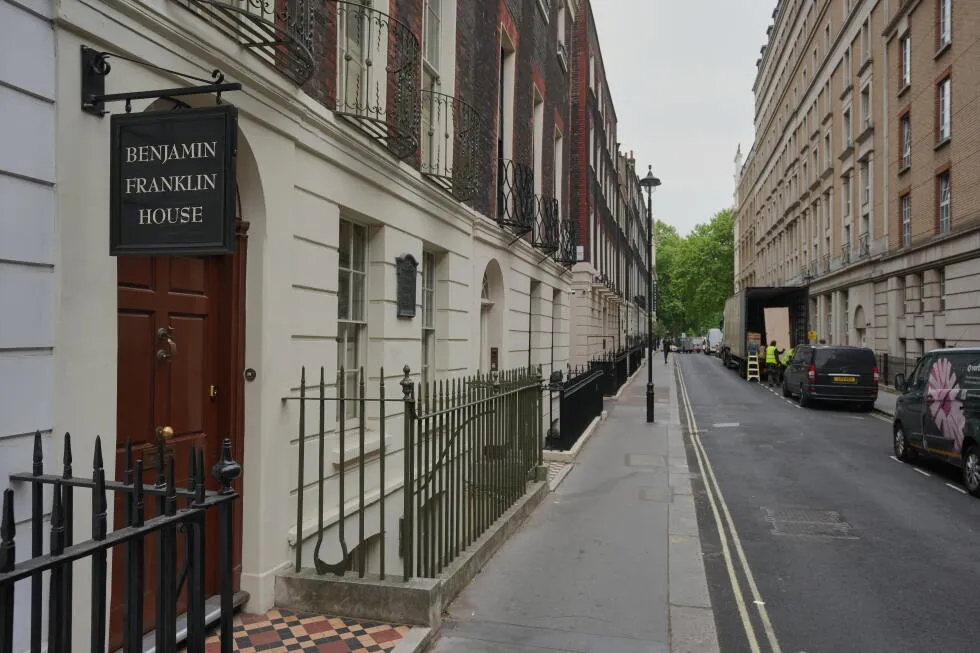
Ben Franklin chose America. Son William chose the crown. This civil war is a microcosm of revolution 1 of 5 | The Benjamin Franklin House is pictured in central London, Monday, May 11, 2026. (AP Photo/Kin Cheung) 2 of 5 | A marble bust and a portrait of Benjamin Franklin is displayed at the Benjamin Franklin House in London, Monday, May 11, 2026. (AP Photo/Kin Cheung) 3 of 5 | The Benjamin Franklin House is pictured in central London, Monday, May 11, 2026. (AP Photo/Kin Cheung) 4 of 5 | Henry Wilkinson, head of education at the Benjamin Franklin House, walks downstairs at the Benjamin Franklin House in London, Monday, May 11, 2026. (AP Photo/Kin Cheung) 5 of 5 | Henry Wilkinson, head of education at the Benjamin Franklin House, shows a replica of Franklin’s armonica at the Benjamin Franklin House in London, Monday, May 11, 2026. (AP Photo/Kin Cheung) By DANICA KIRKA Updated 1:38 PM MESZ, August 16, 2026 Add AP News on Google Add AP News as your preferred source to see more of our stories on Google. Share Share Facebook Copy Link copied Print Email X LinkedIn Bluesky Flipboard Pinterest Reddit London (AP) — In central London, near where tourists and business travelers board Eurostar trains to Paris, lies the burial place of Benjamin Franklin’s eldest son — a man whose life and family relationships were upended by his stance on the American Revolution. William Franklin was buried at the graveyard of St. Pancras Old Church following his death in 1813, more than three decades after he was forced to leave America because of his service to the country his father fought so hard to win independence from. His burial in the capital of what was then the British Empire is a reminder that the Revolution was as much a civil war as it was the founding act of the United States of America. It is also, historians say, a reminder that the conflict that destroyed friendships and ripped apart families 250 years ago continues today. “Now especially, I think it is important for people to understand that American history is 250 years of everybody disagreeing with each other,” said James Taub, associate curator at the Museum of the American Revolution in Philadelphia. “The American Revolution is an ongoing event. We are living it, right still to this day,” he said. “And we’re all taking part in it in one way or another.” After President Donald Trump’s Great American State Fair in Washington, after the band concerts and barbecues and fireworks that marked Independence Day celebrations across the U.S., the country is still faced with the task of forming a more perfect union out of the anger and confrontation that have filled the period since the Republican returned to the White House in January 2025. Trump goes unmentioned but not ignored as Clinton, Bush and Obama step up as essayists on presidents 2 MIN READ 13 The atomic bomb, a world-changing invention, inflicted suffering and launched the nuclear age 1 MIN READ 11 Canada cancels joint bridge-opening event with US after Trump announces tariffs 1 MIN READ 11 It is a messy process that started amid the wreckage of the Revolution. Often simplified as the tale of the plucky patriots who banded together to defeat the mighty British Empire, the revolution was more accurately an eight-year war fought by people who once saw themselves as British against the armies of their former sovereign. As much as one-third of the population remained loyal to King George III and at times during the war loyalist Americans were the biggest contingent of troops in the British forces. Enslaved Black people fought on both sides of the conflict, as did Indigenous people. People based their allegiances on who they thought was more likely to deliver freedom and justice. That complicated reality played out in the Franklin family. A revolution for the colonies and a tear in the Franklin family’s unity When Ben Franklin flew a kite into a thunderstorm in 1752 to demonstrate that lightning was essentially a massive electrical spark, young William Franklin was by his side. Five years later, father and son traveled to London together after Ben Franklin was sent to the capital of the British Empire to represent Pennsylvania’s colonial government. As Ben Franklin settled into his home at 36 Craven St., which today serves as a museum of the Founding Father’s life in London, William studied law and married. Both enjoyed London’s culture and nightlife. William Franklin returned to America and became governor of New Jersey in 1763, a post he would hold for the next 13 years. But father and son came into increasing conflict when Ben Franklin returned to Philadelphia in 1775. While the elder Franklin backed growing calls for independence as a member of the Continental Congress, William rejected the authority of Congress and continued to represent the king. William Franklin was arrested by the emerging American government’s forces as “an enemy of the country’s liberty” in January 1776 and imprisoned until October 1778, much of the time in solitary confinement. After his release in a prisoner exchange, he became a leader of the loyalist community in the British stronghold of New York City. Following the defeat of British forces, William Franklin sailed for London in 1782. He is believed to have had only one brief meeting with his father between his arrest and Ben Franklin’s death in 1790. Franklin warned his son about the risk from the royal ties The bitter split came about even though Ben Franklin repeatedly warned his son that if he did not step down as royal governor, the new government would arrest him, said Daniel Mark Epstein, who chronicled the relationship in his book “The Loyal Son: The War in Ben Franklin’s House.” But William Franklin would not relent. “He was absolutely not gonna budge,” Epstein said. “He was the last governor to leave his office, and he had to be dragged away literally in irons.” Epstein sees the Franklin story as cautionary tale for the angry citizens of 21st-century America, a country marked by easy access to guns and falling educational standards. By contrast, colonial America was a highly literate society where 90% of the population could read and people were more likely to argue out their problems than resort to violence. Yet still the colonies’ differences with Britain descended into war. “Our educational system has failed us here,” Epstein said. “We’re really in a terrible crisis in terms of education. People find it very, very difficult to have rational arguments because they don’t have the language and yet there’s this crazy availability of weapons.” Taub takes a broader view, seeing echoes of the conflicts that ignited the Revolution in the tensions of today. He said Americans need to understand the complexities of the Revolutionary era so they can see how unique the Declaration of Independence was in 1776 and why so many other countries have since modeled their founding documents on it. “It makes me feel better about us today,” he said. “And I think it will show that we’re just part of 250 years of an ongoing story and 250 years of an ongoing mission that was laid down, a cause that was laid down by people in 1776.”
SRCAssociated Press (AP)
LANGEN
LEANCenter
WORDS1 215
ENT12
SUN · 2026-08-16 · 11:53 GMTBRIEF NSR-2026-0816-102793
NSR-2026-0816-102793News Report·EN·Human Interest
Ben Franklin chose America. Son William chose the crown. This civil war is a microcosm of revolution
The American Revolution was a complex civil war, as exemplified by the fractured relationship between Benjamin Franklin and his son, William. While Benjamin Franklin championed American independence, his eldest son, William, remained loyal to the British Crown and served as the royal governor of New Jersey.
Associated Press (AP)Filed 2026-08-16 · 11:53 GMTLean · CenterRead · 5 min
Associated Press (AP)FIG 01
Reading time
5min
Word count
1 215words
Sources cited
1cited
Entities identified
12entities
Quality score
100%
§ 01
Briefing Summary
AI-generatedNEWSAR · AI
The American Revolution was a complex civil war, as exemplified by the fractured relationship between Benjamin Franklin and his son, William. While Benjamin Franklin championed American independence, his eldest son, William, remained loyal to the British Crown and served as the royal governor of New Jersey. This allegiance led to William's arrest and imprisonment by American forces and his eventual exile to London. His burial in England underscores the reality that the Revolution divided families and was not simply a unified colonial uprising against a foreign power. Historians suggest that the deep disagreements and conflicts of that era, as seen in the Franklin family, continue to resonate in contemporary American society, highlighting a long history of internal division.
Confidence 0.90Sources 1Claims 5Entities 12
§ 02
Article analysis
Model · rule-basedFraming
Human Interest
Conflict
Tone
Measured
AI-assessed
CalmNeutralAlarmist
Factuality
0.60 / 1.00
Mixed
LowHigh
Sources cited
1
Limited
FewMany
§ 03
Key claims
5 extracted01
The American Revolution is an ongoing event; we are living it to this day.
quoteJames Taub
Confidence
1.00
02
American history is 250 years of everybody disagreeing with each other.
quoteJames Taub
Confidence
1.00
03
William Franklin, son of Benjamin Franklin, was buried in London after being forced to leave America due to his service to the British Crown.
factual
Confidence
0.90
04
The American Revolution was as much a civil war as it was the founding act of the United States.
factual
Confidence
0.80
05
The conflict that destroyed friendships and ripped apart families 250 years ago continues today.
factualhistorians
Confidence
0.70
§ 04
Full report
5 min read · 1 215 words§ 05
Entities
12 identifiedKey playerOppositionContextPositiveNeutralNegative
People3
Organizations4
Locations4
§ 06
Keywords & salience
8 termsamerican revolution
1.00
civil war
0.90
benjamin franklin
0.80
william franklin
0.80
family relationships
0.70
founding of the united states
0.60
political division
0.50
historical perspective
0.40
§ 07
Topic connections
Interactive graph No topic relationship data available yet. This graph will appear once topic relationships have been computed.