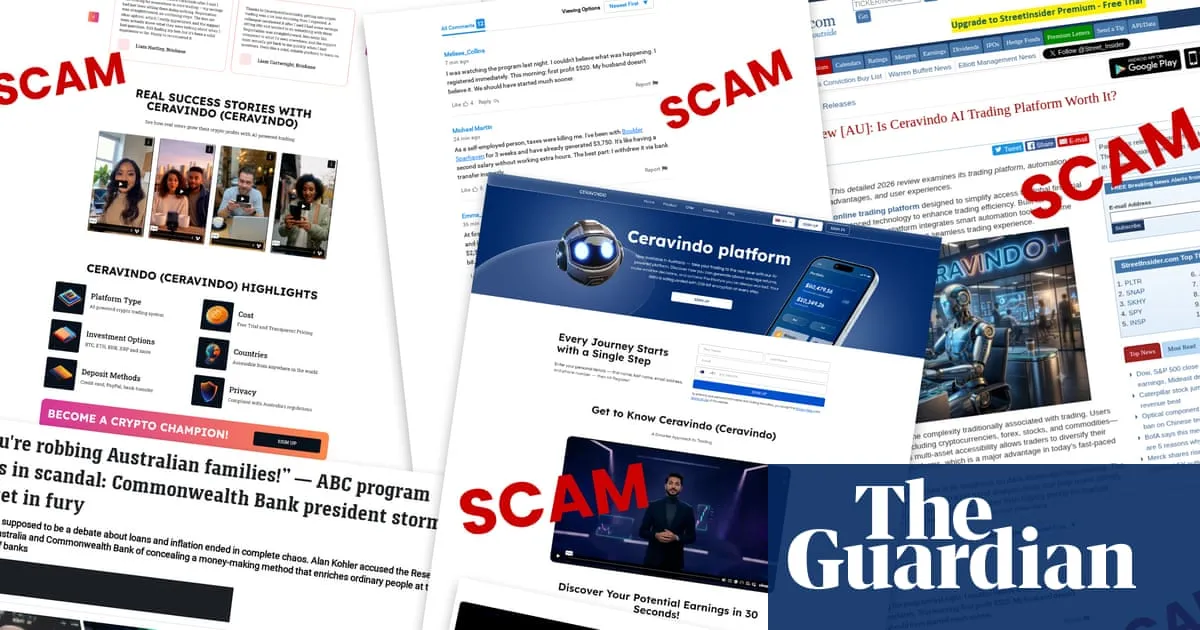
Along with Anthony Albanese, common targets for deepfakes included ABC financial journalist Alan Kohler; and politicians Jacqui Lambie and Angus Taylor. Composite: Australian Securities and Investments Commission View image in fullscreen Along with Anthony Albanese, common targets for deepfakes included ABC financial journalist Alan Kohler; and politicians Jacqui Lambie and Angus Taylor. Composite: Australian Securities and Investments Commission Deepfake Anthony Albanese used in celebrity scams duping Australians out of $7.4m, Asic warns Australia’s corporate watchdog says PM is the figure most commonly used in deepfakes to promote phony investment opportunities Get our breaking news email, free app or daily news podcast There has been a steep rise in scammers luring victims into phony investment opportunities using deepfakes of celebrities and politicians, Australia’s corporate watchdog has warned. And Anthony Albanese is the figure most commonly co-opted. Real footage of the prime minister, overlaid with fake audio promising Australians can invest $4,000 to earn $40,000 a month, appears in one video online. “This is not just another scam product,” the deepfake Albanese says, falsely describing it as an “official platform” with a government guarantee. The Australian Securities and Investment Commission (Asic) dealt with more than 19,400 scams last financial year, almost triple the amount in the year before. Artificial intelligence is making it increasingly easy to generate deepfakes, it warned. Fake celebrities were just the beginning. Scammers have built networks of fake brands, websites, reviews, news articles and videos that work together to convince victims to ultimately give them money, which ends up going to overseas criminals, Asic said. According to reports to the National Anti-Scam Centre’s Scamwatch, Australians lost $7.4m to the top 10 impersonated public figures, and Albanese was at the top of the list. 1:21 Deepfake video of Anthony Albanese promoting fake investment in scam ad – video In one video, a deepfake of the prime minister promises people can earn $35 an hour, which is “about $850 per day” and “over $25,000 per month”, according to the Australian Financial Review. The disinformation and dodgy maths are presented with an American accent. “Greetings. From the first day I became prime minister, I wanted to improve the tax system. We will not fully get rid of taxes, of course, but any resident will be able to receive dividends from them,” the fake says. Economists Tom Piotrowski and Stephen Koukoulas; ABC financial journalist Alan Kohler; and politicians Jacqui Lambie and Angus Taylor (showing Lambie confronting Taylor on Insiders about patronising people) make up the top five. They were followed by entrepreneur Dick Smith, billionaire Gina Rinehart, economist Alan Oster, Pauline Hanson and the late radio legend John Laws. “It is important to note that scammers are receptive to broader changes in the news cycle and will opportunistically change which celebrities they impersonate to capitalise on topical issues,” Asic warned. Last financial year, Asic took down 5,476 phishing scam hyperlinks, almost four times as many as the previous year; 7,051 fake investment platforms, 2.5 times higher; and 3,106 cryptocurrency scams, an increase of almost 30%. “The presence of polished content, familiar branding or convincing testimonials does not mean an investment is legitimate,” the Asic chair, Sarah Court, said. “AI is making investment scams more convincing and harder to detect. A simple online search is not enough to verify whether an opportunity is legitimate. “Before investing, consumers should verify website addresses, check whether a person or company is legitimate and who they claim to be, and be wary of urgent calls to act.” Scamwatch advises consumers to stop before sharing money or information; to check the details independently; and to protect yourself and others by reporting any scams to them, your bank, or cyber.gov.au. Asic said consumers should check for a certified Australian financial services licence, but also be aware that scammers misuse those licences, so they should check against Asic’s professional registers. Commonwealth Bank research published earlier this year found about nine in 10 Australians were confident they could spot an AI scam, but in reality they can do so less than half the time. Deepfakes are also increasingly being used politically. Independent MP Zali Steggall has proposed a bill to crack down on deceptive political advertising, which would require AI-generated content that could mislead voters to be clearly identified. Explore more on these topics Scams AI (Artificial intelligence) Crime - Australia Deepfake Cryptocurrencies Anthony Albanese Asic news Share Reuse this content
SRCThe Guardian - World News
LANGEN
LEANCenter-Left
WORDS730
ENT11
SUN · 2026-08-16 · 14:01 GMTBRIEF NSR-2026-0816-102833
NSR-2026-0816-102833News Report·EN·Technology
Deepfake Anthony Albanese used in celebrity scams duping Australians out of $7.4m, Asic warns
Australia's corporate watchdog, ASIC, has warned of a significant rise in investment scams using deepfakes of public figures, with Prime Minister Anthony Albanese being the most frequently impersonated. These scams have duped Australians out of $7.4 million, according to Scamwatch reports.
Tory ShepherdThe Guardian - World NewsFiled 2026-08-16 · 14:01 GMTLean · Center-LeftRead · 3 min
The Guardian - World NewsFIG 01
Reading time
3min
Word count
730words
Sources cited
3cited
Entities identified
11entities
Quality score
100%
§ 01
Briefing Summary
AI-generatedNEWSAR · AI
Australia's corporate watchdog, ASIC, has warned of a significant rise in investment scams using deepfakes of public figures, with Prime Minister Anthony Albanese being the most frequently impersonated. These scams have duped Australians out of $7.4 million, according to Scamwatch reports. Deepfake videos often feature fabricated audio of Albanese promoting phony investment opportunities with unrealistic returns, falsely claiming government guarantees. Other prominent figures targeted include ABC journalist Alan Kohler and politicians Jacqui Lambie and Angus Taylor. ASIC attributes the increase in sophisticated scams to the growing ease of generating deepfakes with AI, and advises consumers to verify investment legitimacy independently and be wary of urgent calls to action.
Confidence 0.90Sources 3Claims 5Entities 11
§ 02
Article analysis
Model · rule-basedFraming
Technology
Economic Impact
Tone
Mixed Tone
AI-assessed
CalmNeutralAlarmist
Factuality
0.80 / 1.00
Factual
LowHigh
Sources cited
3
Well sourced
FewMany
§ 03
Key claims
5 extracted01
Scammers have built networks of fake brands, websites, reviews, news articles and videos that work together to convince victims.
factualAsic
Confidence
1.00
02
Artificial intelligence is making it increasingly easy to generate deepfakes.
factualAsic
Confidence
1.00
03
Australians lost $7.4m to the top 10 impersonated public figures, with Albanese at the top of the list.
statisticNational Anti-Scam Centre’s Scamwatch
Confidence
1.00
04
There has been a steep rise in scammers luring victims into phony investment opportunities using deepfakes of celebrities and politicians.
factualAsic
Confidence
1.00
05
Deepfake Anthony Albanese is used in celebrity scams to dupe Australians out of $7.4m.
statisticAsic
Confidence
1.00
§ 04
Full report
3 min read · 730 words§ 05
Entities
11 identifiedKey playerOppositionContextPositiveNeutralNegative
People4
Organizations5
Locations1
§ 06
Keywords & salience
9 termsscams
1.00
deepfake
1.00
investment scams
0.90
anthony albanese
0.80
artificial intelligence
0.70
impersonation
0.60
asic
0.50
celebrity scams
0.50
disinformation
0.40
§ 07
Topic connections
Interactive graph Network visualization showing 51 related topics
View Full Graph Person Organization Location Event|Click node to navigate|Edge numbers = shared articles