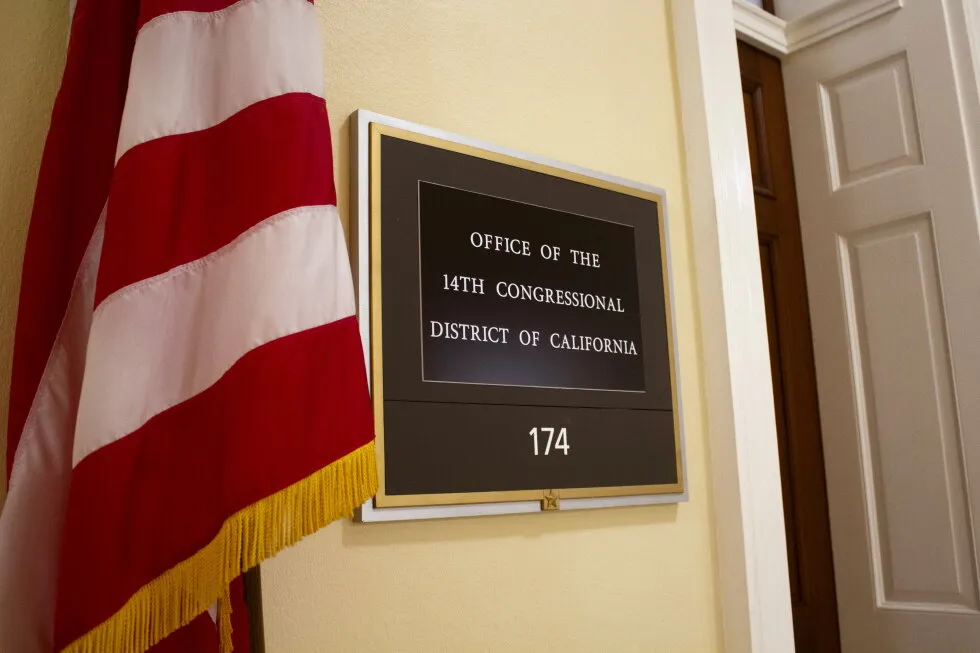
An American flag stands outside the office of California’s 14th Congressional District in the Cannon House Office Building in Washington, Monday, July 20, 2026. (AP Photo/Tallulah Brown Van Zee) Updated [hour]:[minute] [AMPM] [timezone], [monthFull] [day], [year] WASHINGTON (AP) — Four months after Democratic U.S. Rep. Eric Swalwell resigned from Congress amid sexual assault allegations that torpedoed his campaign for California governor, his former Bay Area constituents will pick a replacement Tuesday to serve out the rest of his term.With two Democrats competing on the ballot, the seat in California’s 14th Congressional District is guaranteed to remain under Democratic control and further narrow an already fragile Republican majority in the chamber.State Sen. Aisha Wahab and Bay Area Rapid Transit Board President Melissa Hernandez were the finalists in the June 16 special primary, in which the top two finishers regardless of party affiliation advanced to Tuesday’s special election. The two also will compete in the fall in a slightly redrawn district for a full term that begins in January 2027. Wahab placed first in both the June 16 special primary and the June 2 primary for the full-term seat to replace Swalwell, who has denied the allegations against him. In both contests, Wahab led Hernandez by more than 20 percentage points.Hernandez has more than doubled Wahab’s fundraising and spending for the campaign, but as of the end of July the two were on roughly even footing in terms of cash in the bank.The race has also attracted the attention of several outside groups, including some affiliated with the American Israel Public Affairs Committee, a powerful pro-Israel lobbying organization. United Democracy Project, a super political action committee backed by AIPAC, spent $1.2 million on the race in August in support of Hernandez and in opposition to Wahab, according to Federal Election Commission records. 6 MIN READ 6 MIN READ 2 MIN READ Another group, Bold America, which has received funding from United Democracy Project, has spent about $1.7 million on the race since the special primary, also in support of Hernandez and in opposition to Wahab. Collectively, outside groups have spent about $4.1 million on the race since mid-July. About $3.7 million was spent to benefit Hernandez’s campaign, compared with just shy of $400,000 to benefit Wahab’s. The boundaries of the 14th Congressional District were redrawn as part of a new congressional map approved by voters in a 2025 statewide ballot measure known as Proposition 50. The map goes into effect for the full-term seat in January, while the winner of the special election will serve under the current boundaries for the remainder of the year.Proposition 50 was placed on the ballot in response to mid-decade redistricting efforts led by President Donald Trump in several Republican-controlled states. While the plan created a congressional map more favorable to Democrats, no dramatic changes were made to the 14th District. Under the current boundaries, Democrats make up 50.4% of registered voters in October, compared with 17.6% for Republicans. Under the new boundaries, Democrats comprise about 49.7% of registered voters as of mid-May, compared with about 17.4% for Republicans.In 2024, Democratic then-Vice President Kamala Harris carried the current 14th District with 65.8% of the vote in the presidential election against Trump. If the election had been held under the new boundaries, Harris would have received 65.4% of the vote.Both versions of the district are contained entirely within Alameda County in the East Bay. The current district includes Hayward, Livermore, Pleasanton and Union City, as well as parts of San Leandro, Fremont and Dublin.Here are some of the key facts about the election and data points the AP Decision Team will monitor as the votes are tallied: When do polls close?Polls close at 8 p.m. PT, which is 11 p.m. ET.What’s on the ballot?The Associated Press will provide vote results and declare a winner in the 14th Congressional District special election.Who gets to vote?Any registered voter in the current version of California’s 14th Congressional District may participate in the special election.How many voters are there?As of May 2026, there were about 423,000 registered voters in the 14th Congressional District, including about 210,000 Democrats, about 73,000 Republicans and about 116,000 voters with no party preference. How many people actually vote?Nearly 124,000 voters cast ballots in the June 16 special primary. About 276,000 people voted in the regularly scheduled 2024 general election in the 14th District.How much of the vote is cast early or by absentee ballot?About 98% of votes in the June 16 special primary were from absentee ballots delivered in person or by mail.As of Wednesday, about 52,000 ballots had already been cast in Tuesday’s election, about 32,500 from Democrats, about 7,800 from Republicans and the rest from unaffiliated or third-party voters.When are early and absentee votes released?In Alameda County, the first vote update of the night usually includes only results from mail voting, but the county typically still has a sizable number of mail ballots left to tally by the next morning.How long does vote-counting usually take?In the June 16 special primary, the AP first reported results at 11:17 p.m. ET, or 17 minutes after polls closed. The last vote update of the night was at 1:03 a.m. ET, with about 87% of total votes counted. The vote count reached 99.9% complete at 7:26 p.m. ET on June 18. When will the AP declare a winner?The AP does not make projections and will declare a winner only when it’s determined there is no scenario that would allow a trailing candidate to close the gap. If a race has not been called, the AP will continue to cover any newsworthy developments, such as candidate concessions or declarations of victory. In doing so, the AP will make clear that it has not yet declared a winner and explain why.How do recounts work?There are no automatic recounts in California. Any registered voter may request and pay for a recount. The AP may declare a winner in a race that is subject to a recount if it can determine the lead is too large for a recount or legal challenge to change the outcome.Are we there yet?As of Tuesday, there will be 77 days until the 2026 midterm elections.___Follow the AP’s coverage of the 2026 election at https://apnews.com/projects/elections-2026/. Yoon is an elections and democracy reporter for The Associated Press, with a focus on analyzing vote and demographic data and explaining the intricacies of the electoral process. He is now covering his seventh presidential campaign cycle.
SRCAssociated Press (AP)
LANGEN
LEANCenter
WORDS1 074
ENT12
MON · 2026-08-17 · 11:23 GMTBRIEF NSR-2026-0817-103066
NSR-2026-0817-103066News Report·EN·Political Strategy
AP Decision Notes: What to expect in California’s special congressional election
California's 14th Congressional District is holding a special election Tuesday to replace former U.S. Rep.
By
ROBERT YOONAssociated Press (AP)Filed 2026-08-17 · 11:23 GMTLean · CenterRead · 5 min
Associated Press (AP)FIG 01
Reading time
5min
Word count
1 074words
Sources cited
0cited
Entities identified
12entities
Quality score
100%
§ 01
Briefing Summary
AI-generatedNEWSAR · AI
California's 14th Congressional District is holding a special election Tuesday to replace former U.S. Rep. Eric Swalwell. The race features two Democrats, State Sen. Aisha Wahab and BART Board President Melissa Hernandez, ensuring the seat remains under Democratic control. Wahab won the special primary and has consistently led Hernandez in vote percentage, though Hernandez has outspent her significantly. Outside groups, particularly those affiliated with AIPAC, have heavily funded Hernandez's campaign, spending millions in support of her and against Wahab. The election will determine who serves out the remainder of Swalwell's term under current district boundaries, with both candidates also competing for a full term in a slightly redrawn district starting in 2027.
Confidence 0.90Claims 5Entities 12
§ 02
Article analysis
Model · rule-basedFraming
Political Strategy
Legal & Judicial
Tone
Measured
AI-assessed
CalmNeutralAlarmist
Factuality
0.90 / 1.00
Factual
LowHigh
Sources cited
0
No named sources
FewMany
§ 03
Key claims
5 extracted01
Bold America, funded by United Democracy Project, spent about $1.7 million since the special primary to support Hernandez and oppose Wahab.
statistic
Confidence
1.00
02
United Democracy Project, backed by AIPAC, spent $1.2 million in August to support Hernandez and oppose Wahab.
statisticFederal Election Commission records
Confidence
1.00
03
State Sen. Aisha Wahab and BART Board President Melissa Hernandez are the finalists in the special election.
factual
Confidence
1.00
04
California's 14th Congressional District seat is guaranteed to remain under Democratic control.
factual
Confidence
1.00
05
Eric Swalwell resigned from Congress amid sexual assault allegations.
factual
Confidence
0.90
§ 04
Full report
5 min read · 1 074 words§ 05
Entities
12 identifiedKey playerOppositionContextPositiveNeutralNegative
People3
Organizations5
Locations3
§ 06
Keywords & salience
9 termsspecial congressional election
1.00
california's 14th congressional district
0.90
democratic control
0.80
aisha wahab
0.70
melissa hernandez
0.70
campaign spending
0.60
outside groups
0.50
sexual assault allegations
0.40
aipac
0.40
§ 07
Topic connections
Interactive graph No topic relationship data available yet. This graph will appear once topic relationships have been computed.