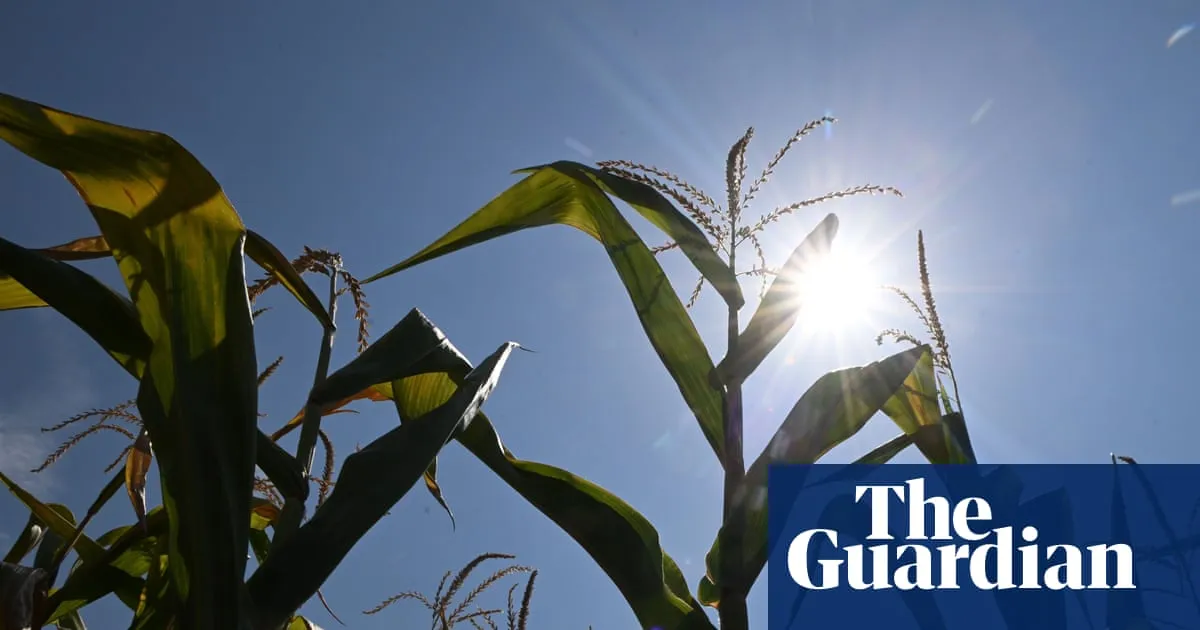
Successive intense heatwaves and an increasingly severe, continent-wide drought have left many of Europe’s farmers in an “unprecedented” crisis, with vegetable and grain growers in particular warning of “catastrophic” harvests.French vegetable production is down by “a very significant extent” compared with previous years, French growers have said, with shortfalls put at 25% for courgettes, 35% for lettuces, 40% for peas, 60% for broccoli and 50% to 100% for artichokes.“The vegetable sector is facing a historic crisis,” said Prince de Bretagne, which groups together more than 1,300 vegetable producers in Brittany, calling for “urgent action” to address a “dramatic” fall in yields and in the quality of many crops.Accelerated, human-caused global heating and a supersized El Niño have scorched fields across Europe this summer, with plant development prevented by temperatures routinely exceeding 30C and often 35C, almost no rainfall, and hot winds.“Usually one region fares better, which helps compensate,” Eric Legras, of the 4,400-member French canned and frozen vegetable producers’ association, told Le Monde. “This year, all our main production areas have been hit, and at the same time.”Cereal production has been equally hard hit, with the agriculture ministry estimating the maize harvest in France – Europe’s largest grains producer – will be down by 35% on 2025 levels at about 9m tonnes, a quantity last seen in 1980.Part of the fall is due to farmers’ switching to other crops, such as sunflowers, the ministry said, but it also reflects the impact of this summer’s vicious heatwaves, which have battered the crucial crop during critical stages of its growth cycle.That is likely to cause big problems for livestock farmers. With dairy cows typically starting to suffer from heat stress above 25C, many producers have already reported milk yields down by 10%-15%. Most are now also concerned about winter feed.Agreste, the agriculture ministry’s statistics service, said last week that production of hay for winter cattle forage was running about 30% lower than the 1989-2018 average, a shortfall that “is worsening and is now affecting a growing numbers of regions”.Egg production, too, has been hit by a catastrophic mortality rate in poultry houses, particularly during the June heatwave. According to France’s national egg promotion board, output has is about 1m eggs a day lower than the norm.In Italy, about 60% of farmland across the country is now affected by drought ranging from mild to severe, according to data published earlier this month by Coldiretti, the country’s largest farmers’ organisation.Crop yields, especially for corn, rice and soya beans as well as vegetables and fruit, have been badly hit, and milk production has fallen by 20%. The overall cost to the sector, including damage caused by wildfires and heavy storms, is put at more than €3bn.skip past newsletter promotionafter newsletter promotionAn aerial view of a rice field in Italy earlier this month showing a sharp contrast between a yellowed and dried section affected by severe heat stress and the remaining area where rows of green rice plants are still visible in Novara, in the Po valley, where growers have been forced to irrigate crops only on alternate weeks. Photograph: Simone Padovani/Getty ImagesThe drought is particularly acute in the Po valley, a huge geographical area straddling four northern regions, the backbone of Italian agriculture and home to about 80% of the Italian rice production, due to severe depletion of the country’s longest river.Italy is Europe’s largest rice producer, with about 235,000 hectares (580,000 acres) planted in 2025. This year, however, the severe drought has forced growers to adopt an unprecedented response to save the season, irrigating crops only on alternate weeks.In Spain, cereal harvests are 35% below the previous year in Castilla y León, 49% in the Madrid region and 24% in Andalucía. Sheep and goat’s milk production is also down 6.5% and 10.8% respectively, authorities have said.After a disastrous harvest in drought-stricken 2024, olive oil production increased significantly last year and the wet winter and spring were good news for a crop not harvested until late autumn. Growers say it is too early to say how this year will look.However, Spain’s national wine federation has predicted a 20% fall in production for 2026, and its director, José Luis Benítez, warned that successive heatwaves will reduce crops as grapes are smaller for lack of moisture.Governments have pledged costly aid packages to help the sector. The French prime minister, Sébastien Lecornu, has promised €145m (£124) in immediate aid, along with “structural support and investment measures” in the 2027 budget.
SRCThe Guardian - World News
LANGEN
LEANCenter-Left
WORDS742
ENT12
MON · 2026-08-17 · 16:01 GMTBRIEF NSR-2026-0817-103161
NSR-2026-0817-103161News Report·EN·Economic Impact
European farmers face ‘unprecedented crisis’ after successive heatwaves
Europe's farmers are facing an "unprecedented crisis" due to successive heatwaves and a continent-wide drought, leading to warnings of "catastrophic" harvests. Vegetable and grain growers are experiencing significant yield reductions across countries like France, Italy, and Spain.
Jon Henley in Paris, Angela Giuffrida in Rome and Stephen Burgen in BarcelonaThe Guardian - World NewsFiled 2026-08-17 · 16:01 GMTLean · Center-LeftRead · 3 min
The Guardian - World NewsFIG 01
Reading time
3min
Word count
742words
Sources cited
5cited
Entities identified
12entities
Quality score
100%
§ 01
Briefing Summary
AI-generatedNEWSAR · AI
Europe's farmers are facing an "unprecedented crisis" due to successive heatwaves and a continent-wide drought, leading to warnings of "catastrophic" harvests. Vegetable and grain growers are experiencing significant yield reductions across countries like France, Italy, and Spain. For instance, French vegetable production has seen shortfalls ranging from 25% for courgettes to 100% for artichokes, while French maize harvest is projected to be down 35%. The drought is also impacting livestock farmers, with reduced milk yields and concerns over winter feed, and has led to increased mortality in poultry houses. Italy's agricultural sector faces over €3 billion in costs from drought, wildfires, and storms, with crop yields and milk production significantly down. Governments are pledging aid packages to support the affected farmers.
Confidence 0.90Sources 5Claims 5Entities 12
§ 02
Article analysis
Model · rule-basedFraming
Economic Impact
Environmental
Tone
Mixed Tone
AI-assessed
CalmNeutralAlarmist
Factuality
0.80 / 1.00
Factual
LowHigh
Sources cited
5
Well sourced
FewMany
§ 03
Key claims
5 extracted01
The maize harvest in France is estimated to be down by 35% on 2025 levels, reaching about 9m tonnes, a quantity last seen in 1980.
statisticagriculture ministry
Confidence
0.95
02
About 60% of farmland across Italy is affected by drought.
statisticColdiretti
Confidence
0.90
03
Production of hay for winter cattle forage is running about 30% lower than the 1989-2018 average.
statisticAgreste
Confidence
0.90
04
French vegetable production is down by a significant extent, with courgettes at 25% shortfall, lettuces 35%, peas 40%, broccoli 60%, and artichokes 50-100%.
statisticFrench growers
Confidence
0.90
05
Milk yields have fallen by 10%-15% due to heat stress in dairy cows.
statisticproducers
Confidence
0.85
§ 04
Full report
3 min read · 742 words§ 05
Entities
12 identifiedKey playerOppositionContextPositiveNeutralNegative
People1
Locations4
§ 06
Keywords & salience
10 termsagricultural crisis
1.00
drought
1.00
heatwaves
1.00
crop yields
0.90
global heating
0.80
cereal production
0.70
vegetable production
0.70
livestock
0.60
el niño
0.50
food security
0.40
§ 07
Topic connections
Interactive graph Network visualization showing 51 related topics
View Full Graph Person Organization Location Event|Click node to navigate|Edge numbers = shared articles