A novel sanctuary in Antarctica is preserving ice samples from rapidly melting glaciers 0 seconds of 44 secondsVolume 0% Press shift question mark to access a list of keyboard shortcuts Keyboard ShortcutsEnabledDisabled Shortcuts Open/Close/ or ? Play/PauseSPACE Increase Volume↑ Decrease Volume↓ Seek Forward→ Seek Backward← Captions On/Offc Fullscreen/Exit Fullscreenf Mute/Unmutem Decrease Caption Size- Increase Caption Size+ or = Seek %0-9 Next Up A Tale of Squeals and Purrs: A look inside a sanctuary taking in hundreds of guinea pigs 01:38 Subtitle Settings OffEnglish(US)_v Font Color White Font Opacity 100% Font Size 100% Font Family Arial Character Edge None Edge Color Black Background Color Black Background Opacity 50% Window Color Black Window Opacity 0% Reset WhiteBlackRedGreenBlueYellowMagentaCyan 100%75%50%25% 200%175%150%125%100%75%50% ArialCourierGeorgiaImpactLucida ConsoleTahomaTimes New RomanTrebuchet MSVerdana NoneRaisedDepressedUniformDrop Shadow WhiteBlackRedGreenBlueYellowMagentaCyan WhiteBlackRedGreenBlueYellowMagentaCyan 100%75%50%25%0% WhiteBlackRedGreenBlueYellowMagentaCyan 100%75%50%25%0% 00:00 00:44 00:44 More Videos 01:38 A Tale of Squeals and Purrs: A look inside a sanctuary taking in hundreds of guinea pigs 01:00 Endangered Kemp’s ridley sea turtle moves to Houston Zoo 01:00 San Diego Zoo Wildlife Alliance celebrates World Elephant day highlighting its herd 01:05 The robot smartphone that can do tricks and chat to its user 02:13 Nepal maternal and infant mortality increases following loss of US aid, according to health officials 01:20 Addiction drama 'Union County' blurs line between reality and fiction 00:21 Trump says record-setting Navy deployment to support Iran operations 'not nearly long enough' 01:43 High school football player in Arkansas practices with a venomous snake in his helmet Close 1 of 2 | In a race against time to store vital scientific information, an ice sanctuary has been launched in Antarctica to preserve the cores from endangered glaciers. The Ice Memory Foundation aims to safeguard the data contained within the ice for future scientific research as rising temperatures drive Glacier Loss worldwide. (AP video shot by Niccolò Lupone) 2 of 2 | This undated image released on Wednesday, Jan. 14, 2026 by the Ice Memory Foundation, shows the Concordia Station, where the Ice Memory Sanctuary is being built in Antarctica for ice cores from the Alps carrying the memory of Earth’s current atmosphere, which are preserved at a temperature close to -52°C/-61°F for future generations of scientists to study. (ENEA PNRA via AP) By NICOLE WINFIELD and PAOLO SANTALUCIA Updated 3:59 PM MESZ, January 14, 2026 Leer en español Add AP News on Google Add AP News as your preferred source to see more of our stories on Google. Share Share Facebook Copy Link copied Print Email X LinkedIn Bluesky Flipboard Pinterest Reddit ROME (AP) — Scientists in Antarctica on Wednesday inaugurated the first global repository of mountain ice cores, preserving the history of the Earth’s atmosphere in a frozen vault for future generations to study as global warming melts glaciers around the world. An ice core is something of an atmospheric time capsule, containing information about the Earth’s past changes in a frozen climate archive. With global glaciers melting at an unprecedented rate, scientists have raced to preserve ice cores for future study before they disappear altogether. The Ice Memory Foundation, a consortium of European research institutes, inaugurated the frozen sanctuary on Wednesday at the Concordia Station in the Antarctic Plateau. The foundation livestreamed the ceremonial ribbon cutting and opening of the frozen cave where the ice samples will be kept for future generations. The first two sets of samples of Alpine mountain ice cores were drilled out of Mont Blanc in France and Grand Combin in Switzerland and arrived at the station after a 50-day refrigerated icebreaker and plane journey from Trieste, Italy. During the inauguration ceremony, pairs of foundation team members brought box after box of ice cores into the cave, burrowed deep into a 5-meter (yard) high compacted snow drift at a constant temperature of around -52°C/-61°F. A looming rock collapse threatens a Swiss village as thawing permafrost destabilizes the Alps 2 MIN READ 129 Nero’s Bridge emerges from Tiber River as Rome faces water crisis 1 MIN READ 16 Climate Change created conditions for Canada fires, scientists say, as Trump blames mismanagement 1 MIN READ 16 “By safeguarding physical samples of atmospheric gases, aerosols, pollutants and dust trapped in ice layers, the Ice Memory Foundation ensures that future generations of researchers will be able to study past climate conditions using technologies that may not yet exist,” said Carlo Barbante, vice chair of the Ice Memory Foundation and a professor at Ca’ Foscari University in Venice. This undated image released on Wednesday, Jan. 14, 2026 by the Ice Memory Foundation, shows the Concordia Station, where the Ice Memory Sanctuary is being built in Antarctica for ice cores from the Alps carrying the memory of Earth’s current atmosphere, which are preserved at a temperature close to -52°C/-61°F for future generations of scientists to study. (ENEA PNRA via AP) The Ice Memory project was launched in 2015 by a consortium of research institutes: From France, the National Centre for Scientific Research (CNRS), the French National Research Institute for Sustainable Development (IRD) and the University of Grenoble-Alpes; from Italy the National Council of Research (CNR) and the Ca’ Foscari University in Venice, and Switzerland’s Paul Scherrer Institute. Scientists have already identified and drilled ice cores at 10 glacier sites worldwide and plan to transport them to the cave sanctuary for safekeeping in the coming years. The aim over the coming decade is to craft an international convention to preserve and safeguard the samples for future generations to study. As temperatures globally rise, glaciers are disappearing at a rapid clip, and with them critical information about the atmosphere: Since 2000, glaciers have lost between 2% and 39% of their ice regionally and about 5% globally, the foundation said. “These ice cores are not relics … they are reference points,” said Celeste Saulo, secretary-general of the U.N. World Meteorological Organisation. “They allow scientists now and in the future to understand what changed, how fast and why.” NICOLE WINFIELD Winfield has been on the Vatican beat since 2001, covering the papacies of St. John Paul II, Pope Benedict XVI and the Francis pontificate and traveling the world with them. PAOLO SANTALUCIA Santalucia covers events throughout Southern Europe, Italy, the Mediterranean sea and the Vatican for The Associated Press based in Rome. instagram mailto
SRCAssociated Press (AP)
LANGEN
LEANCenter
WORDS1 037
ENT8
TUE · 2026-08-18 · 05:23 GMTBRIEF NSR-2026-0818-103299
NSR-2026-0818-103299News Report·EN·Environmental
A novel sanctuary in Antarctica is preserving ice samples from rapidly melting glaciers
Scientists have inaugurated the first global repository of mountain ice cores in Antarctica, a frozen vault designed to preserve atmospheric history from rapidly melting glaciers. The Ice Memory Foundation, a European research consortium, established this sanctuary at Concordia station to safeguard ice cores containing data on Earth's past climate.
Associated Press (AP)Filed 2026-08-18 · 05:23 GMTLean · CenterRead · 5 min
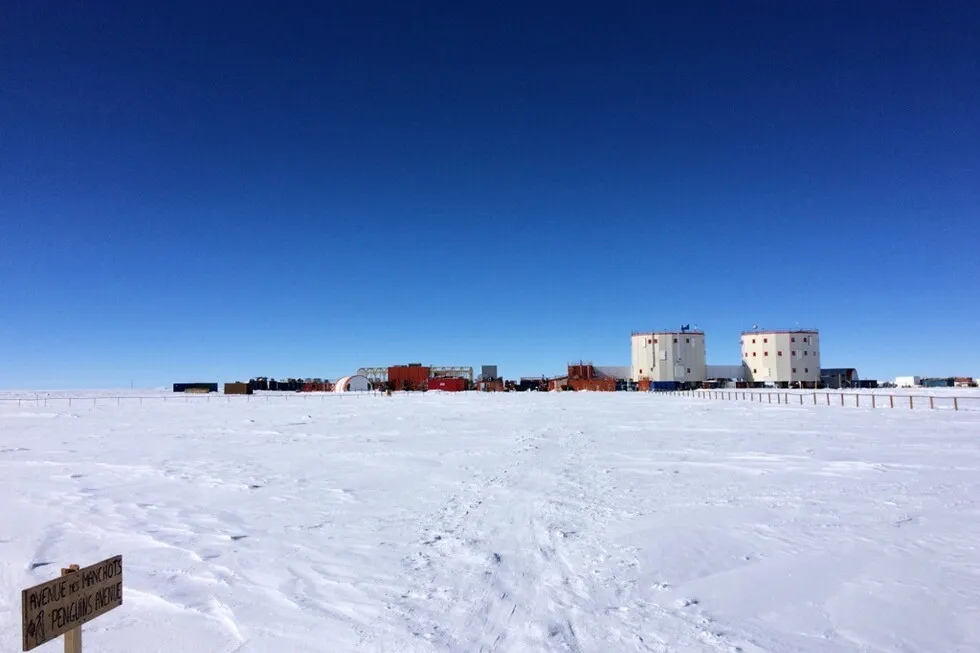
Associated Press (AP)FIG 01
Reading time
5min
Word count
1 037words
Sources cited
2cited
Entities identified
8entities
Quality score
100%
§ 01
Briefing Summary
AI-generatedNEWSAR · AI
Scientists have inaugurated the first global repository of mountain ice cores in Antarctica, a frozen vault designed to preserve atmospheric history from rapidly melting glaciers. The Ice Memory Foundation, a European research consortium, established this sanctuary at Concordia station to safeguard ice cores containing data on Earth's past climate. These ice cores, acting as atmospheric time capsules, are crucial for future scientific study as glaciers disappear due to global warming. The first samples, from Mont Blanc in France and Grand Combin in Switzerland, have arrived and are being stored at approximately -52°C (-61°F). This initiative aims to ensure that future generations of researchers can analyze past atmospheric conditions, even with technologies that may not yet exist.
Confidence 0.90Sources 2Claims 4Entities 8
§ 02
Article analysis
Model · rule-basedFraming
Environmental
Human Interest
Tone
Measured
AI-assessed
CalmNeutralAlarmist
Factuality
0.80 / 1.00
Factual
LowHigh
Sources cited
2
Limited
FewMany
§ 03
Key claims
4 extracted01
The sanctuary preserves ice cores at a temperature close to -52°C/-61°F.
factualIce Memory Foundation
Confidence
1.00
02
Rising temperatures are driving glacier loss worldwide.
factual
Confidence
1.00
03
The Ice Memory Foundation aims to safeguard data within ice for future scientific research.
factualIce Memory Foundation
Confidence
1.00
04
A novel sanctuary in Antarctica has been launched to preserve ice samples from rapidly melting glaciers.
factual
Confidence
1.00
§ 04
Full report
5 min read · 1 037 words§ 05
Entities
8 identifiedKey playerOppositionContextPositiveNeutralNegative
§ 06
Keywords & salience
8 termsantarctica ice sanctuary
1.00
melting glaciers
0.90
ice core preservation
0.80
scientific research
0.70
rising temperatures
0.60
climate data
0.50
ice memory foundation
0.50
glacier loss
0.40
§ 07
Topic connections
Interactive graph No topic relationship data available yet. This graph will appear once topic relationships have been computed.