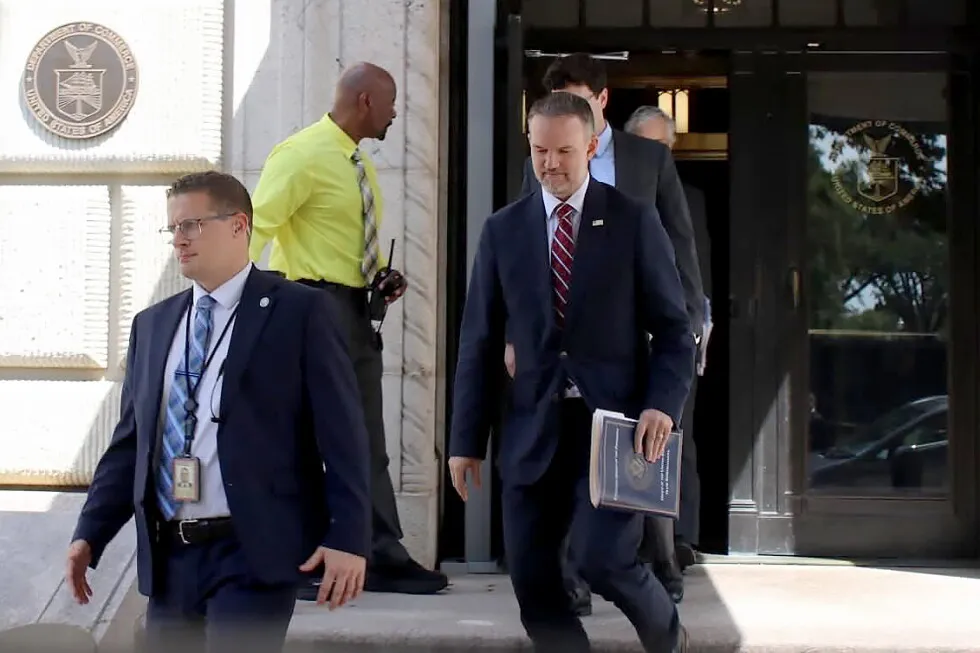
US, Canada hold last-minute talks to stop 50% U.S. tariffs on $20 billion worth of Canadian goods 1 of 2 | United States Trade Representative Jamieson Greer, center, leaves the U.S. Department of Commerce following a meeting with Canadian officials, in Washington, Monday, Aug. 17, 2026. (Kelly Geraldine Malone/The Canadian Press via AP) 2 of 2 | Canada-U.S. Trade Minister Dominic LeBlanc makes brief comments to reporters outside the U.S. Department of Commerce following a meeting with U.S. Trade Representative Jamieson Greer and Commerce Secretary Howard Lutnick, in Washington, Monday, Aug. 17, 2026. (Kelly Geraldine Malone/The Canadian Press via AP) By PAUL WISEMAN and ROB GILLIES Updated 6:01 AM MESZ, August 18, 2026 Add AP News on Google Add AP News as your preferred source to see more of our stories on Google. Share Share Facebook Copy Link copied Print Email X LinkedIn Bluesky Flipboard Pinterest Reddit WASHINGTON (AP) — The United States and Canada have wrangled for decades over trade, poking each other interminably over sore spots like Canadian softwood lumber imports and U.S. access to Canada’s protected dairy market. Somehow the two neighbors still managed to remain friends, allies — and trading partners. Canadian soldiers fought alongside Americans in Afghanistan after 9/11. The 5,525-mile U.S.-Canada border is undefended, and nearly 330,000 people and $2 billion dollars’ worth of goods cross it every day; 800,000 Canadians live in the United States. President Donald Trump’s belligerent approach to dealing with Canada marks an extraordinary departure from the traditionally cooperative relationship between the two countries. Trump has hit Canadian goods with tariffs — in a push to bring manufacturing back to the United States — and has repeatedly made inflammatory comments about turning Canada into America’s 51st state. The Canadian public is fed up. A petition to expel the U.S. ambassador, a Trump ally, has collected nearly 218,000 signatures since July 21. It accuses Ambassador Pete Hoekstra of having “normalized’’ Trump’s talk of annexing Canada, among other things. Tension could hit new heights at 12:01 a.m. Wednesday if Trump goes ahead with his plan to impose 50% tariffs on $20 billion worth of Canadian products, ranging from hockey sticks to tongue depressors. What to know about the 50% tariffs Trump is imposing on Canada 5 MIN READ Trump imposes 50% tariffs on Canadian goods, citing disputes over autos, alcohol and cheese 5 MIN READ Trump imposes double-digit tariffs on dozens of countries as his 10% levies are set to expire Friday 5 MIN READ As the deadline approaches, the two countries are seeking a truce that would avoid the new round of tariffs. ″We are negotiating,” Canadian Prime Minister Mark Carney told reporters Monday, speaking in French. “The negotiations are very intense and delicate. This is not the time to talk about negotiations in public.” Nearly 72% of Canadian goods exports last year went to the United States. And the Trump administration might be wary of imposing a hefty new tariff — paid by U.S. importers who try to pass along the cost to consumers via higher prices — ahead of November’s midterm elections. American voters are already frustrated with the high cost of living. “I don’t think either side really wants these tariffs to come into effect,’’ said Ryan Majerus, a partner at King & Spalding and a former U.S. trade official. “There’s a pretty strong push on both sides to find an off ramp here.’’ Majerus said the United States is aiming to get Canada to buy more U.S. military equipment, including F-35 fighters; to take part in Trump’s “Golden Dome’’ missile defense; and to give the United States more access to critical minerals, thereby reducing America’s reliance on tenuous supplies from geopolitical rival China. The Canadians would like relief from U.S. tariffs on steel and aluminum as well as softwood lumber, which America says receives unfair government subsidies. Trump has made tariffs the centerpiece of his second-term economic agenda. Last year, he imposed double-digit import taxes on almost every country on earth, justifying them by declaring the longstanding U.S. trade deficit a national emergency. The Supreme Court in February ruled that he’d overstepped his authority, striking down those tariffs and setting the stage for the federal government to pay refunds to importers. Trump immediately looked for other ways to rebuild his tariff wall. Last month, he imposed import taxes of 10% to 12.5% on 59 countries and the European Union — which together account for 99% of U.S. imports — for allegedly failing to have or to enforce restrictions on imports made from forced labor. Then he reached back to the Great Depression to find a cudgel with which to whack Canada, one of his favorite targets. Trump invoked Section 338 of the Tariff Act of 1930 to impose 50% tariffs on products that account for about 5% of Canadian exports to the United States. Nearly a century ago, with the U.S. and world economies in collapse, Congress passed the 1930 tariff law, imposing hefty taxes on imports from around the world. Known as the Smoot-Hawley tariffs, for their congressional sponsors, they are notorious among economists and historians for limiting world commerce and making the Great Depression worse. Section 338 tariffs have never been used before. U.S. trade negotiators traditionally have favored another tool, Section 301 of the Trade Act of 1974 — the provision Trump invoked for last month’s forced-labor tariffs. Section 338 authorizes the president to impose tariffs of up to 50% on imports from countries that have discriminated against U.S. businesses. Unlike Section 301 sanctions, no investigation is required. Nor is there any limit on how long the tariffs can stay in place. In announcing the Section 338 tariffs, Trump claimed that Canada discriminates against American exports of autos, alcohol and cheese. Trump is angry because Canada and China were the only countries that punched back with retaliatory tariffs of their own when he slapped levies on their products last year. “If a country retaliates against us, we’re obviously not going to tolerate that,” U.S. Trade Representative Jamieson Greer told reporters Friday at the Iowa State Fair. “We’ll take action. My sense is the Canadians, they want to have a more conciliatory approach, but we’ll see.” The U.S. is renegotiating a North American trade pact — the US-Mexico-Canada Agreement — that Trump strong-armed America’s neighbors into accepting in his first term. The threat of Section 338 tariffs gives the United States leverage to seek fresh concessions from Ottawa. “From Carney’s perspective, you need (USMCA) to be renegotiated,’' said Christopher Gundermann, fellow in the economics program at the Center for Strategic and International Studies. ”You can’t renegotiate it with a massive trade war going on.’' But the Canadian public’s furor over Trump’s policies may limit Carney’s ability to cut a deal. Canada could retaliate again if the new 50% tariffs take effect, potentially aggravating a trade fight. Canada’s government “cannot look like it is simply caving to the Trump administration’s demands,’’ said Daniel Béland, a political science professor at McGill University in Montreal. “Making further concessions without getting something meaningful in exchange would probably lead to a strong backlash ... The risk is for the Carney government to make Canada look weak and, therefore, even more vulnerable to future trade and geopolitical bullying on the part of the Trump administration.” Dominic LeBlanc, Canada’s minister for U.S. trade, met with Greer on Monday. He was tight-lipped afterward. “The work is continuing,’’ he said. “We continue to do our job.’’
SRCAssociated Press (AP)
LANGEN
LEANCenter
WORDS1 242
ENT12
TUE · 2026-08-18 · 04:23 GMTBRIEF NSR-2026-0818-103300
NSR-2026-0818-103300News Report·EN·Diplomatic
US, Canada hold last-minute talks to stop 50% U.S. tariffs on $20 billion worth of Canadian goods
The United States and Canada are engaged in last-minute negotiations to avert a looming 50% U.S. tariff on $20 billion worth of Canadian goods, set to take effect Wednesday.
Associated Press (AP)Filed 2026-08-18 · 04:23 GMTLean · CenterRead · 5 min
Associated Press (AP)FIG 01
Reading time
5min
Word count
1 242words
Sources cited
3cited
Entities identified
12entities
Quality score
100%
§ 01
Briefing Summary
AI-generatedNEWSAR · AI
The United States and Canada are engaged in last-minute negotiations to avert a looming 50% U.S. tariff on $20 billion worth of Canadian goods, set to take effect Wednesday. President Trump's administration is imposing these tariffs, citing disputes over autos, alcohol, and cheese, and is also seeking concessions on military equipment and critical minerals. Canada, in turn, desires relief from existing U.S. tariffs on steel, aluminum, and softwood lumber. This trade dispute marks a departure from the historically cooperative relationship between the two nations. The outcome of these intense and delicate talks is uncertain, with both sides seeking a resolution to avoid further escalation.
Confidence 0.90Sources 3Claims 5Entities 12
§ 02
Article analysis
Model · rule-basedFraming
Diplomatic
Economic Impact
Tone
Mixed Tone
AI-assessed
CalmNeutralAlarmist
Factuality
0.70 / 1.00
Factual
LowHigh
Sources cited
3
Well sourced
FewMany
§ 03
Key claims
5 extracted01
Canadian Prime Minister Mark Carney stated that negotiations are 'very intense and delicate' and 'not the time to talk about negotiations in public'.
quoteMark Carney
Confidence
1.00
02
Nearly 72% of Canadian goods exports went to the United States last year.
statistic
Confidence
1.00
03
A petition to expel the US ambassador has collected nearly 218,000 signatures, accusing him of normalizing talk of annexing Canada.
factual
Confidence
1.00
04
The US and Canada are holding last-minute talks to prevent the US from imposing 50% tariffs on $20 billion of Canadian goods.
factual
Confidence
1.00
05
President Donald Trump's approach to Canada is an extraordinary departure from the traditionally cooperative relationship.
factual
Confidence
0.90
§ 04
Full report
5 min read · 1 242 words§ 05
Entities
12 identifiedKey playerOppositionContextPositiveNeutralNegative
People5
Organizations2
Locations3
Events1
Topics1
§ 06
Keywords & salience
8 termstariffs
1.00
us-canada trade
1.00
trade negotiations
0.90
donald trump
0.80
trade disputes
0.70
economic relations
0.60
protectionism
0.50
bilateral relations
0.40
§ 07
Topic connections
Interactive graph Network visualization showing 51 related topics
View Full Graph Person Organization Location Event|Click node to navigate|Edge numbers = shared articles