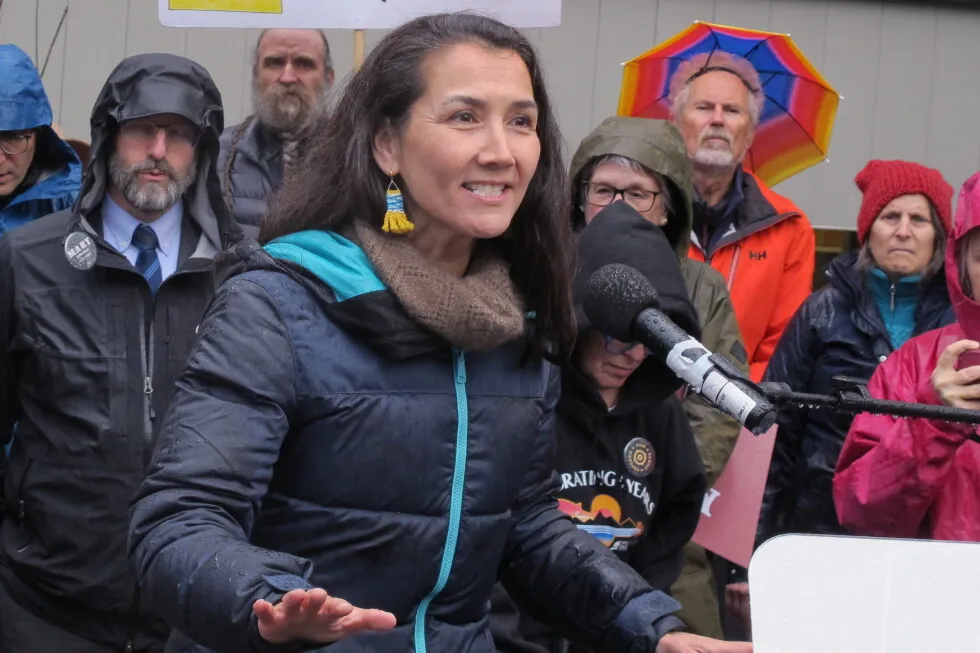
2 Dan Sullivans face off in Alaska’s US Senate primary, which also features a former congresswoman 1 of 5 | Alaska U.S. Senate candidate Mary Peltola, a Democrat, speaks during a campaign rally on May 14, 2026, in Juneau, Alaska. (AP Photo/Becky Bohrer, file) 2 of 5 | Sen. Dan Sullivan, R-Alaska, speaks to reporters at the Capitol in Washington, June 30, 2025. (AP Photo/Mark Schiefelbein) 3 of 5 | Dan Sullivan, a candidate in Alaska’s U.S. Senate race who shares his name with the incumbent seeking reelection, talks with a reporter, July 3, 2026, in Petersburg, Alaska. (AP Photo/Becky Bohrer, File) 4 of 5 | Alaska U.S. House candidate Bill Hill, an independent, speaks with people at a campaign fundraising event in Juneau, Alaska, June 4, 2026. (AP Photo/Becky Bohrer, File) 5 of 5 | Alaska Republican U.S. Rep. Nick Begich walks down a corridor in the state Capitol before giving a speech to Alaska lawmakers, March 10, 2026, in Juneau, Alaska. (AP Photo/Becky Bohrer, File) 1 of 5 | Alaska U.S. Senate candidate Mary Peltola, a Democrat, speaks during a campaign rally on May 14, 2026, in Juneau, Alaska. (AP Photo/Becky Bohrer, file) 1 of 5 Alaska U.S. Senate candidate Mary Peltola, a Democrat, speaks during a campaign rally on May 14, 2026, in Juneau, Alaska. (AP Photo/Becky Bohrer, file) Add AP News on Google Add AP News as your preferred source to see more of our stories on Google. Share 2 of 5 | Sen. Dan Sullivan, R-Alaska, speaks to reporters at the Capitol in Washington, June 30, 2025. (AP Photo/Mark Schiefelbein) 2 of 5 Sen. Dan Sullivan, R-Alaska, speaks to reporters at the Capitol in Washington, June 30, 2025. (AP Photo/Mark Schiefelbein) Add AP News on Google Add AP News as your preferred source to see more of our stories on Google. Share 3 of 5 | Dan Sullivan, a candidate in Alaska’s U.S. Senate race who shares his name with the incumbent seeking reelection, talks with a reporter, July 3, 2026, in Petersburg, Alaska. (AP Photo/Becky Bohrer, File) 3 of 5 Dan Sullivan, a candidate in Alaska’s U.S. Senate race who shares his name with the incumbent seeking reelection, talks with a reporter, July 3, 2026, in Petersburg, Alaska. (AP Photo/Becky Bohrer, File) Add AP News on Google Add AP News as your preferred source to see more of our stories on Google. Share 4 of 5 | Alaska U.S. House candidate Bill Hill, an independent, speaks with people at a campaign fundraising event in Juneau, Alaska, June 4, 2026. (AP Photo/Becky Bohrer, File) 4 of 5 Alaska U.S. House candidate Bill Hill, an independent, speaks with people at a campaign fundraising event in Juneau, Alaska, June 4, 2026. (AP Photo/Becky Bohrer, File) Add AP News on Google Add AP News as your preferred source to see more of our stories on Google. Share 5 of 5 | Alaska Republican U.S. Rep. Nick Begich walks down a corridor in the state Capitol before giving a speech to Alaska lawmakers, March 10, 2026, in Juneau, Alaska. (AP Photo/Becky Bohrer, File) 5 of 5 Alaska Republican U.S. Rep. Nick Begich walks down a corridor in the state Capitol before giving a speech to Alaska lawmakers, March 10, 2026, in Juneau, Alaska. (AP Photo/Becky Bohrer, File) Add AP News on Google Add AP News as your preferred source to see more of our stories on Google. Share Updated [hour]:[minute] [AMPM] [timezone], [monthFull] [day], [year] Juneau, Alaska (AP) — Alaska voters are choosing candidates for November’s general election in a series of primary contests Tuesday, including a U.S. Senate race that will be among the most closely watched in the nation this fall.The campaign featured over a dozen contenders in each of the top races — for Senate, U.S. House and governor. Under Alaska’s open primary system, all candidates appear on the same ballot, and the four who receive the most votes qualify for the ranked vote general election.Tuesday’s ballot also included candidates running for the Legislature and a statewide initiative that would reimpose campaign contribution limits in state and local elections.Senate race includes 2 Dan Sullivans and a former congresswomanThe highest-profile candidates in a field of 16 were two-term Republican Sen. Dan Sullivan and Democratic former U.S. Rep. Mary Peltola. The race, which could help determine control of the Senate, has drawn significant attention from outside groups, with Republican and Democratic campaign organizations identifying it as a top target. Peltola shook up her campaign leadership days before the primary. During the campaign, Sullivan, a veteran and ally of President Donald Trump, emphasized his support for the military, efforts to open more land for oil development and Trump’s signature tax and spending bill passed last year. He accused Peltola of being aligned with Lower 48 “liberals.”Peltola leaned into the “fish, family, freedom” slogan that first got her elected in 2022. She has criticized a political system that she said is rigged by special interests and allows politicians to enrich themselves. 5 MIN READ 5 MIN READ 6 MIN READ But it was a third candidate, a Republican also named Dan Sullivan, who garnered much of the attention. Dan J. Sullivan won a legal fight to appear on the ballot following claims by the senator and GOP allies that he was a sham candidate running at the behest of Democrats with the intent of causing confusion. Dan J. Sullivan, a retired teacher from the island community of Petersburg, denied that and said his run was spurred by frustration with the incumbent.He appeared on the ballot as Daniel J. Sullivan Jr., with no party affiliation — a decision that a state elections official said was intended to minimize possible confusion. Meanwhile, the senator was listed as Dan S. Sullivan, Republican and incumbent. The “incumbent” label does not accompany the names of any other candidates seeking reelection.The drama involving the dueling Dan Sullivans caught the attention of Trump. In a social media post endorsing the senator days before the primary, he called the other’s candidacy an attempt to trick voters and urged his followers to vote for “SULLIVAN, DAN S.” Republican Begich faced challenge from independent fishermanIn the race for Alaska’s only House seat, the most prominent candidates were Republican Rep. Nick Begich, seeking a second term, and independent Bill Hill, a fisherman and former educator from a small southwestern village.Progressive Democrat Matt Schultz suspended his campaign last month but remained on the ballot. His campaign said Schultz would withdraw as a general election candidate if he makes the primary’s top four. Schultz urged support for Hill, who leaned into concerns about affordability. Begich, who was endorsed by Trump, cast himself as hardworking and effective in his role. House Speaker Mike Johnson appeared at a rally for Begich in a conservative part of the state this month, though the event was closed to news media. Governor’s race wide openThe campaign for the state’s top executive office was an open race this year because Republican Gov. Mike Dunleavy was barred by term limits from seeking a third consecutive stint. Two Democrats hope to emerge from a crowded, largely Republican field: former state lawmakers Jonathan Kreiss-Tomkins and Tom Begich, who is Nick Begich’s uncle. If one of them wins in November, he would become Alaska’s first Democratic governor since Tony Knowles left office in 2002.Republicans in the race included Bernadette Wilson, a businessperson and conservative activist; Click Bishop, a former state labor commissioner and lawmaker; Dave Bronson, former mayor of Anchorage; and Adam Crum and Treg Taylor, two former members of Dunleavy’s Cabinet. Former Gov. Bill Walker, an independent, was also on the ballot. Ballot measure addresses money in state politicsThe lone measure before voters on the primary ballot asked them to reimpose campaign contribution limits five years after a divided federal appeals court struck down a number of caps. The measure proposes a $2,000 limit on how much individuals can give to candidates in state and local elections and a $5,000 cap on what they can give to political parties. It would also limit spending by groups other than political parties and how much individuals and groups can give to joint campaigns for governor and lieutenant governor.Supporters say such limits are needed to prevent special interests and wealthy donors from having outsize influence on a campaign or race. Opponents say the measure would favor candidates with name recognition and argue that restricting what someone can contribute limits their voice. Political spending by wealthy people has become a flashpoint in races in Alaska and elsewhere. In 2025 in Wisconsin, billionaires Elon Musk and George Soros helped push spending in a state Supreme Court campaign past $100 million, the most ever for a court race in the U.S. Bohrer is a statehouse and political reporter based in Juneau, Alaska.
SRCAssociated Press (AP)
LANGEN
LEANCenter
WORDS1 464
ENT12
TUE · 2026-08-18 · 04:23 GMTBRIEF NSR-2026-0818-103304
NSR-2026-0818-103304News Report·EN·Political Strategy
2 Dan Sullivans face off in Alaska’s US Senate primary, which also features a former congresswoman
Alaska voters are participating in primary elections to select candidates for the November general election, with a closely watched U.S. Senate race featuring incumbent Republican Dan Sullivan and Democratic former U.S.
By
BECKY BOHRERAssociated Press (AP)Filed 2026-08-18 · 04:23 GMTLean · CenterRead · 6 min
Associated Press (AP)FIG 01
Reading time
6min
Word count
1 464words
Sources cited
0cited
Entities identified
12entities
Quality score
100%
§ 01
Briefing Summary
AI-generatedNEWSAR · AI
Alaska voters are participating in primary elections to select candidates for the November general election, with a closely watched U.S. Senate race featuring incumbent Republican Dan Sullivan and Democratic former U.S. Rep. Mary Peltola. The Senate race also includes another Republican candidate named Dan Sullivan, whose presence on the ballot drew attention and was endorsed by Donald Trump. Alaska's open primary system allows all candidates on the same ballot, with the top four advancing to the general election. Other key races include the U.S. House and governor, and a ballot measure to reimpose campaign contribution limits.
Confidence 0.90Claims 5Entities 12
§ 02
Article analysis
Model · rule-basedFraming
Political Strategy
Human Interest
Tone
Measured
AI-assessed
CalmNeutralAlarmist
Factuality
0.80 / 1.00
Factual
LowHigh
Sources cited
0
No named sources
FewMany
§ 03
Key claims
5 extracted01
Nick Begich is an Alaska Republican U.S. Representative.
factual
Confidence
1.00
02
Bill Hill, an independent, is a candidate for the Alaska U.S. House.
factual
Confidence
1.00
03
Sen. Dan Sullivan, R-Alaska, is seeking reelection.
factual
Confidence
1.00
04
Mary Peltola, a Democrat, is a candidate in Alaska's U.S. Senate race.
factual
Confidence
1.00
05
Two candidates named Dan Sullivan are competing in Alaska's U.S. Senate primary.
factual
Confidence
1.00
§ 04
Full report
6 min read · 1 464 words§ 05
Entities
12 identifiedKey playerOppositionContextPositiveNeutralNegative
People4
Locations5
§ 06
Keywords & salience
9 termsus senate primary
1.00
alaska
0.90
dan sullivan
0.80
incumbent seeking reelection
0.70
former congresswoman
0.60
campaign rally
0.50
democrat
0.40
republican
0.40
independent
0.40
§ 07
Topic connections
Interactive graph Network visualization showing 39 related topics
View Full Graph Person Organization Location Event|Click node to navigate|Edge numbers = shared articles