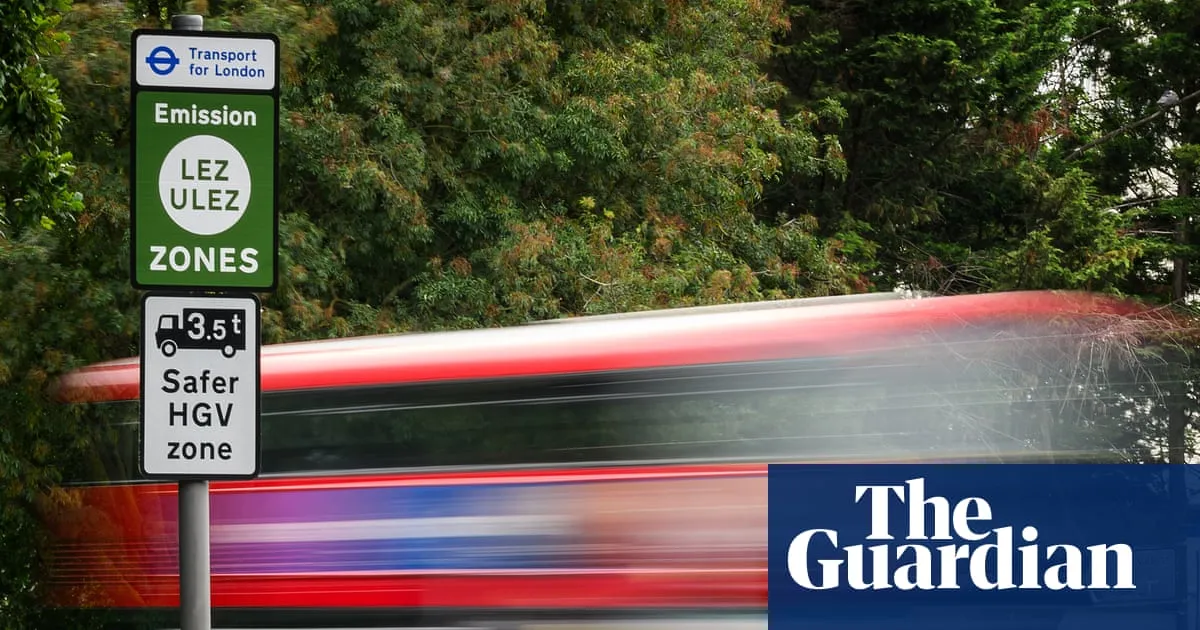
Children’s lungs grew bigger and stronger after the most polluting vehicles were restricted from entering London, a study has found.Examinations of London schoolchildren before and after the introduction of the city’s ultra-low emission zone (Ulez) found a restoration of lung capacity that had been stunted by exposure to pollution.The researchers said the findings were a vindication of the low-emission zone policy, which had been criticised as a burden on motorists.“Traffic pollution in cities damages children’s health and development,” said Chris Griffiths, a professor of primary care at the University of Oxford and London" class="entity-link entity-organization" data-entity-id="18663" data-entity-type="organization">Queen Mary University of London (QMUL), and the study’s joint senior author.“We provide the strongest evidence yet on how these harms can be prevented. Ambitious clean-air zones should be considered a priority for cities globally with traffic-related air pollution.”Air pollution from traffic has stunted the development of children’s lungs in London for decades. Previous research found that by the age of eight or nine, children from the most polluted areas had 5-10% less lung capacity than their peers elsewhere.That impairment, which scientists said was the result of exposure to nitrogen dioxide, put them at increased risk as adults of developing respiratory diseases, such as asthma and chronic obstructive pulmonary disease, cardiovascular and metabolic disease, and premature death.Londoners’ health was explicitly cited by the mayor, Sadiq Khan, to justify the introduction of Ulez – the world’s largest and most ambitious low-emission zone – in 2019. At the time, the policy, while intuitively sensible, lacked evidence, but researchers at QMUL saw an opportunity.Before Ulez came into force, they recruited 1,664 children aged six to nine in London and 1,750 in Luton, which, as a town with a similar mix of traffic pollutants but no clean air zone, was used as a control.The team measured and monitored the children’s size and health at annual school visits from 2018 to 2022 to assess how air quality changes after the introduction of Ulez had affected their lung development.Initial measurements showed children in London had significantly smaller lungs compared with those in Luton. But after Ulez came into force, the size and health of the London children’s lungs improved until they were comparable with those of the children in Luton.The children’s lung function improvements correlated strongly with air quality improvements. The researchers found that within five years of Ulez coming into force, the London children’s exposure to nitrogen dioxide fell twice as fast and twice as much as that of the Luton children.skip past newsletter promotionafter newsletter promotionWriting in the Guardian on Tuesday, Khan said: “Introducing and expanding the Ulez involved some incredibly difficult decisions. I never took them lightly, but I knew that – as mayor – I could not stand by while Londoners young and old lost their lives to a problem it was within my power to solve.“For years, politicians and pundits opposed to the Ulez have cynically sought to turn questions of public health into a crude culture war. Today, though, it’s clear that we’re winning the battle against toxic air in the capital – and it’s London’s children who are reaping the rewards,” he added.The health minister Karin Smyth said the study was “a powerful reminder of the impact that air quality has on children’s lung health. “[It] will help to improve our understanding of how reductions in air pollution can restore normal lung growth among children, reduce the risk of respiratory illnesses in adulthood, and support our goal to give every child the best start in life.”Stephen Burgess, a professor of biostatistics at the University of Cambridge who was not involved in the research, said it was not clear that the changes observed were truly attributable to Ulez, as opposed to other factors such as the impact of the Covid pandemic on pollution levels.“Nevertheless, the finding is important because lung function in childhood is an important measure of health, and the study provides encouraging evidence that changes in the urban environment may benefit children’s lung development,” he said.
SRCThe Guardian - World News
LANGEN
LEANCenter-Left
WORDS660
ENT10
TUE · 2026-08-18 · 22:30 GMTBRIEF NSR-2026-0819-103603
NSR-2026-0819-103603News Report·EN·Public Health
Ulez led to better lung size and function among London children, study finds
A study of London schoolchildren found that their lung size and function improved after the introduction of the Ultra-Low Emission Zone (Ulez). Researchers compared children in London to those in Luton, a control city without a similar clean air zone, from 2018 to 2022.
Damien Gayle Environment correspondentThe Guardian - World NewsFiled 2026-08-18 · 22:30 GMTLean · Center-LeftRead · 3 min
The Guardian - World NewsFIG 01
Reading time
3min
Word count
660words
Sources cited
2cited
Entities identified
10entities
Quality score
100%
§ 01
Briefing Summary
AI-generatedNEWSAR · AI
A study of London schoolchildren found that their lung size and function improved after the introduction of the Ultra-Low Emission Zone (Ulez). Researchers compared children in London to those in Luton, a control city without a similar clean air zone, from 2018 to 2022. Initial measurements showed London children had smaller lungs, but after Ulez was implemented, their lung capacity grew and became comparable to their Luton peers. The study attributes these improvements to reduced exposure to nitrogen dioxide from traffic pollution, suggesting Ulez has helped reverse lung development impairments in children. This research provides evidence supporting the policy's positive impact on children's health.
Confidence 0.90Sources 2Claims 5Entities 10
§ 02
Article analysis
Model · rule-basedFraming
Public Health
Environmental
Tone
Measured
AI-assessed
CalmNeutralAlarmist
Factuality
0.80 / 1.00
Factual
LowHigh
Sources cited
2
Limited
FewMany
§ 03
Key claims
5 extracted01
Traffic pollution in cities damages children's health and development.
quoteChris Griffiths
Confidence
1.00
02
Initial measurements showed children in London had significantly smaller lungs compared with those in Luton.
factualstudy
Confidence
0.90
03
Examinations of London schoolchildren found a restoration of lung capacity that had been stunted by pollution exposure.
factualstudy
Confidence
0.90
04
Children's lungs grew bigger and stronger after the Ulez was introduced, restricting polluting vehicles in London.
factualstudy
Confidence
0.90
05
By age eight or nine, children from most polluted areas had 5-10% less lung capacity than their peers elsewhere.
statisticPrevious research
Confidence
0.80
§ 04
Full report
3 min read · 660 words§ 05
Entities
10 identifiedKey playerOppositionContextPositiveNeutralNegative
Organizations2
§ 06
Keywords & salience
10 termslung function
1.00
ulez
1.00
air pollution
0.90
children's health
0.90
low-emission zone
0.80
traffic pollution
0.70
lung capacity
0.60
clean-air zones
0.50
nitrogen dioxide
0.40
respiratory diseases
0.40
§ 07
Topic connections
Interactive graph Network visualization showing 51 related topics
View Full Graph Person Organization Location Event|Click node to navigate|Edge numbers = shared articles