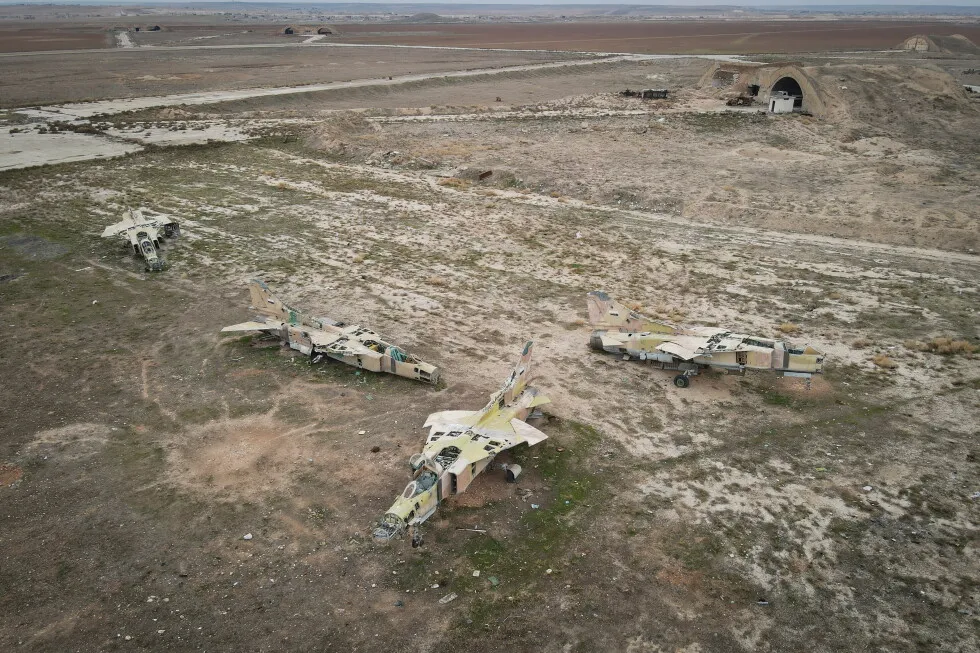
Decommissioned Syrian air force planes are seen at the Abu Duhur military air base east of Idlib, following the takeover of the area by Syrian opposition fighters on Saturday, Dec. 7, 2024. (AP Photo/Omar Albam, File) By GHAITH ALSAYED and SUZAN FRASER Updated 1:27 PM MESZ, August 19, 2026 Add AP News on Google Add AP News as your preferred source to see more of our stories on Google. Share Share Facebook Copy Link copied Print Email X LinkedIn Bluesky Flipboard Pinterest Reddit DAMASCUS, Syria (AP) — A Turkish delegation had visited an air base in northern Syria the day before it was hit by Israeli airstrikes, Syrian officials said. The Israeli strikes hit the Abu Duhur base early Tuesday, hours after the delegation had left, causing damage but no casualties. Israeli Prime Minister Benjamin Netanyahu’s office said in a statement that Israel had attacked the base because Syria was “on the verge of breaching” an agreed-upon “status quo in security matters” by allowing Turkish troops to deploy there. Two Syrian officials who spoke on condition of anonymity because they were not authorized to comment publicly said the Turkish delegation had visited the air base in the northwestern province of Idlib on Monday to review rehabilitation work underway at the facility. It was the first confirmation of a Turkish presence at the Abu Duhur base. Turkish and Syrian officials have not publicly commented on Turkey’s role there but have condemned the attack, as did Tom Barrack, the U.S. ambassador to Turkey who also serves as special envoy to Syria, and a number of Arab countries. Turkish officials on Wednesday did not comment on the reported presence of a Turkish military delegation. But Turkey’s communications directorate accused Netanyahu of making “untenable allegations ... intended to legitimize Israel’s unlawful airstrikes targeting Syria’s sovereignty and territorial integrity.” It alleged that Netanyahu aimed “to pursue expansionist and destabilizing policies in the region ahead of the elections in Israel.” Israel strikes an air base in northwest Syria to prevent Turkish troops from deploying 2 MIN READ 86 Turkey wants to join a new Lebanon security initiative after UN mission ends 3 MIN READ Fringe Israeli settler group is sneaking into Syria to try to claim land for a Jewish outpost 3 MIN READ Turkey “will resolutely continue to cooperate with the Syrian Government on a legitimate basis for the establishment of peace, stability, and prosperity in Syria, and will never allow the destabilization of Syria,” it said. The Abu Duhur air base lies at a strategic location near the borders between Idlib, Aleppo and Hama provinces. During the time of former Syrian President Bashar Assad, who was ousted by a rebel offensive in December 2024, MiG-23 and MiG-21 fighter jets and L-39 aircraft operated out of the base. Turkey has been supporting Syria’s effort to rebuild its armed forces by training Syrian personnel at Turkish military schools and bases, and by supplying equipment and logistical support. Officials have not disclosed the types of equipment involved. The two countries signed an agreement last year that formalized their military cooperation. Earlier this year, Syrian troops also took part in military exercises held in Turkey. Turkish officials have repeatedly stated that Ankara does not consider Syria’s security separate from its own. Israel, meanwhile, has remained suspicious of the new authorities in Damascus, led by former Islamist insurgents. Syria’s interim President Ahmad al-Sharaa has said repeatedly that he does not want a conflict with Israel. Israel carried out hundreds of airstrikes around Syria after Assad’s fall, mainly destroying assets of the Syrian army to keep them out of the hands of his successors. The Israeli military also seized control of a U.N.-patrolled buffer zone in southern Syria, which it continues to occupy. Turkey, a NATO member that also recently signed a defense pact with Saudi Arabia and Pakistan, gave no indication that it would respond militarily to the Israeli strikes in Syria, but the incident added further strain to already tense Turkish-Israeli relations. Turkey and Israel once were close allies, but the relationship has been marked by deep frictions under Turkish President Recep Tayyip Erdogan’s more than two-decade rule, despite brief periods of reconciliation. Erdogan is an outspoken critic of Israel’s policies toward the Palestinians, while Israel has been angered by Erdogan’s support for the Hamas militant group. The fall of Assad’s government further strained their relations as the two rivals sought to curb each other’s influence in the neighboring country, with some analysts fearing that they could be headed toward a proxy war.
SRCAssociated Press (AP)
LANGEN
LEANCenter
WORDS755
ENT9
WED · 2026-08-19 · 11:53 GMTBRIEF NSR-2026-0819-103779
NSR-2026-0819-103779News Report·EN·Conflict
Israeli strikes hit an air base hours after a Turkish delegation visit, Syrian officials say
Israeli airstrikes targeted the Abu Duhur air base in northwestern Syria early Tuesday, hours after a Turkish delegation had visited the facility. Syrian officials confirmed the delegation's visit to review rehabilitation work, marking the first confirmation of a Turkish presence at the base.
Associated Press (AP)Filed 2026-08-19 · 11:53 GMTLean · CenterRead · 4 min
Associated Press (AP)FIG 01
Reading time
4min
Word count
755words
Sources cited
5cited
Entities identified
9entities
Quality score
100%
§ 01
Briefing Summary
AI-generatedNEWSAR · AI
Israeli airstrikes targeted the Abu Duhur air base in northwestern Syria early Tuesday, hours after a Turkish delegation had visited the facility. Syrian officials confirmed the delegation's visit to review rehabilitation work, marking the first confirmation of a Turkish presence at the base. Israel's Prime Minister's office stated the strikes were a response to Syria being "on the verge of breaching" a security status quo by allowing Turkish troop deployment. While the strikes caused damage, no casualties were reported. Both Turkish and Syrian officials condemned the attack. Turkey's communications directorate accused Netanyahu of making "untenable allegations" to legitimize "unlawful airstrikes" and pursue "expansionist and destabilizing policies." The incident further strained already tense Turkish-Israeli relations.
Confidence 0.90Sources 5Claims 5Entities 9
§ 02
Article analysis
Model · rule-basedFraming
Conflict
Diplomatic
Tone
Measured
AI-assessed
CalmNeutralAlarmist
Factuality
0.70 / 1.00
Factual
LowHigh
Sources cited
5
Well sourced
FewMany
§ 03
Key claims
5 extracted01
Turkey accused Netanyahu of making 'untenable allegations' to legitimize 'unlawful airstrikes' and pursue 'expansionist and destabilizing policies'.
quoteTurkey’s communications directorate
Confidence
0.95
02
Israel attacked the base because Syria was 'on the verge of breaching' an agreed-upon 'status quo in security matters' by allowing Turkish troops to deploy there.
quoteIsraeli Prime Minister Benjamin Netanyahu’s office
Confidence
0.95
03
Turkey 'will resolutely continue to cooperate with the Syrian Government on a legitimate basis for the establishment of peace, stability, and prosperity in Syria'.
quoteTurkey’s communications directorate
Confidence
0.90
04
Israeli airstrikes hit the Abu Duhur air base in northern Syria.
factualSyrian officials
Confidence
0.90
05
A Turkish delegation visited the air base the day before the Israeli strikes.
factualSyrian officials
Confidence
0.85
§ 04
Full report
4 min read · 755 words§ 05
Entities
9 identifiedKey playerOppositionContextPositiveNeutralNegative
§ 06
Keywords & salience
10 termsisraeli airstrikes
1.00
syrian air base
0.90
turkish delegation
0.80
syrian officials
0.70
abu duhur base
0.70
syrian sovereignty
0.60
territorial integrity
0.50
regional security
0.50
benjamin netanyahu
0.40
turkey syria relations
0.40
§ 07
Topic connections
Interactive graph Network visualization showing 51 related topics
View Full Graph Person Organization Location Event|Click node to navigate|Edge numbers = shared articles