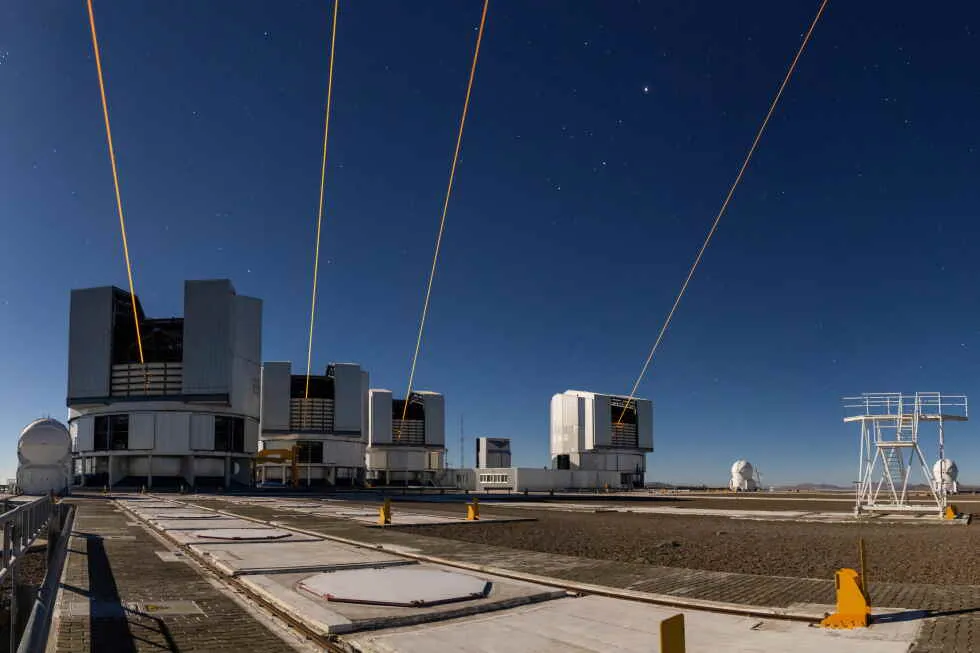
This photo made with a long exposure and released by the European Southern Observatory (ESO) on Nov. 10, 2025, shows four lasers at ESO’s Paranal Observatory, each one launched from one of the four eight-meter telescopes on site in Taltal, Chile. (A. Berdeu/European Southern Observatory via AP) Updated [hour]:[minute] [AMPM] [timezone], [monthFull] [day], [year] NEW YORK (AP) — A telescope has spied the fastest known star in our galaxy, racing around the supermassive black hole at the center of the Milky Way.The star is zipping around the black hole, reaching speeds of about 15,534 miles per second (25,000 kilometers per second). That’s 100,000 times faster than a commercial plane.“That star is really, extremely fast,” said astronomer Stefan Gillessen with the Max Planck Institute for Extraterrestrial Physics.The newly discovered star also orbits the black hole at closer range than scientists have ever seen before, taking just 8.7 years to complete a revolution. It harnesses the black hole’s gravity to fly faster without falling in.Gillessen and colleagues uncovered the star in data collected by the European Southern Observatory’s Very Large Telescope in Chile’s Atacama Desert. Their findings were published Wednesday in the journal Nature. There are several hundred stars that closely orbit this giant black hole and are sensitive to its gravity. Scientists have mapped the orbits of around 50 of them. The new star is 10 times closer than the previous record holder, meaning that it also feels the effects of the black hole’s rotation. There are supermassive black holes lurking in the center of almost every large galaxy. But nothing can escape them — not even light — so it’s notoriously difficult for scientists to figure out what’s going on inside. 2 MIN READ 1 MIN READ 5 MIN READ Studying stars like this one could help scientists measure those mysterious properties, including how fast the supermassive black hole spins. Advanced telescopes are helping to pinpoint fainter stars that previously eluded detection, so there could be even speedier ones waiting to be found. “This is just the tip of the iceberg,” said astronomer Tuan Do with the University of California, Los Angeles, who had no role in the study. “As we get fainter, there should be many more stars like this.”___The Associated Press Health and Science Department receives support from the Howard Hughes Medical Institute’s Department of Science Education and the Robert Wood Johnson Foundation. The AP is solely responsible for all content.
SRCAssociated Press (AP)
LANGEN
LEANCenter
WORDS403
ENT12
WED · 2026-08-19 · 15:23 GMTBRIEF NSR-2026-0819-103884
NSR-2026-0819-103884News Report·EN·Human Interest
Telescope spies the fastest star in the Milky Way zipping around a black hole
Astronomers have discovered the fastest known star in the Milky Way, orbiting the supermassive black hole at the galaxy's center. This star reaches speeds of approximately 15,534 miles per second and completes an orbit in just 8.7 years, making it the closest observed star to the black hole.
By
ADITHI RAMAKRISHNANAssociated Press (AP)Filed 2026-08-19 · 15:23 GMTLean · CenterRead · 2 min
Associated Press (AP)FIG 01
Reading time
2min
Word count
403words
Sources cited
2cited
Entities identified
12entities
Quality score
100%
§ 01
Briefing Summary
AI-generatedNEWSAR · AI
Astronomers have discovered the fastest known star in the Milky Way, orbiting the supermassive black hole at the galaxy's center. This star reaches speeds of approximately 15,534 miles per second and completes an orbit in just 8.7 years, making it the closest observed star to the black hole. The discovery was made using data from the European Southern Observatory's Very Large Telescope and published in the journal Nature. Studying such stars can help scientists understand the properties of black holes, including their spin rate. Researchers anticipate that advanced telescopes may reveal even faster stars in the future.
Confidence 0.90Sources 2Claims 5Entities 12
§ 02
Article analysis
Model · rule-basedFraming
Human Interest
Technology
Tone
Mixed Tone
AI-assessed
CalmNeutralAlarmist
Factuality
0.90 / 1.00
Factual
LowHigh
Sources cited
2
Limited
FewMany
§ 03
Key claims
5 extracted01
Astronomer Stefan Gillessen stated, 'That star is really, extremely fast.'
quoteStefan Gillessen
Confidence
1.00
02
Studying such stars can help scientists measure properties of supermassive black holes, including their spin speed.
factual
Confidence
1.00
03
This star completes an orbit around the black hole in just 8.7 years, closer than any previously observed star.
factual
Confidence
1.00
04
The star reaches speeds of approximately 15,534 miles per second (25,000 kilometers per second).
statistic
Confidence
1.00
05
A telescope has detected the fastest known star in the Milky Way, orbiting the supermassive black hole at the galaxy's center.
factual
Confidence
1.00
§ 04
Full report
2 min read · 403 words§ 05
Entities
12 identifiedKey playerOppositionContextPositiveNeutralNegative
Organizations5
§ 06
Keywords & salience
10 termssupermassive black hole
1.00
fastest star
1.00
milky way
0.90
galaxy
0.80
astronomy
0.70
telescope
0.60
star orbits
0.50
gravity
0.50
european southern observatory
0.40
atacama desert
0.40
§ 07
Topic connections
Interactive graph No topic relationship data available yet. This graph will appear once topic relationships have been computed.