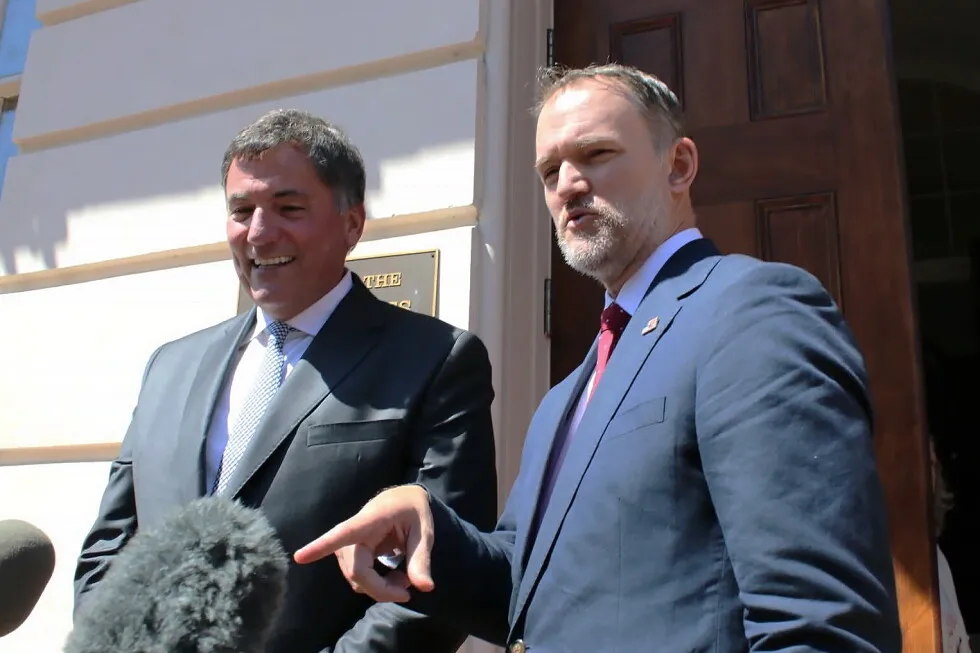
Trump says US and Canada have a trade deal, but key terms remain unclear 1 of 4 | Canada-U.S. Trade Minister Dominic LeBlanc, left, and United States Trade Representative Jamieson Greer speak to reporters in Washington, D.C., on Wednesday, Aug. 19, 2026, the day after the Trump administration temporarily delayed tariffs on Canada. (Kelly Geraldine Malone/The Canadian Press via AP) 2 of 4 | Canada-U.S. Trade Minister Dominic LeBlanc, centre left, and United States Trade Representative Jamieson Greer, leave a meeting in Washington, D.C., on Wednesday, Aug. 19, 2026, the day after the Trump administration temporarily delayed tariffs on Canada. (Kelly Geraldine Malone/The Canadian Press via AP) 3 of 4 | Canada-U.S. Trade Minister Dominic LeBlanc, left, and United States Trade Representative Jamieson Greer, speak to reporters in Washington, D.C., on Wednesday, Aug. 19, 2026, the day after the Trump administration temporarily delayed tariffs on Canada. (Kelly Geraldine Malone/The Canadian Press via AP) 4 of 4 | Canada-U.S. Trade Minister Dominic LeBlanc, left, and United States Trade Representative Jamieson Greer, speak to reporters in Washington, D.C., on Wednesday, Aug. 19, 2026, the day after the Trump administration temporarily delayed tariffs on Canada. (Kelly Geraldine Malone/The Canadian Press via AP) By ROB GILLIES, PAUL WISEMAN and SEUNG MIN KIM Updated 9:48 PM MESZ, August 19, 2026 Add AP News on Google Add AP News as your preferred source to see more of our stories on Google. Share Share Facebook Copy Link copied Print Email X LinkedIn Bluesky Flipboard Pinterest Reddit WASHINGTON (AP) — Canada has dodged President Donald Trump’s threat of 50% tariffs — at least for now. Trump went on social media late Tuesday to say he was pausing for three days the taxes on $20 billion worth of Canadian imports less than two hours before they were set to go into effect. Speaking to reporters at the White House Wednesday, Trump said that talks with Canada yielded a “very fair deal for both” sides. “Our farmers are going to be thrilled, our manufacturers are going to be thrilled,” Trump said in an impromptu gaggle during a tour of South Lawn construction. Trump also noted that the agreement is all subject to the “finalization of documents.” For now, the tariffs have been postponed until 12:01 a.m. Saturday. Dominic LeBlanc, the minister responsible for Canada-U.S. trade, returned to Ottawa on Wednesday to meet Canadian Prime Minister Mark Carney, who was also set to chair Cabinet and a virtual meeting with provincial and territorial leaders. Trump’s tariff threat would hit 5% of Canadian exports Last month, Trump invoked a never-before-used legal authority, dating back to the Great Depression, to announce that the United States would slap 50% tariffs on $20 billion, or about 5%, of Canadian exports to the United States, ranging from hockey sticks to tongue depressors. Trump claimed that Canada discriminates against American exports of autos, alcohol and cheese. The U.S. president is also furious that Canada and China were the only countries that punched back with retaliatory tariffs of their own when he slapped levies on their products. The United States and Canada have sparred for decades over trade, poking each other over sore spots like Canadian softwood lumber imports and U.S. access to Canada’s protected dairy market. Trump says US and Canada have reached last-minute deal to delay 50% US tariffs on Canadian imports 2 MIN READ 17 Trump imposes 50% tariffs on Canadian goods, citing disputes over autos, alcohol and cheese 3 MIN READ 890 Prime Minister Carney says Canada is ready to respond if Trump’s new tariffs go into effect 3 MIN READ 890 Canada’s dairy market has been a persistent irritant While details of the agreement emerging Wednesday remain vague, Trump claimed that Canada had agreed to end tariffs on U.S. agricultural products. “The tariffs will be non-existent for our farmers. Our farmers were paying tremendous tariffs into Canada, and those tariffs are going to be totally eviscerated. Down to zero,” he said. Canada currently allows a set amount of dairy imports at low tariffs. Once imports exceed that limit, much higher tariffs apply. The U.S. says Canada’s “supply management″ system makes it harder for American dairy producers to get full access to the Canadian market. LeBlanc, talking to reporters in Washington, said that Canada’s “agriculture sector will be well protected and we have maintained our tough line.’’ That leaves another key question unresolved: how Canada can preserve supply management while giving U.S. farmers the additional access Trump says they will get. Also unclear is what Canada would get out of the deal. Carney says the emerging agreement would provide greater certainty and preserve favorable terms for key sectors, but Ottawa has not detailed what tariff relief Washington has offered. In the Truth Social post announcing the three-day tariff pause, Trump declared that the long-canceled Keystone XL pipeline “may be awoken from the grave.” He posted an illustration of himself wrangling with a pipeline. He did not say whether reviving Keystone XL was part of the agreement. The White House did not return a request for more details on the Keystone element. But earlier this year, Trump granted a key approval for a major new Canada-to-U.S. pipeline nicknamed “Keystone Light.” It would carry up to 550,000 barrels (87,400 cubic meters) of oil a day from Canada through Montana and Wyoming, where it would link with another pipeline. Keystone XL was designed to carry up to 830,000 barrels of crude a day from Canada’s oil sands to Nebraska and onward to U.S. Gulf Coast refineries. The project became a major political and environmental fight: President Barack Obama rejected it in 2015, Trump revived it in his first term and President Joe Biden canceled its permit in 2021. The Canadian company behind it later abandoned the project. Carney had already raised reviving Keystone XL with Trump at the White House in October 2025, and Trump was receptive, according to a Canadian government official familiar with the discussion. A revival would align with a longstanding Canadian goal rather than amount to a new U.S. concession. Carney did not mention the pipeline in his latest statement or detail what Canada had agreed to in the broader trade talks. Eight of Canada’s 10 provinces restrict or ban U.S. alcohol — measures imposed in retaliation for Trump’s previous tariffs on a number of Canadian goods last year and amid anger over his repeated talk of making Canada the 51st U.S. state. The Distilled Spirits Council says U.S. spirits exports to Canada have fallen more than 70%. Ontario, Canada’s most populous province, is especially important. Its government-run LCBO, one of the world’s largest alcohol purchasers, sold nearly $1 billion Canadian dollars ($723 million) in U.S. products annually before pulling them from shelves. The White House says the emerging deal includes a Canadian commitment to address the restrictions. But Carney cannot order provinces to restore sales. And provincial leaders could resist if the broader deal falls short of their priorities. For instance, Quebec is focused on dairy supply management, Ontario on protecting its auto industry and British Columbia on softwood lumber. The backlash extends beyond liquor stores, with Canadian travel to the United States falling sharply. Even if U.S. alcohol returns, sales could take time to recover. An agreement could clear the way for a broader trade deal The U.S. is renegotiating a North American trade pact — the US-Mexico-Canada Agreement — that Trump strong-armed America’s neighbors into accepting in his first term. The U.S. has begun formal USMCA negotiations with Mexico but not with Canada. If the threat of 50% tariffs is cleared, it “should help pave the way for formal U.S.-Canada negotiations,’' said Wendy Cutler, a former U.S. trade negotiator who is now senior vice president the Asia Society Policy Institute. Both countries had incentives to head off an escalation in trade tensions. Nearly 72% of Canada’s goods exports last year went to the United States. And the Trump administration might be wary of imposing a hefty new tariff — paid by U.S. importers who try to pass along the cost to consumers via higher prices — ahead of November’s midterm elections. American voters are already frustrated with the high cost of living. SEUNG MIN KIM Kim covers the White House for The Associated Press. She joined the AP in 2022 and is based in Washington. Kim is also a political analyst for CNN. twitter mailto
SRCAssociated Press (AP)
LANGEN
LEANCenter
WORDS1 395
ENT12
WED · 2026-08-19 · 19:53 GMTBRIEF NSR-2026-0819-103946
NSR-2026-0819-103946News Report·EN·Diplomatic
Trump says US and Canada have a trade deal, but key terms remain unclear
President Trump announced a temporary three-day pause on 50% tariffs threatened against $20 billion of Canadian imports, which were set to take effect just hours later. He stated that negotiations with Canada resulted in a "very fair deal for both" sides, particularly benefiting farmers and manufacturers, though key terms remain unclear and subject to document finalization.
Associated Press (AP)Filed 2026-08-19 · 19:53 GMTLean · CenterRead · 6 min
Associated Press (AP)FIG 01
Reading time
6min
Word count
1 395words
Sources cited
3cited
Entities identified
12entities
Quality score
100%
§ 01
Briefing Summary
AI-generatedNEWSAR · AI
President Trump announced a temporary three-day pause on 50% tariffs threatened against $20 billion of Canadian imports, which were set to take effect just hours later. He stated that negotiations with Canada resulted in a "very fair deal for both" sides, particularly benefiting farmers and manufacturers, though key terms remain unclear and subject to document finalization. The tariffs are postponed until Saturday morning. While Trump claimed Canada agreed to eliminate tariffs on U.S. agricultural products, Canadian officials emphasized that their agriculture sector will be protected, leaving the specifics of market access and Canada's "supply management" system unresolved. The article also notes Trump's mention of potentially reviving the Keystone XL pipeline and ongoing disputes over U.S. alcohol imports into Canada.
Confidence 0.90Sources 3Claims 5Entities 12
§ 02
Article analysis
Model · rule-basedFraming
Diplomatic
Economic Impact
Tone
Measured
AI-assessed
CalmNeutralAlarmist
Factuality
0.70 / 1.00
Factual
LowHigh
Sources cited
3
Well sourced
FewMany
§ 03
Key claims
5 extracted01
The threatened tariffs would have impacted $20 billion worth of Canadian exports, approximately 5% of total Canadian exports to the U.S.
factual
Confidence
1.00
02
The agreement is subject to the 'finalization of documents'.
quoteDonald Trump
Confidence
1.00
03
Trump stated that a 'very fair deal for both' sides was reached in talks with Canada.
quoteDonald Trump
Confidence
1.00
04
The tariffs were set to go into effect at 12:01 a.m. Saturday.
factual
Confidence
1.00
05
President Donald Trump announced a temporary delay of 50% tariffs on Canadian imports.
quoteDonald Trump
Confidence
1.00
§ 04
Full report
6 min read · 1 395 words§ 05
Entities
12 identifiedKey playerOppositionContextPositiveNeutralNegative
People4
Locations4
§ 06
Keywords & salience
9 termstrade deal
1.00
tariffs
0.90
donald trump
0.80
canada-u.s. trade
0.80
trade negotiations
0.70
import taxes
0.60
trade agreement
0.50
dominic leblanc
0.40
jamieson greer
0.40
§ 07
Topic connections
Interactive graph Network visualization showing 51 related topics
View Full Graph Person Organization Location Event|Click node to navigate|Edge numbers = shared articles