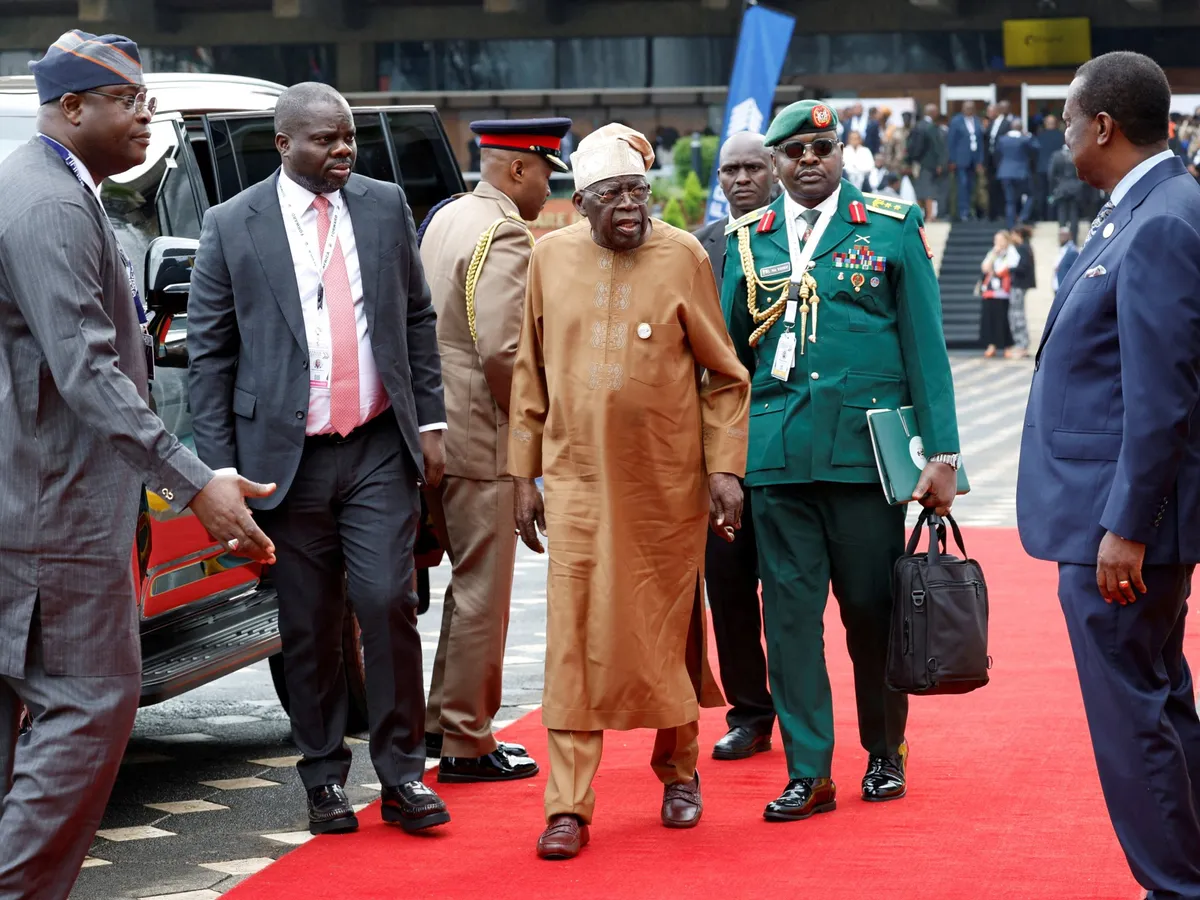
Rising costs fuel anger, but Tinubu’s machinery and opposition divisions may shape the race.Nigeria's President Bola Tinubu (centre) has faced growing criticism over insecurity, including a surge in mass kidnappings across the country [Monicah Mwangi/Reuters]Published On 20 Aug 2026Abuja, Nigeria – Every morning, Shukurat Oyedele unlocks her small plastic goods shop near Offa Garage in Ilorin, north-central Nigeria, even when she expects few customers.On the quietest days, the 43-year-old sits outside reading the Quran while waiting for buyers.Her business once attracted a steady flow of customers. But as prices have risen, many Nigerians have been forced to cut back on purchases they once considered routine.“People are interested in buying the things I sell, but they have become really expensive. Once they check their pockets and see that they cannot afford it, they won’t buy it no matter how much they like it, except if they can’t do without it,” Oyedele, a mother of four, told Al Jazeera.A 21-litre (5.5 gallon) bucket that sold for 1,500 naira ($1.10) two years ago now costs about 3,200 naira ($2.40), she said, more than doubling in price and forcing many customers to delay purchases or buy smaller quantities.Oyedele’s profits have fallen, and the shop that was once fully stocked now carries fewer goods.“I just keep opening the shop every day, so I wouldn’t shut down totally. The market is not what it used to be,” she said.Oyedele’s struggle captures the political dilemma facing President Bola Tinubu as Nigeria moves towards the 2027 presidential election: whether voters will judge his reforms by their long-term promises or by the immediate economic pain they have endured.Tinubu removed the fuel subsidy shortly after taking office in 2023 and introduced foreign-exchange reforms that allowed the naira to trade more freely, arguing that the measures were necessary to strengthen public finances, attract investment, and stabilise Africa’s largest economy.The reforms won support from investors and economists who had long argued that Nigeria needed to address deep structural problems in its economy. But the benefits of such reforms are typically slower to reach households than the costs they create.The International Monetary Fund (IMF) said Nigeria’s reforms had improved macroeconomic stability, but warned that living conditions remained difficult for many citizens. For many households, the immediate impact has been higher food prices, rising transport costs and declining purchasing power.“The government has to convince Nigerians that those gains will eventually translate into better lives, and give them a credible reason to wait for that to happen,” Sekinat Ojeniyi, a senior analyst at global risk advisory firm Africa Practice, told Al Jazeera.“That is a much harder political proposition when people have already made significant sacrifices.”For Tinubu, the political test is not only defending his reforms. It is persuading voters to endure their costs before they feel their benefits.The cost of waitingTinubu’s government points to improving economic indicators as evidence that the reforms are beginning to work.But many Nigerians experience the economy through what they pay for food, transport and basic household needs.“Voters experiencing that at the household level are not weighing GDP [gross domestic product] charts,” Cheta Nwanze, a partner at Nigerian research firm SBM Intelligence, told Al Jazeera.“Tinubu’s path to a second term depends almost entirely on opposition fragmentation and lower turnout among his critics, not persuasion,” he said.For Oyedele, the crisis is measured not through official figures, but through what her family can afford.“We can’t cook jollof rice the way we used to cook it. Now we cook concoction rice, and we can buy some spices such as curry to elevate the taste,” she said.“People don’t vote for GDP growth; they vote based on what they can feel in their own lives,” Ojeniyi said.That gap between government economic arguments and household realities could become one of the defining issues of the election.Anger without a vehicleEconomic hardship is not the only challenge facing the government.Nigeria continues to face insecurity involving armed fighters, kidnappers and religious groups, particularly in parts of the north and Middle Belt.Anne Ochayi, a 31-year-old lawyer living in Makurdi, told Al Jazeera that insecurity remains her biggest concern as she travels through the region, where she worries about banditry, farmer-herder violence, robbery and kidnapping.“We all live in fear. Aside from being on the road, this thing can come and meet you in your house,” she said.“If this issue of insecurity persists, they can’t convince me to vote for them,” she said.The security crisis gives opposition parties another issue to campaign on. But public frustration alone does not guarantee electoral change.Former Vice President Atiku Abubakar and former Anambra State Governor Peter Obi remain among the most prominent opposition figures seeking to challenge Tinubu, but attempts to unite the opposition behind a single candidate have so far failed.“The structural issue is that Nigeria’s electoral system rewards whoever consolidates the anti-incumbent vote into a single candidate,” Nwanze said.“With Atiku, Obi and others running on separate platforms, the mathematics favour Tinubu even with weak personal numbers.”The power of incumbencyTinubu enters the race facing dissatisfaction over the economy and insecurity, but the ruling All Progressives Congress (APC) retains one of its biggest advantages: organisation.The APC controls the federal government and has built one of Nigeria’s most extensive political networks, giving Tinubu an advantage in grassroots mobilisation.“The APC’s structural advantage is not popularity, but organisation,” Nwanze said.“The party controls the federal government and extensive political structures across many states.”Ojeniyi said those networks matter because Nigerian elections are fought through local political structures as much as national campaigns.“I think there is a danger of viewing the 2027 election purely as a referendum on Tinubu,” she said.“It is also a referendum on the quality of Nigeria’s political opposition and, more broadly, on whether our democracy is producing meaningful choices for citizens.”For voters such as Oyedele and Thomas Eneji, the election will ultimately be judged by whether daily life improves, not by political promises.Eneji, a ride-hailing driver in Abuja, told Al Jazeera he plans to vote in 2027 and hopes for a government that can make life easier for workers like him.Fuel costs, he said, have made it harder for drivers to earn enough to survive.But he also worries about whether votes will translate into political change.“I will keep on voting; it is just so unfortunate that sometimes we vote and your vote doesn’t count because of one or two manipulations,” he said.
SRCAl Jazeera
LANGEN
LEANCenter
WORDS1 053
ENT12
THU · 2026-08-20 · 00:06 GMTBRIEF NSR-2026-0820-104013
NSR-2026-0820-104013News Report·EN·Economic Impact
Nigeria’s election campaign begins with Tinubu facing a reform test
Nigeria's President Bola Tinubu faces a significant challenge as the country approaches the 2027 election, with rising costs fueling public anger. Tinubu's administration implemented fuel subsidy removal and foreign-exchange reforms in 2023, intended to strengthen the economy, but these measures have led to increased prices for basic goods and transport, impacting households.
By Pelumi SalakoAl JazeeraFiled 2026-08-20 · 00:06 GMTLean · CenterRead · 5 min
Al JazeeraFIG 01
Reading time
5min
Word count
1 053words
Sources cited
2cited
Entities identified
12entities
Quality score
100%
§ 01
Briefing Summary
AI-generatedNEWSAR · AI
Nigeria's President Bola Tinubu faces a significant challenge as the country approaches the 2027 election, with rising costs fueling public anger. Tinubu's administration implemented fuel subsidy removal and foreign-exchange reforms in 2023, intended to strengthen the economy, but these measures have led to increased prices for basic goods and transport, impacting households. While the IMF acknowledges macroeconomic stability improvements, citizens experience immediate economic hardship. The government must convince voters that long-term benefits will outweigh current sacrifices. Insecurity, particularly mass kidnappings, also remains a major concern for citizens. Despite widespread frustration, opposition divisions may influence the election outcome, with analysts suggesting Tinubu's path to re-election may depend on voter turnout and opposition fragmentation rather than persuasion.
Confidence 0.90Sources 2Claims 5Entities 12
§ 02
Article analysis
Model · rule-basedFraming
Economic Impact
Human Interest
Tone
Measured
AI-assessed
CalmNeutralAlarmist
Factuality
0.60 / 1.00
Mixed
LowHigh
Sources cited
2
Limited
FewMany
§ 03
Key claims
5 extracted01
The IMF stated Nigeria's reforms improved macroeconomic stability but warned living conditions remain difficult.
quoteInternational Monetary Fund (IMF)
Confidence
1.00
02
President Bola Tinubu implemented fuel subsidy removal and foreign-exchange reforms shortly after taking office in 2023.
factual
Confidence
1.00
03
A 21-litre bucket of goods has more than doubled in price from 1,500 naira ($1.10) to 3,200 naira ($2.40) in two years.
statisticShukurat Oyedele
Confidence
1.00
04
Rising costs of goods are forcing Nigerians to cut back on purchases, impacting small businesses.
quoteShukurat Oyedele
Confidence
1.00
05
Tinubu faces a political test to convince voters that reforms will eventually translate into better lives.
quoteSekinat Ojeniyi
Confidence
0.90
§ 04
Full report
5 min read · 1 053 words§ 05
Entities
12 identifiedKey playerOppositionContextPositiveNeutralNegative
Organizations1
§ 06
Keywords & salience
10 termsbola tinubu
1.00
economic reforms
0.90
nigeria election
0.90
rising costs
0.80
inflation
0.70
foreign-exchange reforms
0.60
fuel subsidy
0.60
living conditions
0.50
macroeconomic stability
0.50
insecurity
0.40
§ 07
Topic connections
Interactive graph Network visualization showing 51 related topics
View Full Graph Person Organization Location Event|Click node to navigate|Edge numbers = shared articles