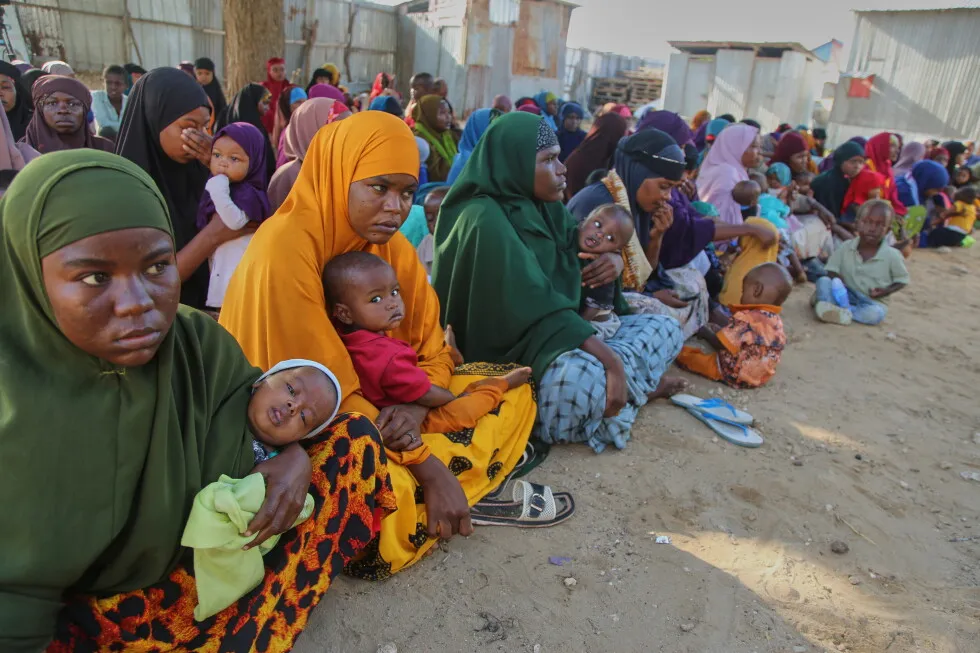
Somalia faces another hunger crisis and the UN food agency head says it has far less funds to help 1 of 5 | Somali women displaced by drought sit at Feynuus Nutrition Centre on the outskirts of the capital, Mogadishu, Somalia Wednesday, Aug. 19, 2026. (AP Photo/Farah Abdi Warsameh) 2 of 5 | A child is weighed at Feynuus Nutrition Centre on the outskirts of the capital, Mogadishu, Somalia Wednesday, Aug. 19, 2026. (AP Photo/Farah Abdi Warsameh) 3 of 5 | Acting Executive Director of the World Food Programme (WFP) Carl Skau, center, meets Somali women displaced by drought at Feynuus Nutrition Centre on the outskirts of the capital, Mogadishu, Somalia, Wednesday, Aug. 19, 2026. (AP Photo/Farah Abdi Warsameh) 4 of 5 | A Somali woman displaced by drought sits holding her child at Feynuus Nutrition Centre on the outskirts of the capital, Mogadishu, Somalia, Wednesday, Aug. 19, 2026. (AP Photo/Farah Abdi Warsameh) 5 of 5 | Somali women displaced by drought sit at Feynuus Nutrition Centre on the outskirts of the capital, Mogadishu, Somalia, Wednesday, Aug. 19, 2026. (AP Photo/Farah Abdi Warsameh) By OMAR FARUK Updated 3:38 PM MESZ, August 20, 2026 Add AP News on Google Add AP News as your preferred source to see more of our stories on Google. Share Share Facebook Copy Link copied Print Email X LinkedIn Bluesky Flipboard Pinterest Reddit Mogadishu, Somalia (AP) — Six million people in Somalia are facing acute food insecurity while the World Food Program has only a tenth of the resources it had in 2022 when it helped avert famine in the drought- and conflict-stricken East African nation, the head of the U.N. agency told The Associated Press. “We can only do the bare minimum,” WFP executive director Carl Skau said Wednesday during a visit to a nutrition center on the outskirts of the capital, Mogadishu. “We’re only providing these nutrition supplies to the children that are really the worst hit.” The reduced funds, because of cuts in international aid by donors and the redirection of resources to other humanitarian crises, meant that the WFP is unable to expand its assistance in Somalia, Skau said. The WFP projects that 1.9 million children under age 5 in the country will suffer acute malnutrition this year, including nearly 500,000 who will require urgent treatment for severe acute malnutrition. Overall, around 30% of the population faces critical levels of food insecurity, the U.N. has said. “We had 10 times more resources than now,” Skau said of the 2022 hunger emergency that was caused by a prolonged drought. “We were able to step in, and we prevented a famine here in Somalia.” Thousands flee yearslong drought in Somalia as hunger deepens and aid shrinks 1 MIN READ 23 Famine has ended in Gaza. But the gains are fragile and it could get worse 1 MIN READ 23 Afghanistan’s child deaths are rising as food distributions face cuts, UN says 1 MIN READ 23 “We know what’s going on, we have the capacity, we have the experience of dealing with this. We just need the resources now to do it.” The consequences of the current food shortage, which is also a result of drought, conflict and the displacement of people, are seen at the Feynuus Health Center in Mogadishu’s Kahda district. Dozens of women carrying babies waited beneath a large tree or crowded along the veranda of the corrugated-metal facility seeking help. Inside, health workers placed children in a blue weighing sling, screened them for malnutrition, and distributed therapeutic food. Halima Mohamed Hassan, a mother of six, had walked nearly 3 kilometers (2 miles) carrying her malnourished 4-year-old child. She is pregnant, but said she hadn’t eaten for two days. Her last meal was plain rice. Health workers treated the child she brought with a special nutrient-dense food, while Hassan said that her other children were also malnourished, but she wasn’t able to bring them to the center. Hassan fled the Lower Shabelle region four months ago after her husband died of malnutrition, she said. Food and water became scarce, and conflict made it increasingly dangerous for the family to stay. She and her children walked for four nights before reaching a camp for internally displaced people on Mogadishu’s outskirts. Hassan now shares a makeshift shelter with her widowed mother and her mother’s four other children. The two women look for occasional work washing clothes in nearby neighborhoods to feed their household of 12. The Feynuus center receives between 250 and 350 patients daily, mainly displaced women and children from regions outside Mogadishu, said Abdirahman Barkhad, program director of Youth Link Somalia, which operates the center. Barkhad said that about 10 nearby health and nutrition centers had closed because of a reduction in humanitarian funding, increasing pressure on those that remain. “We have witnessed children collapsing, because their families do not have enough food,” he said. Mohamud Moallim Abdulle, commissioner of the Somali Disaster Management Agency, described the country’s food situation as “extremely alarming.” He said that an estimated 1.85 million children are malnourished, while around 6 million people are affected by drought, and 2 million urgently need assistance. Skau said that mothers he met this week in the town of Burhakaba described drought, insecurity, and also rising food prices as the main drivers of the crisis. Some had lost their crops and fled their homes. Others walked for three or four hours to reach health facilities, because aid workers couldn’t reach them. “I spoke to women with eight to 10 children,” Skau said. “They don’t know where the next meal is going to come from.” Insecurity, with Somalia battling a 20-year-long insurgency by the al-Shabab militant group, also makes humanitarian operations more expensive. WFP must use aircraft in areas where staff and supplies can’t travel safely by road, and some communities are inaccessible, Skau said. He said that conflict in the Middle East was adding to the pressure by driving up fuel and food prices, limiting agricultural supplies, and drawing funding toward other emergencies. After her child received some food at the center, Hassan began the walk back to the camp they live in. Her five other children were still waiting and hungry, she said, and she would have to return with them one at a time. For more on Africa and development: https://apnews.com/hub/africa-pulse The Associated Press receives financial support for global health and development coverage in Africa from the Gates Foundation. The AP is solely responsible for all content. Find AP’s standards for working with philanthropies, a list of supporters and funded coverage areas at AP.org.
SRCAssociated Press (AP)
LANGEN
LEANCenter
WORDS1 095
ENT12
THU · 2026-08-20 · 13:53 GMTBRIEF NSR-2026-0820-104170
NSR-2026-0820-104170News Report·EN·Human Interest
Somalia faces another hunger crisis and the UN food agency head says it has far less funds to help
Somalia is facing a severe hunger crisis, with six million people experiencing acute food insecurity. The World Food Programme (WFP) has only a tenth of the resources it had in 2022, when it helped avert famine.
Associated Press (AP)Filed 2026-08-20 · 13:53 GMTLean · CenterRead · 5 min
Associated Press (AP)FIG 01
Reading time
5min
Word count
1 095words
Sources cited
2cited
Entities identified
12entities
Quality score
100%
§ 01
Briefing Summary
AI-generatedNEWSAR · AI
Somalia is facing a severe hunger crisis, with six million people experiencing acute food insecurity. The World Food Programme (WFP) has only a tenth of the resources it had in 2022, when it helped avert famine. WFP Executive Director Carl Skau stated that the agency can only provide "bare minimum" assistance, focusing on the most severely affected children. Reduced international aid and redirection of resources to other crises are cited as reasons for the funding shortfall. The WFP projects 1.9 million children under five will suffer acute malnutrition this year, with nearly 500,000 needing urgent treatment. The crisis is driven by drought, conflict, displacement, and rising food prices.
Confidence 0.90Sources 2Claims 5Entities 12
§ 02
Article analysis
Model · rule-basedFraming
Human Interest
Public Health
Tone
Measured
AI-assessed
CalmNeutralAlarmist
Factuality
0.90 / 1.00
Factual
LowHigh
Sources cited
2
Limited
FewMany
§ 03
Key claims
5 extracted01
The WFP is unable to expand its assistance in Somalia due to reduced funds.
factualWorld Food Programme (WFP) head Carl Skau
Confidence
1.00
02
The World Food Programme has only a tenth of the resources it had in 2022.
statisticWorld Food Programme (WFP) head Carl Skau
Confidence
1.00
03
Six million people in Somalia are facing acute food insecurity.
statisticWorld Food Programme (WFP) head Carl Skau
Confidence
1.00
04
Nearly 500,000 children will require urgent treatment for severe acute malnutrition.
statisticWorld Food Programme (WFP)
Confidence
0.90
05
The WFP projects that 1.9 million children under age 5 in Somalia will suffer acute malnutrition this year.
predictionWorld Food Programme (WFP)
Confidence
0.90
§ 04
Full report
5 min read · 1 095 words§ 05
Entities
12 identifiedKey playerOppositionContextPositiveNeutralNegative
Locations4
§ 06
Keywords & salience
9 termshunger crisis
1.00
food insecurity
0.90
funding cuts
0.80
world food programme
0.70
somalia
0.70
malnutrition
0.60
drought
0.50
humanitarian crises
0.50
international aid
0.40
§ 07
Topic connections
Interactive graph Network visualization showing 17 related topics
View Full Graph Person Organization Location Event|Click node to navigate|Edge numbers = shared articles