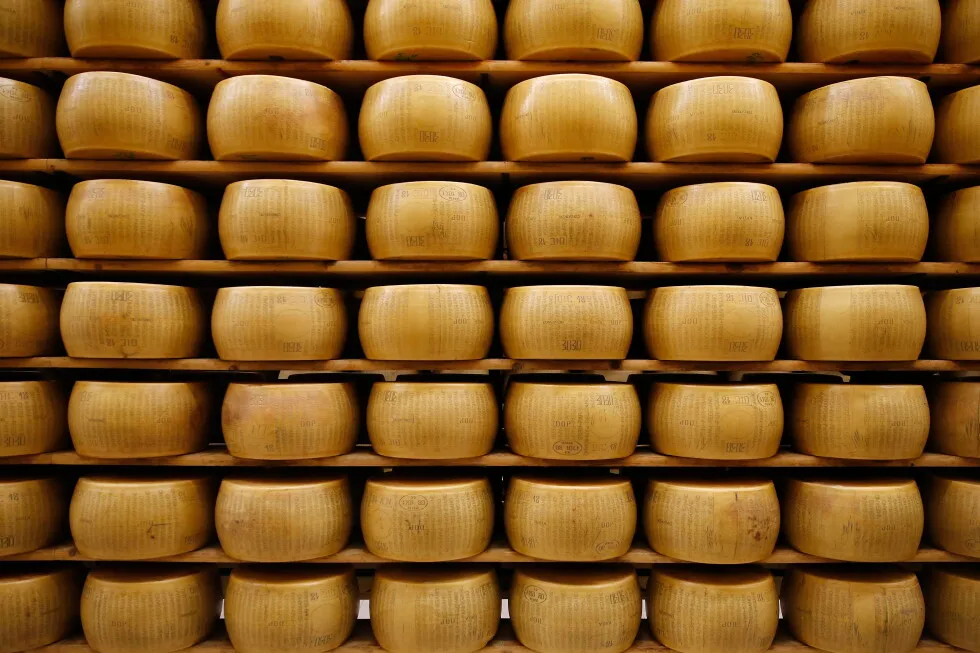
Parmigiano Reggiano Parmesan cheese wheels are stored in Noceto, near Parma, Italy, Oct. 8, 2019. (AP Photo/Antonio Calanni, File) Updated [hour]:[minute] [AMPM] [timezone], [monthFull] [day], [year] MILAN (AP) — As Italy has been plunged into a period of extreme heat, social media accounts amplified and falsified reports about the impact on the production of Parmigiano Reggiano cheese and a regional bank that stores the cheese wheels as collateral for loans.Parmigiano Reggiano cheese is made according to strict specifications within defined geographic areas in the Emilia Romagna region of northern Italy. Milk comes from dairy cattle fed only on locally grown forage, and the wheels must be aged for a minimum of 12 months, and can continue to 24, 36 or 40 months.To help producers manage their capital, a handful of banks accept the cheese wheels as collateral on loans during the aging process — the largest of which is the Credito Emiliano S.p.A’s Magazini Generali delle Tagliate (MGT), which has been operating since 1953.social media claimed that the extreme heat that swept Italy threatened both the cheese and its main cheese bank. Here’s a closer look at the facts.CLAIM: extreme heat is creating a “Great Parmesan Crisis” threatening both Parmigiano Reggiano cheese and Italy’s “cheese banks,” where hundreds of thousands of wheels of the cheese are stored as loan collateral.THE FACTS: Fortunately, wheels of the beloved cheese are neatly tucked away in cool storage and aging nicely while the rest of Italy sweats. MGT, which stores 500,000 cheese wheels valued at 300 million euros ($350 million) in two storage facilities, confirmed all is well. 2 MIN READ 4 MIN READ 5 MIN READ Giancarlo Ravanetti, MGT’s general manager, said the extreme heat had pushed energy consumption to keep the facilities cool up by 30%. But he said neither the cheese wheels nor MGT’s operations were at risk due to the extreme temperatures, which this summer have regularly neared 40 degrees Celsius (104 degrees Fahrenheit).“The warehouses have not been affected and have continued operating normally, ensuring the cheese wheels are stored and aged under optimal conditions,” he said, adding that he does not anticipate longer-term consequences, even if extreme heat persists in the future.MGT has been investing for several years to make the warehouses more energy efficient. It has replaced two obsolete refrigeration units with a high-efficiency unit, improved thermal insulation of the buildings and installed photovoltaic systems at both warehouses, reaching an installed capacity of 1.5 MW. The Parmigiano Reggiano consortium, which protects and regulates the prized hard cheese, acknowledges the “long-standing challenge” of heatwaves, as extreme heat can reduce milk production significantly, with “yields potentially falling by around 10%.”But, the consortium said in a statement that Parmigiano Reggiano production “is not currently at risk.”It emphasized that cows are mostly fed preserved and dried forage to guarantee supply even during drought. Farms that supply 70% of the milk used to make the cheese are equipped with fans, controlled water-spraying systems and environmental monitoring to keep the cows comfortable. The remaining milk supply comes from hilly and mountain areas where temperatures are generally cooler, the consortium said.___Find AP Fact Checks here: https://apnews.com/APFactCheck. Barry covers all things Italy for The Associated Press. Her focus includes fashion and design, overtourism and the environment, politics and sometimes the Vatican.
SRCAssociated Press (AP)
LANGEN
LEANCenter
WORDS545
ENT10
THU · 2026-08-20 · 17:23 GMTBRIEF NSR-2026-0820-104247
NSR-2026-0820-104247News Report·EN·Economic Impact
FACT FOCUS: Social media falsely claims heatwave threatens Parmigiano Reggiano cheese and bank
Social media falsely claimed that Italy's extreme heatwave was creating a "Great Parmesan Crisis" threatening Parmigiano Reggiano cheese and the banks that store it as loan collateral. However, the cheese wheels are kept in cool storage facilities, and the main storage bank, Credito Emiliano's Magazini Generali delle Tagliate (MGT), confirmed that operations are normal.
By
COLLEEN BARRYAssociated Press (AP)Filed 2026-08-20 · 17:23 GMTLean · CenterRead · 3 min
Associated Press (AP)FIG 01
Reading time
3min
Word count
545words
Sources cited
2cited
Entities identified
10entities
Quality score
100%
§ 01
Briefing Summary
AI-generatedNEWSAR · AI
Social media falsely claimed that Italy's extreme heatwave was creating a "Great Parmesan Crisis" threatening Parmigiano Reggiano cheese and the banks that store it as loan collateral. However, the cheese wheels are kept in cool storage facilities, and the main storage bank, Credito Emiliano's Magazini Generali delle Tagliate (MGT), confirmed that operations are normal. While the heat increased cooling costs by 30%, MGT's facilities were unaffected and aging cheese under optimal conditions. The Parmigiano Reggiano consortium acknowledged that heatwaves can reduce milk production but stated that overall production is not at risk, as cows are fed preserved forage and farms have cooling systems.
Confidence 0.90Sources 2Claims 5Entities 10
§ 02
Article analysis
Model · rule-basedFraming
Economic Impact
Human Interest
Tone
Measured
AI-assessed
CalmNeutralAlarmist
Factuality
0.90 / 1.00
Factual
LowHigh
Sources cited
2
Limited
FewMany
§ 03
Key claims
5 extracted01
Extreme heat increased energy consumption for cooling MGT facilities by 30%, but operations were not at risk.
factualGiancarlo Ravanetti (MGT General Manager)
Confidence
1.00
02
Parmigiano Reggiano cheese wheels are stored in cool conditions and aging normally despite extreme heat.
factualCredito Emiliano S.p.A’s Magazini Generali delle Tagliate (MGT)
Confidence
1.00
03
Social media falsely claimed that extreme heat threatened Parmigiano Reggiano cheese and its storage banks.
factual
Confidence
1.00
04
Parmigiano Reggiano production is not currently at risk due to heatwaves.
factualParmigiano Reggiano consortium
Confidence
0.90
05
Extreme heat can reduce milk production for Parmigiano Reggiano by around 10%.
statisticParmigiano Reggiano consortium
Confidence
0.90
§ 04
Full report
3 min read · 545 words§ 05
Entities
10 identifiedKey playerOppositionContextPositiveNeutralNegative
Organizations3
Locations4
§ 06
Keywords & salience
9 termsparmigiano reggiano
1.00
heatwave
0.90
social media misinformation
0.80
cheese banks
0.70
loan collateral
0.60
food production
0.50
credito emiliano
0.50
aging process
0.40
energy consumption
0.40
§ 07
Topic connections
Interactive graph No topic relationship data available yet. This graph will appear once topic relationships have been computed.