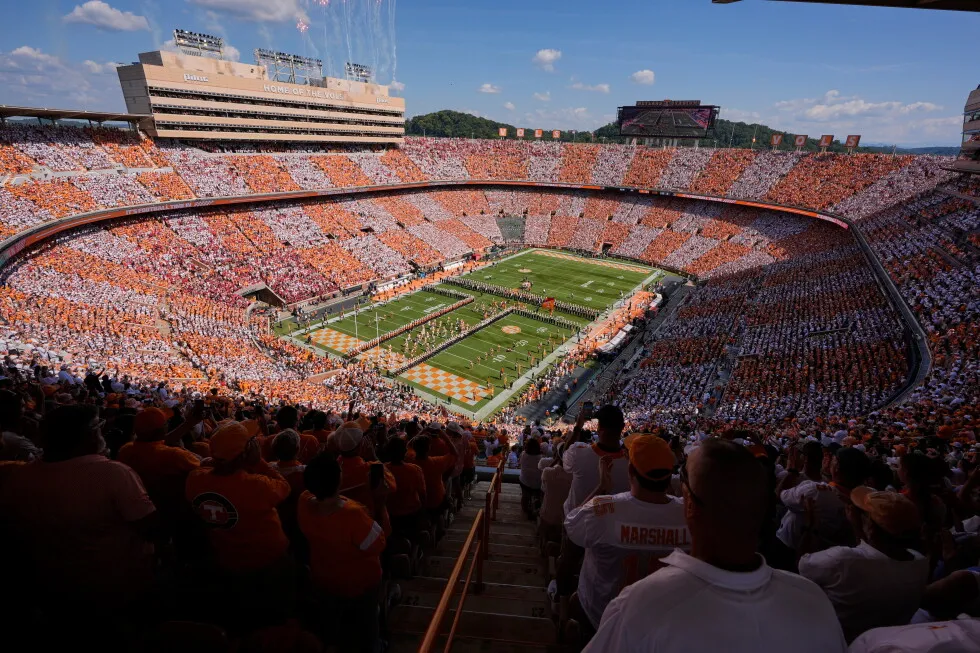
Tennessee runs onto the field before an NCAA college football game against Georgia, Sept. 13, 2025, in Knoxville, Tenn. (AP Photo/George Walker IV, File) By TERESA WALKER and ANDREW DESTIN Updated 7:18 PM MESZ, August 20, 2026 Add AP News on Google Add AP News as your preferred source to see more of our stories on Google. Share Share Facebook Copy Link copied Print Email X LinkedIn Bluesky Flipboard Pinterest Reddit Knoxville, Tenn. (AP) — You’ve heard about the patches coming soon to a college football jersey near you. You’ve seen the corporate logos cropping up on football fields from South Carolina to the University of Washington. Talent fees on season tickets, league-level deals with the likes of PayPal, naming rights revenue not just for a stadium but for the playing field within the stadium. All of this is now standard fare for universities scrambling to keep up in the sprawling and expensive industry that college athletics has become. For the latest year available (2024), the 352 Division I members of the NCAA alone reported generating nearly $20.5 billion in revenue. The problem is that, on average, most Bowl Subdivision athletic departments at the top of the food chain also reported losing money. Finding fresh dollars is critically paramount for departments becoming more creative by the day. Universities are not just slapping corporate logos on uniforms and facilities but building entertainment districts that can be lucrative far beyond game days. They are executing mind-boggling CFO-level reorganizations that are no longer unusual. “There’s never been a closer relationship between resources and competitive success as there is right now,” Tennessee athletic director Danny White said before adding: “This is the game that we’re in.” It used to be that athletic departments spent heavily on facilities and coaching staffs to land recruits wanting the best in their pursuit of a pro contract. That’s still going on, of course, but athletes now are getting far more than ever before. Five years ago, the NCAA cleared the way for athletes to earn endorsement money through name, image and likeness deals. QB Dante Moore’s offseason included golf, bowling and growth. Now comes football for No. 2 Oregon Mississippi State coach Jeff Lebby is confident in roster upgrades, but the SEC schedule is tough LSU opens the Lane Kiffin era at No. 11, immersed in intrigue with a schedule full of opportunities That spelled the end of the amateurism model so familiar for decades in college sports. It also started a flood of spending that has only grown more chaotic with the $2.8 billion House settlement that allowed each school to spend more than $20 millon of its own money — each year — on its athletes alongside third-party NIL deals that are under discussion all the way to Capitol Hill. Raising prices and fees for fans is a bit easier when the game-day experience is special. That is why Tennessee will keep building after wrapping up a $337 million renovation of Neyland Stadium. Up next is a step familiar to fans of pro teams like the Atlanta Braves and the Chicago Cubs: Construction of an entertainment district, a $280 million public-private development along the Tennessee River between Neyland and the basketball arena. A condo-hotel will offer a view into Neyland with shops, restaurants and an area for concerts or game-day events. Jeff Schemmel, president of College Sports Solutions, said he has believed in the need for athletic departments to create public-private partnerships for a long time to use one of their biggest assets — land and property — to produce money in a new way. This is our AP Top 25 Poll newsletter. You can subscribe below and we will email it you weekly. This site is protected by reCAPTCHA and the Google and Terms of Service apply. “It’s not fundraising. It’s not ticketing. It’s not multimedia rights,” said Schemmel, a former athletic director at San Diego State and a former chair of the NCAA’s Division I Championship and Sports Management Cabinet. “It’s new revenue, and I think most presidents and most athletic directors are willing to share that new revenue piece because it’s brand new,” he said. “If I were sitting in the chair again like I used to, I think I would certainly look at developing those kinds of public-private partnerships in areas completely outside of athletics.” Iowa State athletic director Jamie Pollard is often credited with originating mixed-use districts on a college campus to go beyond simple fund-raising. Iowa State announced its retail, office and entertainment development between Jack Trice Stadium and Hilton Coliseum in 2022 with a completion date of fall 2027. “I anticipate that you’re going to probably see the creation of more mixed-use facility developments in college sports in the next 10 years than there will ever be in the history of sports,” said Patrick Rishe, director of the sports business program at Washington University in St. Louis. When Washington joined the Big Ten with Oregon, UCLA and USC in 2024, the Huskies expected to receive only a half-share of the conference’s media rights revenue until 2030. A full share was nearly $79.9 million during the 2025 fiscal year. But the Huskies haven’t generated net revenue since the 2023 fiscal year and, according to the Seattle Times, are projected to have a $16 million cash flow deficit in fiscal 2027. Pat Chun, hired as Washington’s athletic director in 2024, said the university has taken loans on future TV revenue from both the Big Ten and the Fox News Network. In the meantime, Washington is looking to raise new revenue and cut costs. The Huskies are looking at a uniform patch deal and Chun has the support of university president Robert J. Jones trying to gin up revenue. “We believe we’re well positioned for the future,” Chun said. “Obviously, today in college sports it takes resources to do that. We’re working on an increase in what our resources are and managing what our spending is.” Potential risk of turning fans off with higher prices Tennessee was among the first to tack a NIL fee onto tickets specifically to help pay its athletes in September 2024, which hasn’t hurt demand. The 102,000-seat football stadium is sold out again and the school says there are 29,000 people on the waiting list. Basketball, softball, baseball? Sold out for three straight seasons. “We got a lot of eyeballs,” White said. “We’re in a market that we’re not competing with pro sports, and we got a million people that live in Knoxville.” Fans complain on social media about high ticket prices, but White said he thinks those are mostly people buying tickets on secondary markets he doesn’t control. “People have been wondering, thinking, ‘Oh, there’s got to be a ceiling somewhere.’ But, we haven’t seen that yet,” said Alan Morse, director of the Sport Marketing Research Institute at Northern Colorado. Teams already have patches on uniforms promoting apparel deals with Nike or adidas along with their conference affiliation. Then the NCAA approved adding jersey patches in January, and the rush to make deals to do just that has been strong. Kansas, Ohio State, Notre Dame and Vanderbilt are among the schools putting business logos on uniforms in a rush for corporate cash that NASCAR pioneered long ago. Ohio State and Notre Dame reportedly landed patch deals totaling around $30 million. Memphis agreed to put hometown FedEx’s logo in the end zones of the Liberty Bowl last August, then added a FedEx patch to uniforms in April. The Big 12 has a deal with Monster Energy that will link up their logos. The conference also has an agreement with the Big Ten that allows schools to pay their players through PayPal. One benefit for fans who can’t get enough of their alma mater’s stadium: Concerts and other events. Texas A&M used Kyle Field in June to host Argentina and Honduras in a friendly soccer match before the World Cup while Iowa State has had concerts at Jack Trice Stadium featuring country star Luke Combs, Post Malone and Jelly Roll. Morgan Wallen performed on back-to-back nights this summer at Michigan Stadium. Some universities are hiring people as assistant athletic directors simply to focus on generating revenue. Louisville started up a nonprofit arm while rival Kentucky in April 2025 converted its athletic department into a limited-liability holding company called Champions Blue LLC. That change is designed to help Kentucky have more flexibility in identifying and tapping new sources of revenue. When Kentucky hired J Batt as its new athletic director, the university mentioned his role as chief executive officer of Champions Blue first in its announcement. The Big 12 went a different way in April as the first known conference in major college sports to reach a league-wide deal with a private capital group. Each Big 12 school will have access to a line of credit up to $30 million each, paid back with interest of course. “Each conference, each school, has to do what’s in their best interest,” Big 12 Commissioner Brett Yormark said.
SRCAssociated Press (AP)
LANGEN
LEANCenter
WORDS1 506
ENT12
THU · 2026-08-20 · 17:23 GMTBRIEF NSR-2026-0820-104249
NSR-2026-0820-104249News Report·EN·Economic Impact
The playbook for college sports revenue is expanding from logos and fees to entertainment districts
College athletics departments are increasingly diversifying revenue streams beyond traditional sources like logos and ticket fees. Universities are now building entertainment districts, securing naming rights for fields, and implementing talent fees on season tickets to address significant financial shortfalls, despite generating billions in revenue.
Associated Press (AP)Filed 2026-08-20 · 17:23 GMTLean · CenterRead · 7 min
Associated Press (AP)FIG 01
Reading time
7min
Word count
1 506words
Sources cited
1cited
Entities identified
12entities
Quality score
100%
§ 01
Briefing Summary
AI-generatedNEWSAR · AI
College athletics departments are increasingly diversifying revenue streams beyond traditional sources like logos and ticket fees. Universities are now building entertainment districts, securing naming rights for fields, and implementing talent fees on season tickets to address significant financial shortfalls, despite generating billions in revenue. This shift is driven by rising expenses, particularly due to Name, Image, and Likeness (NIL) deals for athletes, which have ended the amateurism model. Examples include Tennessee's planned entertainment district and Iowa State's mixed-use development. Schools are also exploring creative solutions like uniform patch deals and league-wide partnerships to manage finances and maintain competitive success.
Confidence 0.90Sources 1Claims 5Entities 12
§ 02
Article analysis
Model · rule-basedFraming
Economic Impact
Human Interest
Tone
Measured
AI-assessed
CalmNeutralAlarmist
Factuality
0.70 / 1.00
Factual
LowHigh
Sources cited
1
Limited
FewMany
§ 03
Key claims
5 extracted01
There’s never been a closer relationship between resources and competitive success as there is right now.
quoteDanny White
Confidence
1.00
02
Universities are building entertainment districts to generate revenue beyond game days.
factual
Confidence
1.00
03
NCAA Division I members generated nearly $20.5 billion in revenue in 2024.
statistic
Confidence
1.00
04
The $2.8 billion House settlement allows each school to spend over $20 million annually on athletes.
factual
Confidence
0.95
05
Most Bowl Subdivision athletic departments at the top of the food chain reported losing money on average.
statistic
Confidence
0.90
§ 04
Full report
7 min read · 1 506 words§ 05
Entities
12 identifiedKey playerOppositionContextPositiveNeutralNegative
Organizations5
§ 06
Keywords & salience
9 termscollege sports revenue
1.00
entertainment districts
0.90
name, image and likeness
0.80
corporate logos
0.70
athletic departments
0.60
ncaa
0.60
competitive success
0.50
financial reorganization
0.50
amateurism model
0.40
§ 07
Topic connections
Interactive graph No topic relationship data available yet. This graph will appear once topic relationships have been computed.