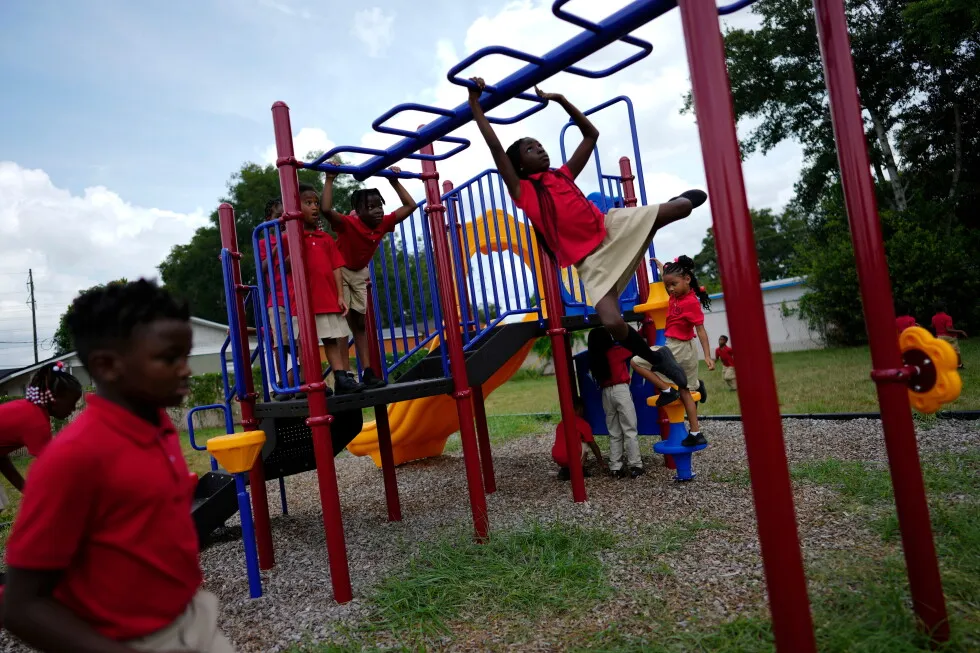
Students from Thomas Leadership Academy play on the school’s playground in Eatonville, Fla., on Aug. 23, 2023. (AP Photo/Rebecca Blackwell, File) By Cheyanne Mumphrey Updated 1:01 PM MESZ, August 21, 2026 Add AP News on Google Add AP News as your preferred source to see more of our stories on Google. Share Share Facebook Copy Link copied Print Email X LinkedIn Bluesky Flipboard Pinterest Reddit For students starting at a new school, the first day holds many questions: Will they see any familiar faces? Who will they sit with at lunch? Who will they play with at recess? “I’m this much nervous,” said Iman Fair-Seldon, 5, holding her hands about 4 inches (10 centimeters) apart. Iman will start first grade next month at a new school in southern New Jersey, near Philadelphia. Despite the nerves, she said she is excited to make new friends. Starting at a new school or making a big transition, such as moving from elementary school to middle school, can be challenging. Parents may want to help but aren’t always sure what to say or do. Here’s some advice from both grown-ups and the ultimate experts: kids who have gone through transition themselves. Parents of young children have significant influence over where their children spend time and with whom, experts say. They can seek out activities that create opportunities for connection, such as parks, playgrounds and birthday parties, and decide when their children are ready for activities like sleepovers. Amira Fair, Iman’s mother, says she prefers to keep to herself, but she pushes past those feelings to help her daughter develop relationships. “I make it my business to exchange numbers and try to schedule monthly playdates,” she said. “One thing I tried to do, especially at her old school, was go to every single birthday function, say hi to the parents, get a present, see the family.” Parents can’t manage every friendship for their children, experts say. Instead, they can help children develop their own sense of what makes a good friend: Are they kind? Are they honest? Can you be yourself around them? Some difficult interactions can help children learn what they value in a friend and how to handle conflict, Sutton said. More from Be Well Autoimmune diseases can strike any part of the body, and mostly affect women. Here’s what to know 14 Calisthenics are making a comeback. Is body weight enough to get a good workout? 24 Gut microbiome tests are everywhere. Should you get one? 14 Parents can also ask questions to help their children think about what they value in friendships: What qualities do you like in your friends? Who makes you feel comfortable being yourself? Those conversations can give children a framework for evaluating their own friendships when problems arise, experts say. Jaiden Journet, a 14-year-old starting at a new high school in North Carolina, suggests parents ask their kids: “Have you found anything you have in common with anyone?” Parents also can support their children through encouragement, especially if they are shy or anxious. Encouraging children to get involved in extracurricular activities or to try something new can help them meet people with similar interests. Shia Watts, 16, says trying something new led her to some of her friends at Notre Dame High School in Sherman Oaks, California. “Last year, I was part of theater production. I’d never done that before, but I met so many amazing people,” she said. When Jamir Gonzalez transferred last year to Uncommon Camden Prep High School in New Jersey, he joined the basketball and debate teams. “If you have any hobbies, find out if they have that at your school, and if they do, talk to the people that are there,” said Jamir, now a 16-year-old senior. Once students find opportunities to connect, starting the conversation is the next step, experts say. Smiling, complimenting others and asking questions can help start a conversation and keep it going. Iman, the New Jersey 5-year-old, remembers how she met her now “B-F-F-F-F-F.” It started with a compliment. “I think I said, ‘I like your shirt,’ and then she said, ‘Thank you.’ And I said, ‘So what’s your name?’” she recalled. Students may find it harder to start conversations when their peers are on their phones, wearing headphones or focused on screens. Experts say parents can encourage children, particularly teens, to put devices away at times so they can be more present and engaged with the people around them. One way to help: Stop texting your child at school, some teachers and experts say. But being too harsh with older children’s tech limits can isolate them socially, Sutton said. Still, parents should talk with their teens about expectations around technology, social media and gaming, including knowing who kids are interacting with online. Technology can also help children maintain friendships when circumstances separate them, Sutton said. “If you move away, it’s no longer like, ‘Hey, I moved out of state, and I can never see you,’ ” she said. “We have FaceTime, and we can still stay connected to friends in that way.” Feeling connected and having a sense of belonging at school can have an important effect on students’ well-being. If a student feels staff and peers at their school care about them, they are less likely to have poor mental health, use substances or be involved in violence, according to the Centers for Disease Control and Prevention, and they are more likely to have better grades and attendance. But a student needn’t have a large friend group to feel connected. Even one relationship can make a meaningful difference, said Nicole Hockley, co-founder and CEO of Sandy Hook Promise, a nonprofit that focuses on gun violence prevention in schools. “Even if you only have one really strong friendship or one strong trusted adult, one strong sense of belonging, that can be enough to really positively affect your well-being and your trajectory through school and life,” she said. For students who are nervous about starting over, Hockley said, it can help to remember that other students may be looking for connection, too. “There’s also someone else just like you in that same space who’s also saying, ‘I would like to meet someone. I’d like to make a friend,’ ” she said. “It can be intimidating, but it’s not hard once you practice it.” The Associated Press’ education coverage receives financial support from multiple private foundations. AP is solely responsible for all content. Find AP’s standards for working with philanthropies, a list of supporters and funded coverage areas at AP.org. Cheyanne Mumphrey Mumphrey reports on wellness trends and topics for The Associated Press. twitter mailto
SRCAssociated Press (AP)
LANGEN
LEANCenter
WORDS1 107
ENT10
FRI · 2026-08-21 · 11:23 GMTBRIEF NSR-2026-0821-104504
NSR-2026-0821-104504News Report·EN·Human Interest
How to help your kids make friends at a new school
Starting at a new school can be challenging for children, but parents can help them make friends. Experts suggest parents facilitate social opportunities for younger children through playdates and events.
Associated Press (AP)Filed 2026-08-21 · 11:23 GMTLean · CenterRead · 5 min
Associated Press (AP)FIG 01
Reading time
5min
Word count
1 107words
Sources cited
3cited
Entities identified
10entities
Quality score
100%
§ 01
Briefing Summary
AI-generatedNEWSAR · AI
Starting at a new school can be challenging for children, but parents can help them make friends. Experts suggest parents facilitate social opportunities for younger children through playdates and events. For older children, parents can encourage them to explore extracurricular activities and help them develop their own criteria for good friendships by asking questions about qualities they value. Encouraging children to be present and engaged by limiting screen time can also aid in forming connections. Even one strong friendship can significantly impact a student's well-being and academic success.
Confidence 0.90Sources 3Claims 5Entities 10
§ 02
Article analysis
Model · rule-basedFraming
Human Interest
Tone
Measured
AI-assessed
CalmNeutralAlarmist
Factuality
0.70 / 1.00
Factual
LowHigh
Sources cited
3
Well sourced
FewMany
§ 03
Key claims
5 extracted01
Starting at a new school or making a big transition can be challenging for students.
factual
Confidence
0.90
02
Parents can't manage every friendship for their children, but can help them develop their own sense of what makes a good friend.
factualexperts
Confidence
0.85
03
Parents can ask questions to help their children think about what qualities they like in friends and who makes them feel comfortable.
factualexperts
Confidence
0.80
04
Parents can help children develop relationships by seeking out activities that create opportunities for connection.
factualexperts
Confidence
0.80
05
Some difficult interactions can help children learn what they value in a friend and how to handle conflict.
factualSutton
Confidence
0.75
§ 04
Full report
5 min read · 1 107 words§ 05
Entities
10 identifiedKey playerOppositionContextPositiveNeutralNegative
People4
§ 06
Keywords & salience
9 termsmaking friends
1.00
new school
0.90
children
0.80
parents
0.80
school transition
0.70
social skills
0.70
child development
0.60
playdates
0.50
conflict resolution
0.40
§ 07
Topic connections
Interactive graph No topic relationship data available yet. This graph will appear once topic relationships have been computed.