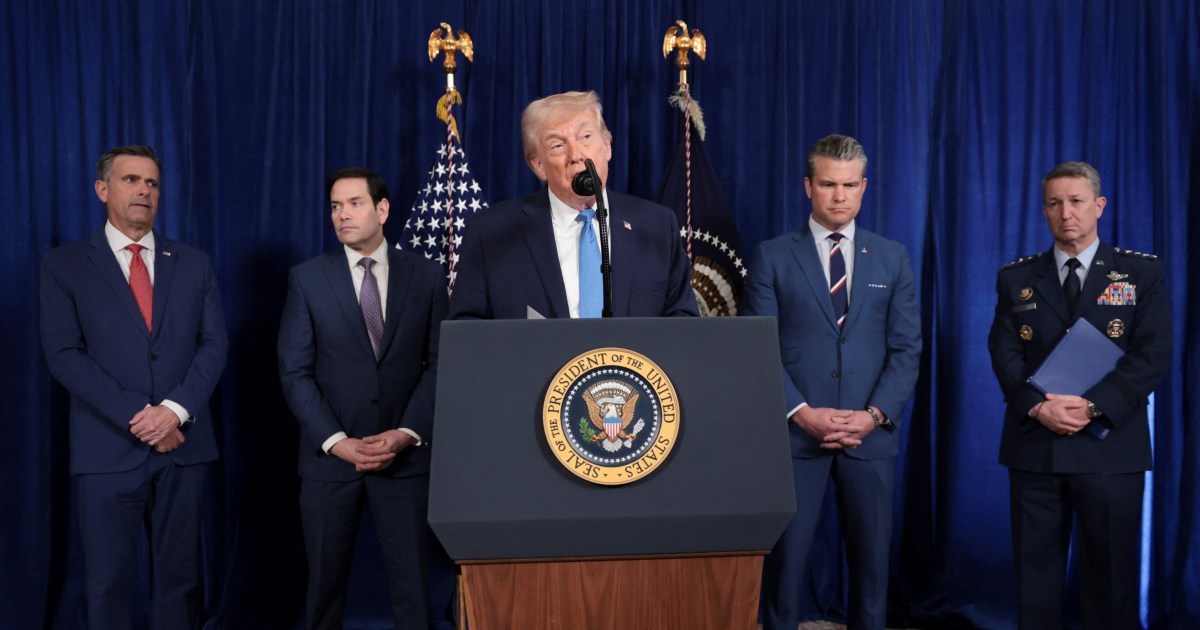
EXPLAINERUS National Defense Strategy says Chinese threat is not a priority as Washington pivots to the Western Hemisphere.US President Donald Trump speaks with, from left, CIA Director John Ratcliffe, Secretary of State Marco Rubio, Secretary of Defense Pete Hegseth and General Dan Caine, chairman of the Joint Chiefs of Staff, during a news conference after a US attack on Venezuela on January 3, 2026 [Jonathan Ernst/Reuters]Published On 25 Jan 2026The United States no longer views China as a top security priority, according to the Pentagon’s 2026 National Defense Strategy (NDS), as President Donald Trump’s administration seeks to focus on the Western Hemisphere in a break from a decade of foreign policy that saw Beijing as the biggest threat to US security and economic interests.The strategy document says US allies and partners such as South Korea “must shoulder their fair share of the burden of our collective defense”. This is in line with Trump’s rhetoric calling on US allies in Europe and the Asia Pacific to step up and boost their defences to counter security threats from Russia and North Korea.Recommended Stories list of 4 itemslist 1 of 4Can China and South Korea reset complex ties after Xi-Lee summit?list 2 of 4China eyes risks, gains as Trump pushes for ‘spheres of influence’list 3 of 4US trade with Southeast Asia and Taiwan surging despite Trump tariffslist 4 of 4US army says homeland, curbing China priorities; limited support for alliesend of listReleased late on Friday, the 34-page Department of Defense blueprint comes weeks after the announcement of Trump’s National Security Strategy, which seeks to “restore American preeminence in the Western Hemisphere” by reinforcing the Monroe Doctrine, a 19th-century US policy opposed to European colonisation and interference in the Americas.So what’s new in the NDS? And how will it impact US allies in the Asia Pacific?Chinese J-15 fighter jets being launched from the deck of the Liaoning aircraft carrier during military drills in the Yellow Sea, off China’s east coast [File: AFP]What’s in Trump’s National Defense Strategy?The major shift in the NDS lies in the shifting approach of the US Defense Department, which considers security of the “homeland and Western Hemisphere” its primary concern.The document noted that the US military would be guided by four central priorities: defend the homeland, push allies around the world away from reliance on the US military, strengthen defence industrial bases and deter China as opposed to a policy of containment.The Pentagon document said relations with China will now be approached through “strength, not confrontation”.“It is neither America’s duty nor in our nation’s interest to act everywhere on our own, nor will we make up for allied security shortfalls from their leaders’ own irresponsible choices,” the document said.Instead, the US would prioritise “threats to Americans’ interests”, it said.The Pentagon said it would provide “military and commercial access” to key locations, such as Greenland, and construct the president’s “Golden Dome” missile defence system for North America.Trump’s threat to take over Greenland has roiled transatlantic ties while the US abduction of Venezuelan President Nicolas Maduro on January 3 has sent shockwaves across the world and raised questions about the undermining of international law. Trump has justified US actions in Venezuela as necessary to secure US security and economic interests.The unclassified version of the NDS, which is released every four years, is uncharacteristically laden with photos of the defence secretary and president and repeatedly targets the administration of former President Joe Biden.Under Biden, the Pentagon described “revisionist powers” like China and Russia as the “central challenge” to US security.The NDS followed the release in December of the National Security Strategy, which argued that Europe is facing civilisational collapse and did not cast Russia as a threat to US interests.The NDS noted that Germany’s economy dwarfs Russia’s, arguing that, therefore, Washington’s NATO allies are “strongly positioned to take primary responsibility for Europe’s conventional defense, with critical but more limited US support”.The strategy blueprint noted that this includes taking the lead in supporting Ukraine’s defence.The document also addressed the question of Iran, repeating the US position that Tehran cannot develop nuclear weapons. It also described Israel as a “model ally”. “And we have an opportunity now to further empower it to defend itself and promote our shared interests, building on President Trump’s historic efforts to secure peace in the Middle East,” it said.Secretary of Defense Pete Hegseth speaks during a news conference with President Donald Trump after US forces abducted Venezuelan President Nicolas Maduro on January 3, 2026 [Jonathan Ernst/Reuters]What’s the impact on US allies?First, Europe is pushed further down on Washington’s list of priorities and has been told to shoulder more responsibility for its own defence. Many NATO allies had already increased their defence spending and offered to provide security guarantees to Ukraine against Russian threats.For South Korea and Japan, the US Defense Department recognised the “direct military threat” from North Korea, led by Kim Jong Un, and noted that Pyongyang’s “nuclear forces are increasingly capable of threatening the US Homeland”.About 28,500 US soldiers are stationed in South Korea as part of a defence treaty to deter the North Korean military threat. Seoul has raised its defence budget by 7.5 percent for this year after pressure from Trump to share more of the defence burden.The NDS noted that South Korea “is capable of taking primary responsibility for deterring North Korea, with critical but more limited US support”, which could result in a reduction of US forces on the Korean Peninsula. “This shift in the balance of responsibility is consistent with America’s interest in updating US force posture on the Korean Peninsula,” the document said.Harsh Pant, a geopolitical analyst based in New Delhi, said the defence strategy is line with the Trump administration’s push to get allies to take control of their own security.“The Trump administration has been advocating that the relationship that they see now in terms of security cooperation with their allies is one where allies will have to bear a heavier burden and pay their share,” Pant told Al Jazeera.“America’s allies in the Indo-Pacific will have to be much more cognisant of their own role in shaping the regional security architecture. America will be there, and it will continue to have an overarching presence, but it won’t foot the bill in ways that it has done in the past,” said Pant, who is the vice president of the Observer Research Foundation think tank.North Korea routinely criticises the US military presence in South Korea and their joint military drills, which the allies say are defensive but which Pyongyang calls dress rehearsals for an invasion.Seoul’s Ministry of National Defence said on Saturday that the US forces based in the country are the “core” of the alliance, adding: “We will be cooperating closely with the US to continue developing it in that direction.”South Korean President Lee Jae Myung said: “It is inconceivable that South Korea – which spends 1.4 times North Korea’s gross domestic product on defence and possesses the world’s fifth largest military – cannot defend itself. Self-reliant national defence is the most fundamental principle amid an increasingly unstable international environment.”Lee made the comments after visiting China this month in an effort to improve ties with the country, which is Seoul’s largest economic partner, its top destination for exports and a primary source of its imports. Seoul wants to cultivate better ties with Beijing, which wields influence over North Korea and its leader.What about Taiwan?When the previous NDS was unveiled under Biden in 2022, it said the most comprehensive and serious challenge to US national security was China’s “coercive and increasingly aggressive endeavor to refashion the Indo-Pacific region and the international system to suit its interests and authoritarian preferences”. A part of that strategy, Washington said at the time, was Beijing’s ambitions concerning Taiwan.
SRCAl Jazeera
LANGEN
LEANCenter
WORDS1 291
ENT12
SUN · 2026-01-25 · 14:36 GMTBRIEF NSR-2026-0125-10452
NSR-2026-0125-10452News Report·EN·National Security
Pentagon downplays China threat: What it means for US allies
The 2026 Pentagon's National Defense Strategy (NDS), released in January, signals a shift in US security priorities under President Trump, downgrading the threat posed by China. The strategy prioritizes the security of the US homeland and the Western Hemisphere, aligning with Trump's "America First" approach and a renewed focus on the Monroe Doctrine.
Yashraj SharmaAl JazeeraFiled 2026-01-25 · 14:36 GMTLean · CenterRead · 6 min
Al JazeeraFIG 01
Reading time
6min
Word count
1 291words
Sources cited
1cited
Entities identified
12entities
Quality score
100%
§ 01
Briefing Summary
AI-generatedNEWSAR · AI
The 2026 Pentagon's National Defense Strategy (NDS), released in January, signals a shift in US security priorities under President Trump, downgrading the threat posed by China. The strategy prioritizes the security of the US homeland and the Western Hemisphere, aligning with Trump's "America First" approach and a renewed focus on the Monroe Doctrine. The NDS also emphasizes that US allies, particularly in the Asia Pacific region like South Korea, must increase their defense spending and take greater responsibility for their own security. This shift marks a departure from the previous decade, where China was considered the primary security and economic threat to the US. The strategy outlines four central priorities for the US military, including defending the homeland and strengthening defense industrial bases.
Confidence 0.90Sources 1Claims 5Entities 12
§ 02
Article analysis
Model · rule-basedFraming
National Security
Political Strategy
Tone
Measured
AI-assessed
CalmNeutralAlarmist
Factuality
0.70 / 1.00
Factual
LowHigh
Sources cited
1
Limited
FewMany
§ 03
Key claims
5 extracted01
Relations with China will now be approached through “strength, not confrontation”.
quotePentagon document
Confidence
1.00
02
The strategy document says US allies and partners such as South Korea “must shoulder their fair share of the burden of our collective defense”.
quotePentagon’s 2026 National Defense Strategy (NDS)
Confidence
1.00
03
The US military would be guided by four central priorities: defend the homeland, push allies away from reliance, strengthen defence industrial bases and deter China.
factualPentagon document
Confidence
0.90
04
Trump’s National Security Strategy seeks to “restore American preeminence in the Western Hemisphere” by reinforcing the Monroe Doctrine.
factualArticle's own claim based on Trump’s National Security Strategy
Confidence
0.90
05
The United States no longer views China as a top security priority, according to the Pentagon’s 2026 National Defense Strategy (NDS).
factualArticle's own claim based on NDS
Confidence
0.90
§ 04
Full report
6 min read · 1 291 words§ 05
Entities
12 identifiedKey playerOppositionContextPositiveNeutralNegative
Organizations3
§ 06
Keywords & salience
8 termsnational defense strategy
1.00
china threat
0.90
us allies
0.80
western hemisphere
0.70
us security
0.60
defense department
0.50
monroe doctrine
0.40
asia pacific
0.40
§ 07
Topic connections
Interactive graph Network visualization showing 51 related topics
View Full Graph Person Organization Location Event|Click node to navigate|Edge numbers = shared articles